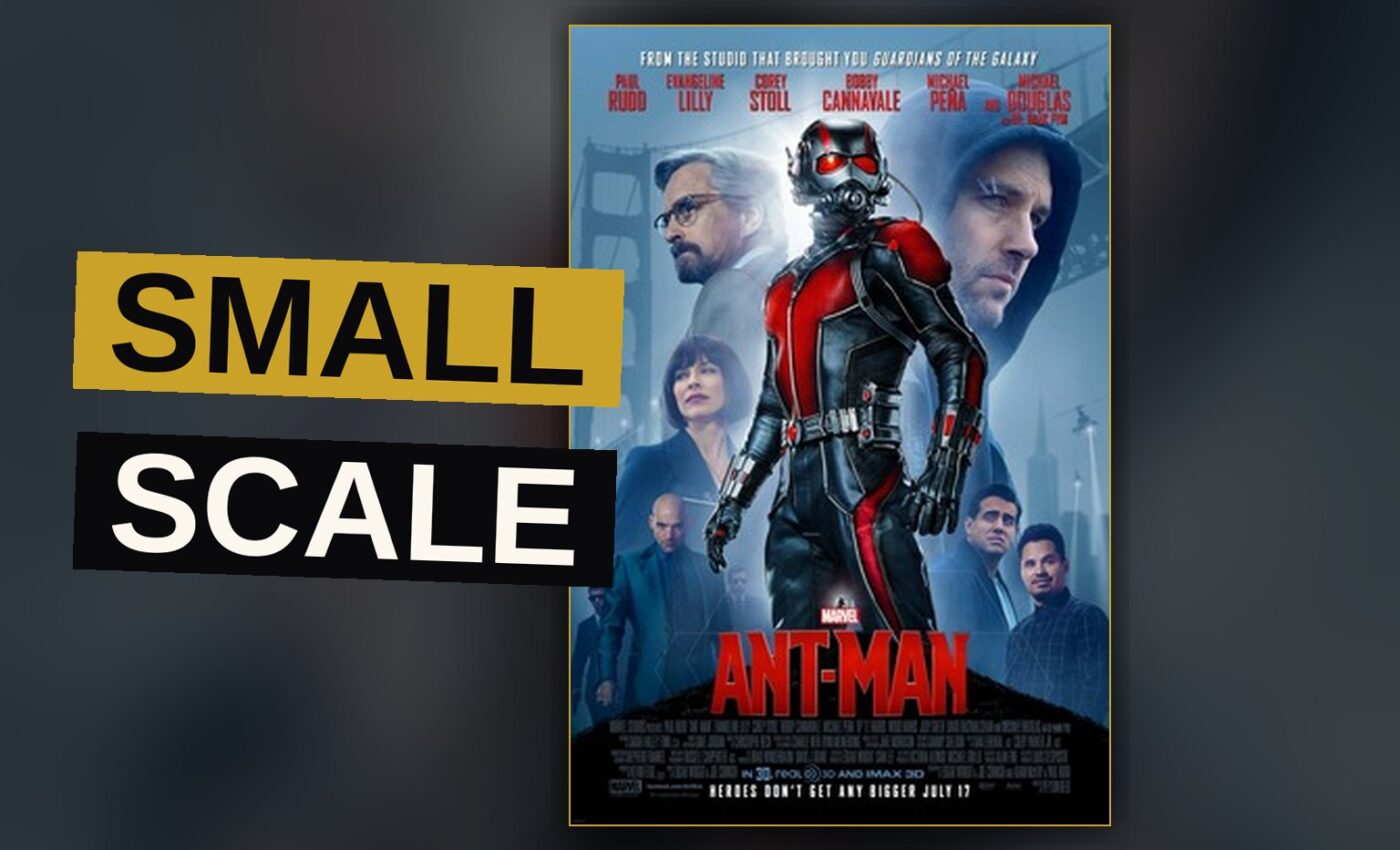
Ant-Man is a heist movie wearing a superhero costume, and that is precisely why it works. Released in 2015 as the twelfth film in the Marvel Cinematic Universe, it arrives with a smaller scale—literally and figuratively—than the cosmic battles that dominate its siblings. The film leans on its charm, its cast, and a genuine sense of fun, even when its plot mechanics wobble.
The story follows Scott Lang, a master thief fresh out of prison, who is recruited by the brilliant but reclusive Dr. Hank Pym. Pym has invented a suit that shrinks its wearer to the size of an ant while retaining human strength. The catch: Pym needs Lang to steal the technology back from his former protégé, Darren Cross, who plans to sell it to the highest bidder. It is a simple setup, and the film treats it with a light touch.
Trailer, via Marvel Entertainment.
Casting Paul Rudd as Scott Lang
Paul Rudd plays Scott Lang, and the casting is the film’s single best decision. Rudd brings a natural, easy wit that makes Lang feel less like a superhero and more like a guy who got lucky. He is not a scientist or a soldier; he is a dad who robbed a bank to pay child support. That grounding matters. When Lang shrinks for the first time, he does not deliver a noble speech. He gasps, stumbles, and makes a joke about his training montage. It is refreshing.
Michael Douglas plays Hank Pym, the inventor who trusts Lang with his life’s work. Douglas plays Pym as a man haunted by his past, including a wife lost to the quantum realm. He is gruff but not cold, and his scenes with Rudd carry a genuine mentor-student energy. Evangeline Lilly plays Hope van Dyne, Pym’s daughter, who is sharper and more capable than Lang in every way. She spends much of the film correcting him, and the film is smart enough to let her be right.
The villain is Darren Cross, played by Corey Stoll. Cross is a problem. He is a corporate rival who has recreated Pym’s technology, but his motives are thin. He wants power, and he wants to hurt Pym. That is it. Stoll does what he can with the role, but the character never rises above a standard Marvel antagonist. He is not terrible; he is just forgettable.
How the Heist Plays Out
The film is best when it commits to the heist structure. The middle act is a series of set pieces that feel like a caper, not a war. Lang breaks into a building, dodges lasers, and fights a security guard who is, from his perspective, the size of a skyscraper. These sequences are inventive and playful. The shrinking effects hold up well, and the film uses its premise to create visual gags that other Marvel films would not attempt.
One standout sequence involves a Thomas the Tank Engine toy. Lang shrinks mid-fall, lands on the toy, and rides it through a child’s bedroom while a train set loops around him. It is silly, but it is also the film’s clearest statement of intent: this is not a movie about saving the universe. It is a movie about getting in, getting the thing, and getting out.
The climax, however, is where the film stumbles. The final battle takes place on a model train set and a falling briefcase, and it is fun in theory. But it also introduces a giant-sized villain, and the fight becomes a standard punch-and-throw affair. The shrinking gimmick, which made the middle of the film so fresh, becomes a background detail in the final act. The film settles for a conventional ending after building a less conventional foundation.
Tone and Pacing
The film runs 117 minutes, and it moves at a brisk clip. The director, Peyton Reed, keeps the tone light, and the script, credited to Rudd and several others, never takes itself too seriously. There are jokes about the Avengers, about Scott’s ex-wife’s new husband, and about the absurdity of talking to ants. The film knows it is ridiculous, and it leans into that.
That tone is the film’s saving grace. Marvel films often struggle with self-seriousness, but Ant-Man does not. It is a comedy first and a superhero film second. The supporting cast helps. Michael Peña plays Luis, Scott’s former cellmate, and he steals every scene he is in. His rapid-fire storytelling style, complete with hand gestures and vocal impersonations, is the film’s funniest recurring bit. T.I. and David Dastmalchian round out the crew, and they bring a working-class energy that the film needs.
The film also benefits from its connection to the larger Marvel universe, but it does not depend on it. There is a cameo from the Falcon, played by Anthony Mackie, and a post-credits scene that teases the future. But the core story stands alone. You do not need to have seen every Marvel film to enjoy this one. That is a strength, and it is a rare one in this franchise.
Final Score
The film is not perfect. The villain is weak, the final act loses some of its charm, and the romance between Lang and Hope feels rushed. But the film knows what it is, and it delivers that thing with confidence. It is a small movie in a big franchise, and that smallness is its identity.
The critical consensus at the time of release was positive, and the film holds up as a solid entry in the Marvel catalog. It is not the best Marvel film, but it is far from the worst. It is a fun, funny, and visually inventive piece of entertainment that does not overstay its welcome.
- Director: Peyton Reed
- Writers: Edgar Wright, Joe Cornish, Adam McKay, Paul Rudd
- Cast: Paul Rudd, Michael Douglas, Evangeline Lilly, Corey Stoll, Michael Peña
- Runtime: 117 minutes
- Release date: July 17, 2015
- Critical score: 7.1 of 10
Ant-Man is a film that understands its own limits and works within them. It does not try to be epic, and that restraint is what makes it enjoyable. It is a heist film with a shrinking suit, a comedy with a superhero budget, and a movie that knows exactly when to be serious and when to be silly.
The film earns its place not by being the biggest or the boldest, but by being the most fun. It is a small win, but a win nonetheless.