
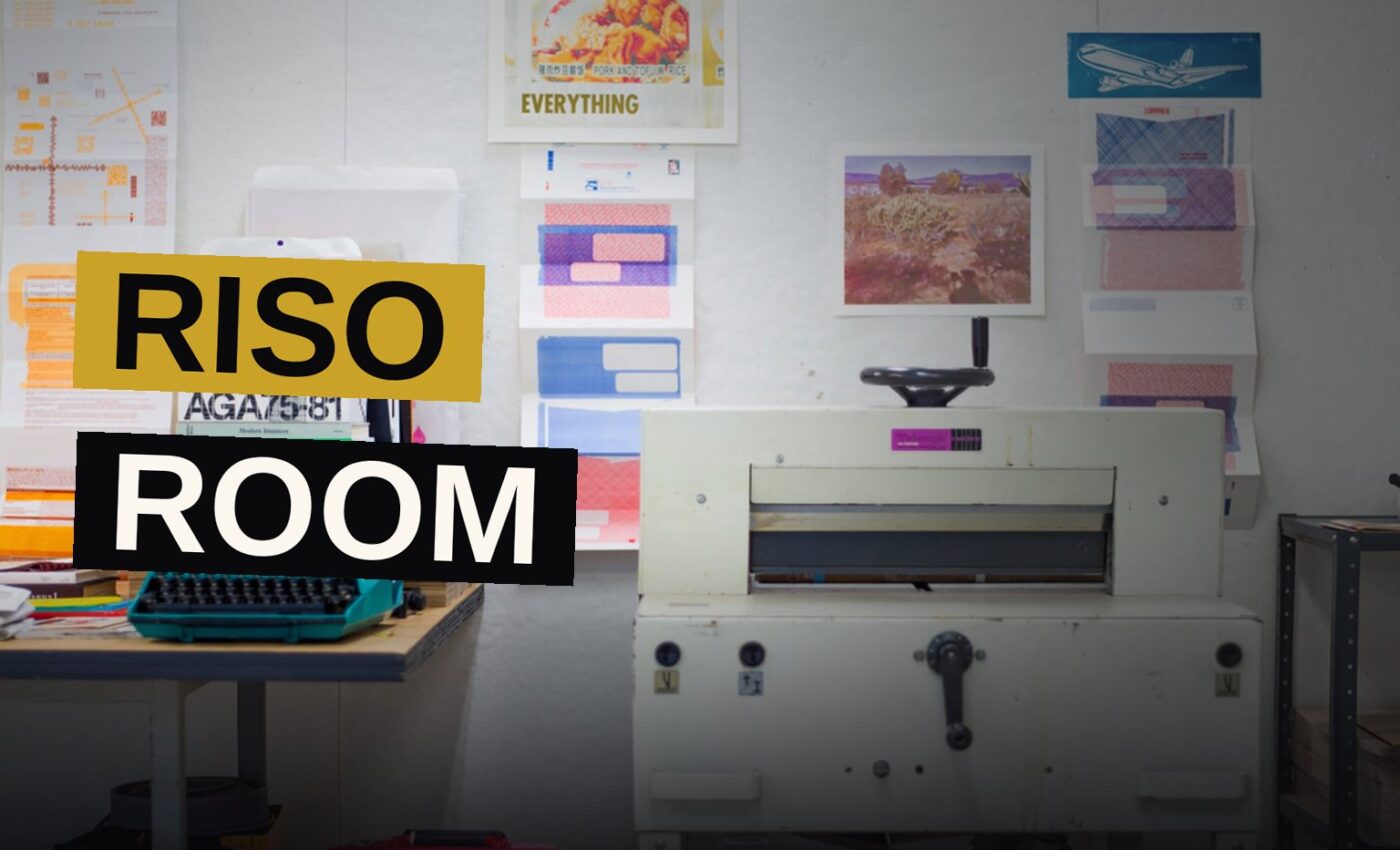
Printmaker and photographer Oswaldo García has traded his native México for a graduate studio in Columbia, Missouri, and he spends his days folding, binding, and printing risographs while dancing to cumbias and reggaetón. His account of his workspace comes via the 354th installment of A View From the Easel, a series in which artists describe the places where they make things.
García met the series’ organizers at Pioneer Works’s Press Play fair in 2024, and his description of his current setup offers a peek at how he balances teaching, making, and playing with sound in a single room.
The Studio Setup
García moved from México two years ago to start an MFA at the University of Missouri-Columbia. He has been working in the Grad Studios building since then, splitting his time between three distinct spaces depending on the task at hand.
| Space | What García uses it for |
|---|---|
| Grad Studios building | General workspace, natural light |
| Photolab studio | Developing |
| The Riso Room / Public House | Printing |
He moved from his first studio in the building to a second one with less natural light, but he likes that setting for scanning and editing. The new studio has more space, which he says helps him look at his projects differently and arrange them in new ways while working on several at once.
A Day in the Studio
García’s schedule is split between teaching and making. He usually starts working in the evening or at night, and he teaches in the morning and takes classes. Within that window, he works on everything at the same time: collecting, drafting, researching, making proofs, starting new projects, printing, folding, and binding.
When he gets tired of one project, he moves to another. Sometimes the move is temporary; other times, he spends a whole day or weekend folding and binding while listening to music. He dances and sings a lot while printing, naming cumbias, reggaetón, and Mexican regional music alongside pop and dance tracks.
For drafting or thinking about a new project, he prefers the silence of his headphones.
Light and Inspiration
García likes natural light, but he moved from a studio with plenty of it to one with less. He says he also likes the reduced light for scanning and editing. The new studio’s extra space is helping him expand his projects and let them breathe.
He finds inspiration in the building itself. The Grad Studios building is full of art studios, which he says motivates him to work. Looking at the process of others helps too. He is currently very inspired by people working in ceramics and fibers, and that has gotten him into trying those practices recently.
What He Loves About the Space
García describes his studio as a blank canvas or paper that he can use to play and assemble books, prints, projections, and installations. He calls it his safe space, where he can always go and just be there with the work, materials, and archive.
The space allows him to try new arrangements and compositions while working on multiple projects at once. That flexibility is central to how he describes his practice.
What He Wishes Were Different
García would love taller walls. He thinks he would go crazy doing bigger things. But he likes how it is.
The height limit is the one concrete complaint he offers about his setup. Everything else he describes — the music, the movement, the inspiration from nearby studios — reads as pure pleasure.
The Paper’s View
García’s account is notable for how fully it commits to joy. He is not pretending the work is difficult or noble. He is dancing, singing, and moving between projects because that is what the work demands of him.
The comparison between his two studios shows the trade-offs he has made. One has natural light but less space; the other has more room to breathe but less light. He has chosen the latter.
His description of the building as a source of motivation is also telling. The proximity to other makers — people in ceramics and fibers — has pushed him into new territory.
García’s studio is a blank canvas he fills with whatever materials and ideas catch his eye. The risographs churn, the books stack up, and the dance moves keep coming. It is a small corner of the world where work and play occupy the same room, and he seems happy to stay there.