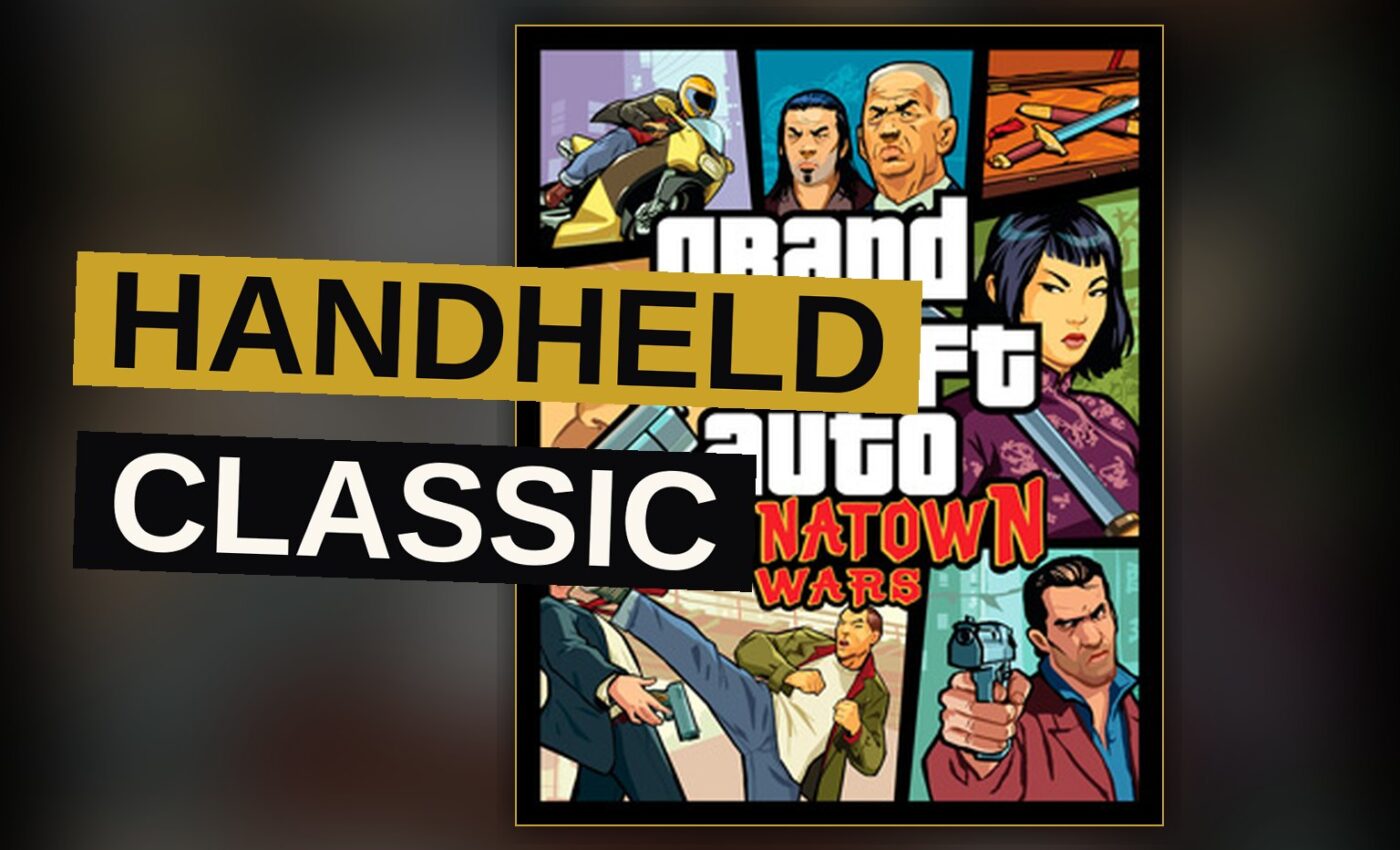
Grand Theft Auto: Chinatown Wars is the strangest game Rockstar ever shipped. It is a full Grand Theft Auto game on Nintendo’s family-friendly DS, and it is also one of the best. The 2009 title, later ported to PSP, iOS and Android, took the open-world formula and squeezed it into a top-down, cel-shaded package that plays like a pure game, not a tech demo. It was bold, it was weird, and it still holds up.
The premise is pure GTA. Huang Lee, a young Triad, flies to Liberty City to deliver a sword to his uncle. Things go wrong immediately. The sword is stolen, Huang is shot, and he wakes up in the back of a car with a dead man beside him. What follows is a revenge story about drugs, money and family, told with the series’ usual dark humor and a surprising amount of heart.
But the story is not the reason to play. The reason to play is how the game feels. Rockstar Leeds, the studio behind the PSP ports of the 3D games, built this one from the ground up for handhelds. They made a game that respects your time, respects the hardware, and never once feels like a compromise.
Trailer, via Rockstar Games.
Touchscreen Mechanics That Redefine Theft
The DS version of Grand Theft Auto: Chinatown Wars is built around the stylus, and it is a revelation. The bottom screen is your tool for almost everything. To steal a car, you do not just press a button. You smash a window, rip out the ignition wires, and connect them. It takes seconds, but it is tactile and thrilling. Every car theft is a tiny minigame.
The same goes for drugs. The game’s economy runs on buying and selling multiple types of narcotics across Liberty City’s districts. Prices fluctuate in real time, and you track them through a PDA-style interface. You can buy low in one neighborhood, drive across town, and sell high. It is a simple supply-and-demand loop, but it is genuinely absorbing. The drug trade is not a side quest; it is the engine that funds everything else.
The touchscreen also handles the GPS, the map, the email and the mission briefings. Nothing requires a manual. The game teaches you through play. It is an interface design that makes other open-world games feel clunky by comparison. On the PSP and mobile ports, the touch controls were replaced with button presses, and while those versions are perfectly playable, they lose a little of the magic. The DS is the definitive way to play.
A Denser Liberty City, Seen From Above
This is not the Liberty City of Grand Theft Auto IV. That game, released the year before, was a sprawling, detailed, cinematic metropolis. Chinatown Wars is a smaller, denser map, viewed from a top-down angle. The camera pulls back, and the city becomes a grid of streets, alleys and landmarks.
The top-down view is not a downgrade. It is a design choice that makes the game faster and more readable. You can see traffic ahead, plan your turns, and weave through streets at high speed. It feels arcade-like, immediate and precise.
The city itself is packed with detail. There are hidden packages, stunt jumps, rampages and random events scattered everywhere. The map is dense with things to do, and the game rewards exploration constantly. You will never be at a loss for an activity, and the short mission structure means you can play in five-minute bursts or five-hour sessions.
The missions themselves are varied and clever. They are shorter than the console games, but they are also more inventive. One mission has you using a camera to take photos of a crime scene. Another has you driving a getaway car while your partner shoots from the passenger seat. A third has you using a remote-controlled car bomb. The mission design is tight, and the difficulty curve is fair.
Sharp Writing And Radio Comedy
Grand Theft Auto: Chinatown Wars is funny in a way the series often is, but it is also sharper than it needs to be. The script is full of dry one-liners, absurd radio ads and self-aware jokes about the genre. The radio stations are a highlight, with a mix of original music and talk shows that parody American culture.
The story, while simple, is well-paced. Huang is a likable protagonist, and his relationship with his uncle’s associates, especially the scheming Chan, adds a layer of intrigue. The game does not take itself too seriously, but it never feels disposable either. The cutscenes are delivered through comic-book style panels, which fits the tone and keeps the action moving.
The voice acting is solid, and the dialogue is frequently quotable. The radio writing is a reminder that Rockstar’s best work is often in the margins, in the throwaway lines and the background details.
Drug Economy That Drives Everything
The drug trading system deserves special mention because it is the most innovative thing in the game. You start with a small amount of cash and a phone that shows current prices. You buy low, sell high, and reinvest your profits. The prices change based on in-game events, like police crackdowns or supply shortages.
The system is deep enough to be engaging but simple enough to be understood in minutes. It encourages you to learn the city’s neighborhoods and their markets. It also gives you a reason to keep playing after the story ends. Building a drug empire is its own reward, and the game tracks your net worth as a score.
This is not a moral lecture. The game treats drug dealing as a business, which is true to the genre and the setting. It is also a lot of fun. The risk-reward loop is compulsive, and the game’s handheld nature makes it perfect for short sessions of buying and selling.
Ports Compared: DS Wins
Grand Theft Auto: Chinatown Wars was released in 2009 on DS, PSP, iOS and Android. The ports differ in how they handle controls. The DS version has the stylus-driven minigames, which are the game’s signature. The PSP version replaces them with button inputs, which are faster but less tactile. The mobile versions use virtual buttons, which work well but lack the physical feedback.
All of these versions are worth playing, but they are not identical. The core game is the same across platforms, but the feel changes with the input method. For the full experience, the DS version is the one to get. It is a game built around the hardware, and it uses that hardware brilliantly. It is a reminder that a great game is not about graphics or scale; it is about design.
Why It Still Matters Today
Grand Theft Auto: Chinatown Wars was not a huge commercial hit, though exact sales figures are not publicly known. Critics loved it, however. It holds an aggregate score of 8.9 out of 10 on IGDB, based on reviews from 9 outlets, and it was praised for its innovation and polish.
The game’s legacy is mixed. Rockstar never made another top-down Grand Theft Auto game. The series went back to fully 3D, and the handheld market eventually collapsed. But Chinatown Wars stands as a proof of concept. It showed that a full open-world game could work on a small screen, and it did so with style and confidence.
It also influenced other games. The drug economy, the quick-fire minigames and the dense map all feel like precursors to modern mobile hits. It is a game that was ahead of its time, and it still feels fresh today.
Ranking The Best Features
- The touchscreen mechanics are the best in the series.
- The drug economy is a genuinely compelling game within the game.
- The top-down view makes driving and combat faster and clearer.
- The writing is sharp and consistently funny.
- The mission design is varied and inventive.
- The ports are all good, but the DS version is the definitive one.
- It is a classic that proves smaller can be better.
Grand Theft Auto: Chinatown Wars is a triumph. It is a game that does everything right, and it deserves to be remembered as one of the best entries in the series. If you own a DS, a PSP, an Android device or an iPhone, there is no excuse not to play it. It is a game you will not forget.
Get the Notebook.
The day's best stories and every fresh verdict, in plain English, in your inbox by seven. One email a day, no more.