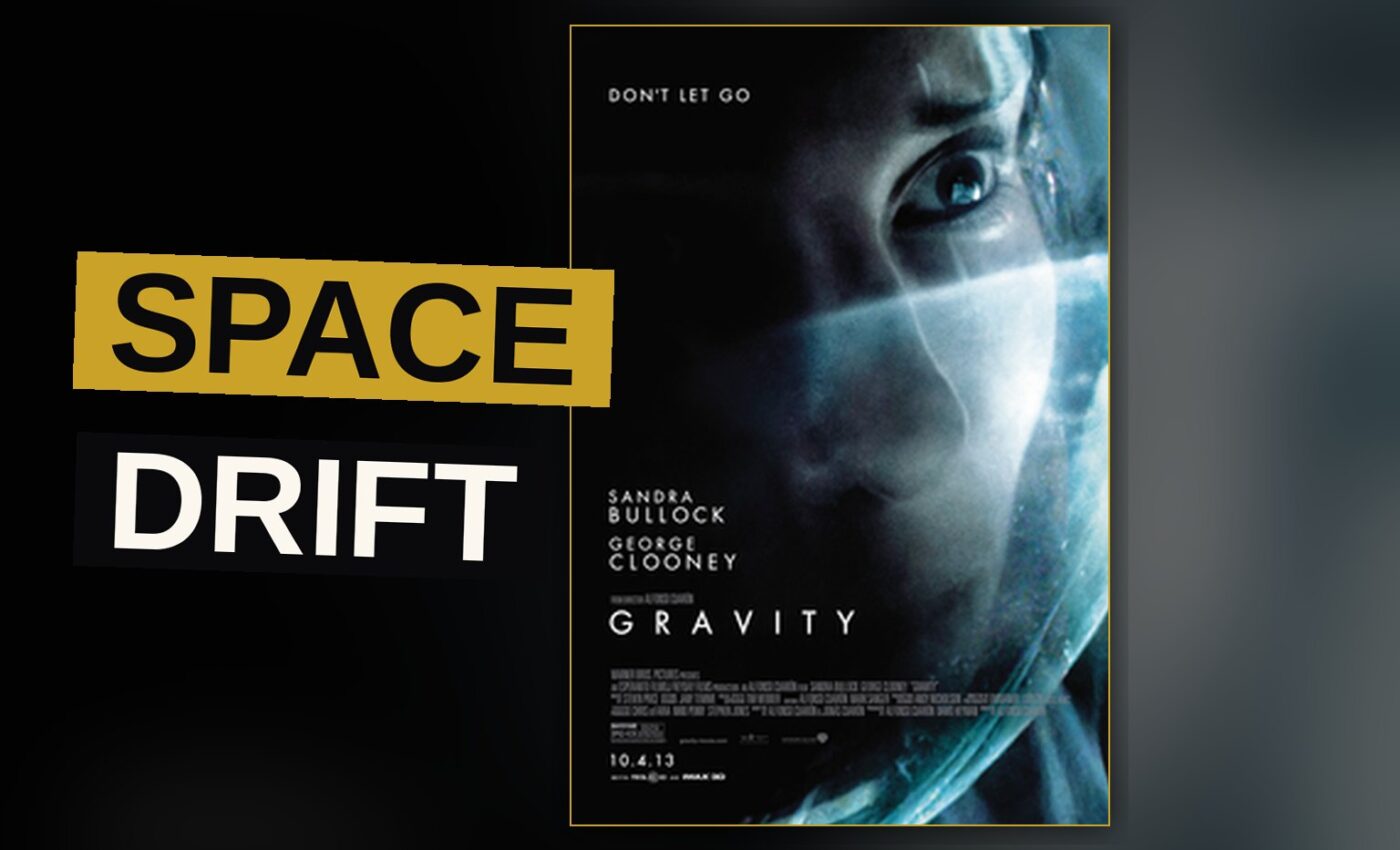
Gravity is a movie about falling. It takes place entirely in space, and it never touches the ground. Alfonso Cuarón’s film is a technical marvel, a taut thriller, and a meditation on mortality all wrapped in one 90-minute package. Sandra Bullock plays Ryan Stone, a medical engineer on her first shuttle mission, who finds herself alone after a catastrophic collision tears apart her crew and her ship. George Clooney plays Matt Kowalski, the veteran astronaut who tries to bring her back. Together, they fight to survive in a vacuum that refuses to cooperate.
The film opens with a slow, deliberate shot of Earth below, a blue marble that feels distant and fragile. Stone is on her first space walk, nervous and competent, when disaster strikes. A cloud of debris from a destroyed satellite rips through the shuttle, killing everyone around her except Kowalski. From that moment, the movie becomes a relentless cascade of obstacles. Each problem solved brings another one closer, until the screen is a blur of spinning bodies and flashing lights.
Cuarón built the film almost entirely in studio stages. He used motion capture suits, practical effects, and a massive curved screen behind the actors to create the illusion of weightlessness. The result looks real. There is no green screen visible anywhere. The stars are sharp. The darkness is absolute. The camera moves with Stone and Kowalski, floating alongside them as they drift through the wreckage of their shuttle.
Trailer, via Warner Bros..
Bullock’s Performance
Bullock carries the film. She plays Stone as a woman who has lost her footing on Earth and found temporary peace in orbit. Her panic is genuine, her determination is fierce, and her exhaustion is physical. The film asks her to do almost nothing but react, and she delivers a performance that is both restrained and monumental. She is terrified, angry, resigned, and ultimately defiant. There is no scenery chewing here. Just a woman doing her best in the worst possible situation.
Clooney’s Kowalski is the opposite. He is calm, confident, and a little bit charming. He tells jokes, he cracks wise remarks, and he keeps the tension light even when the situation is dire. His performance is warm, but it is also controlled. He knows he is dying, and he accepts it. That acceptance is what makes him human. He is not a hero in the traditional sense. He is a man who has lived his life fully and now he is letting it end.
The relationship between the two characters is the heart of the film. They are strangers who become partners in survival. Kowalski protects Stone, teaches her to navigate the void, and pushes her to keep moving. Stone is the one who loses hope. She wants to give up, and Kowalski has to drag her back. The dynamic is simple, but it is powerful. It is the difference between someone who has seen the world and someone who is seeing it for the first time.
The Technical Achievement
The technical achievement is the main event. Cuarón uses long, uninterrupted shots to build tension. The camera follows Stone through the debris field, through the airlock, and across the vast emptiness of space. The sound design is minimal. There is no music during the first half of the film. Only the hiss of air, the crackle of radio static, and the distant hum of machinery. The silence is oppressive. It makes every cough and breath feel dangerous.
The film is also a study in perspective. The audience is never told what to think. The camera shows the destruction, the fear, the beauty, and the terror. It lets the viewer draw their own conclusions. This is a film about being small in a vast universe. It is about the fragility of life and the stubbornness of will. It is about the fact that we are all drifting, and sometimes we need help to find our way back.
“I’m not going to die up here.”
That line, spoken by Stone near the end, sums up the film’s central theme. She has given up. She has accepted that she will die in space. Then she changes her mind. The film is about that change. It is about the moment when a person decides to live, even when the odds are stacked against them. It is about the power of choice, and the courage it takes to make it.
The Debris Field
The centerpiece of the film is the debris field. After the collision, the shuttle is destroyed. Stone is thrown clear, but she is tethered to the station by a cable. She struggles to free herself while the debris closes in. The camera follows her through the wreckage, dodging panels and equipment that could kill her. The scene is tense, and it is beautiful. The sun glints off the metal, and the stars shine through the darkness.
The film uses this scene to explore the idea of fate. The debris is random. It is not aimed at Stone. It is simply there, and she has to avoid it. The film suggests that life is like that. We are all moving through a field of danger, and we have to navigate it the best we can. We cannot control everything. We can only respond.
The scene also demonstrates the film’s commitment to realism. The debris moves in ways that feel natural. It spins, it tumbles, it collides. It is not a cartoon. It is a simulation of real physics. The audience feels the weight of the objects, even though they are not real. This is the magic of the film. It tricks the brain into believing in a world that does not exist.
The Ending
The ending is a twist. Spoiler warning: it is a twist. After surviving the debris field, Stone reaches the International Space Station. She enters the airlock, and she is safe. Then the film reveals that the station is abandoned. It is a cruel joke. She has survived the collision, the debris, and the cold of space, only to find that she is still alone. The film then cuts to a beach, where Stone walks along the water, finally able to breathe again.
The ending is ambiguous. It is not a happy ending, but it is not a tragedy either. Stone survives, but she has lost everything. Her husband is dead. Her job is gone. Her purpose is shattered. The film leaves the audience with a question. What does it mean to survive? Is it better to live and be broken, or to die and be whole?
The answer is not clear. The film does not offer one. It simply presents the situation and lets the audience feel it. This is a rare quality in mainstream cinema. Most films resolve their conflicts neatly. Gravity does not. It ends on a note of uncertainty, which makes it more powerful.
The Sound Design
The sound design deserves special mention. The film is mostly silent. There is no score during the first hour. The sound of breathing, the hiss of air, and the occasional beep of machinery fill the gaps. This creates a sense of isolation. The audience is trapped in Stone’s helmet with her. They hear what she hears. They feel what she feels.
When the music does arrive, it is sparse. A few notes, a low hum, a swelling chord. The music is never overwhelming. It supports the image, it does not dominate it. This is a film that trusts the visuals. It does not need music to tell the story. The story is in the faces, in the movements, in the spaces between the characters.
The sound design also contributes to the film’s realism. In space, there is no sound. The film captures this. The audience hears nothing. There is only the silence. This is a powerful tool. It makes the film feel real. It makes the audience believe that Stone is really out there, floating in the void.
The Legacy
Gravity changed cinema. It showed that a big-budget action film could be quiet, realistic, and character-driven. It proved that audiences would pay to see a movie that demanded their attention. It set a new standard for visual effects. It made space travel feel dangerous. It made the audience care about a character they had never met before.
The film won seven Academy Awards, including Best Director for Cuarón. It was nominated for five others. Its success was a validation of the director’s vision. Cuarón had spent years developing the project, and the final product matched his ambition. The film is a masterpiece of filmmaking. It is a technical triumph, a narrative success, and a philosophical statement.
The legacy of Gravity is evident in other films. It paved the way for more ambitious visual storytelling. It showed that a movie could be about nothing and still be about everything. It demonstrated that the simplest ideas can be the most profound. The film is a reminder of what cinema can do when it is pushed to its limits.
The Final Stretch
The final stretch of the film is a masterclass in editing. The scenes are short, sharp, and effective. The film cuts between Stone’s attempts to survive and her memories of her past. These memories are fragmented. They are not a full biography. They are fragments of a life. A wedding, a funeral, a childhood. These fragments are enough. They tell the audience everything they need to know about Stone.
The final scene on the beach is the climax. Stone walks along the water, and she smiles. It is a small gesture, but it is powerful. She has survived. She has faced her fears. She has done what she needed to do. The film ends on this note. It does not explain everything. It does not tie up every loose end. It simply ends.
The Verdict
Gravity is a great film. It is not perfect. It has flaws. Some of the dialogue is stiff. Some of the plot points are predictable. The ending is a cheat. But these flaws are minor. They do not diminish the overall experience. The film is a triumph of craft. It is a demonstration of what can be achieved when a filmmaker is given the tools and the freedom to realize their vision.
The film is a reminder of why we go to the movies. It is a reminder of the power of cinema. It is a reminder of the beauty of space. It is a reminder of the fragility of life. It is a reminder of the strength of the human spirit.
Gravity is a masterpiece. It is a film that will be remembered for decades. It is a film that deserves its reputation. It is a film that should be seen on the biggest screen possible. It is a film that should be studied. It is a film that should be celebrated.