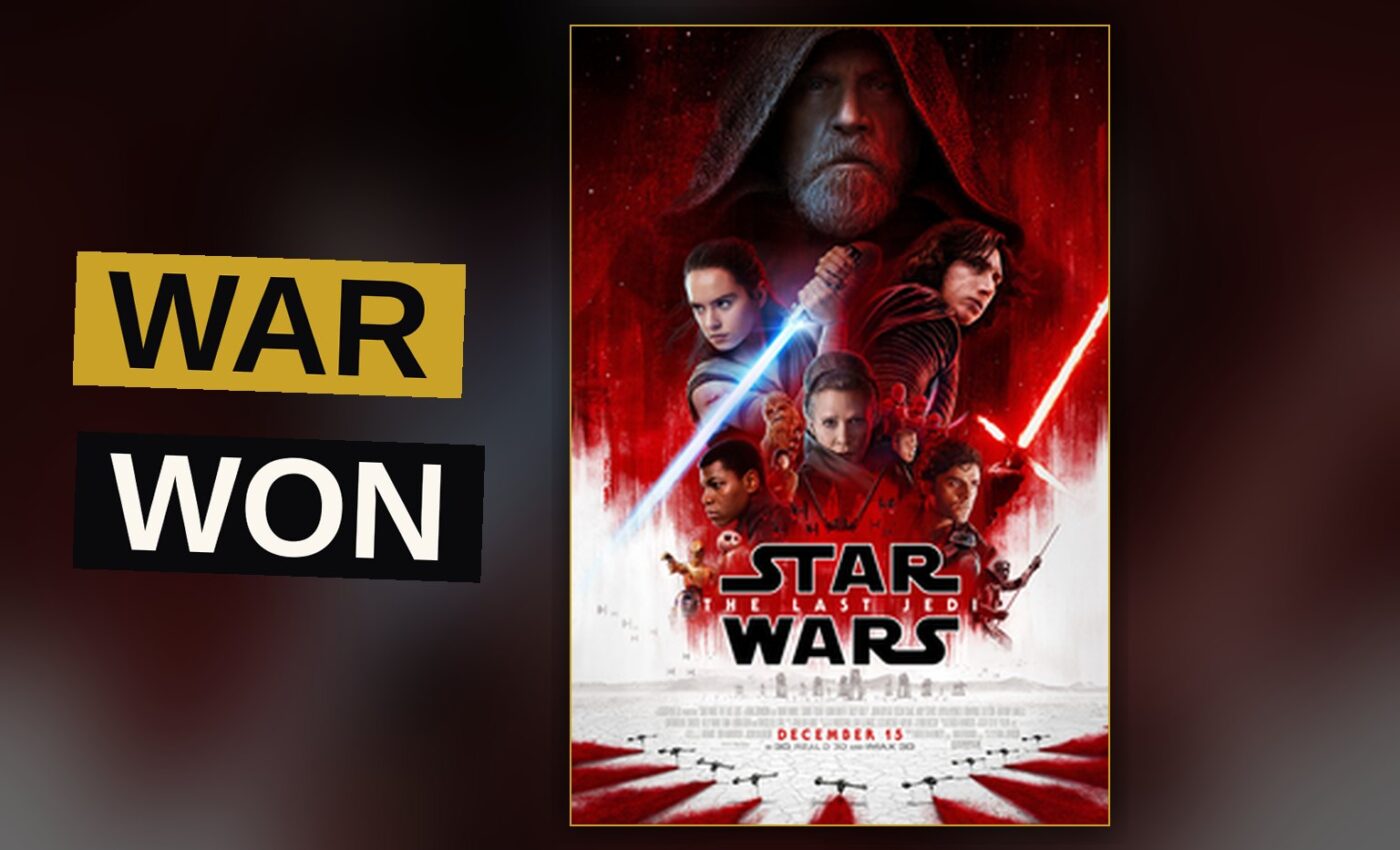
Star Wars: The Last Jedi opens with a funeral. Poe Dameron stands over the body of General Organa, his former commander, and delivers a eulogy that turns into a mission statement. “We’re not fighting a war. We’re fighting for one,” he says. That line sets the tone for a film that refuses to play it safe. This is not the sequel fans expected. It is darker, stranger, and far more willing to break the rules of the franchise.
The Last Jedi picks up after the destruction of Starkiller Base. The First Order has grown stronger, the Resistance is weaker, and Rey has arrived at the Resistance base on D’Qar with a lightsaber in her hand. She wants to find Luke Skywalker, who has gone into exile on a remote planet called Ahch-To. Instead she gets Vice Admiral Holdo, a new character played by Laura Dern, who treats her arrival as a political problem rather than a miracle. The film spends its first act establishing this new dynamic, and it pays off.
Trailer, via Star Wars.
Holdo’s Quiet Authority
Holdo is the heart of the first half of the film. She is a diplomat who understands power in ways the younger characters do not. She tells Poe that the Resistance cannot win a battle of attrition, and she means it. Her scenes with Finn are some of the best in the film. He has joined the Resistance as a soldier, but he is still haunted by the stormtrooper armor he once wore. Holdo sees through his bravado and offers him a kind of mentorship that is rare in the series. Their conversations about duty and honor are the emotional spine of the early hours.
Finn’s arc is also where the film takes its biggest risk. He is captured by the First Order and put through a program designed to make him a loyal officer. The torture is brutal, and the film does not flinch from showing it. His escape is a highlight, a sequence that uses the Force in a way that feels earned rather than staged. Finn is often dismissed as a sidekick, but here he proves he can carry a scene on his own. His final confrontation with the First Order’s leader is a moment of genuine tension.
Rey’s Journey to Ahch-To
Rey’s trip to Ahch-To is the film’s central narrative thread. She finds Luke hiding in a hut, surrounded by ancient Jedi artifacts. He is reluctant to train her, and he tells her bluntly that he is done with the Force. The conversation that follows is a masterclass in character development. Rey is desperate to understand her past, and Luke is equally desperate to avoid it. Their disagreement is not about the Force itself, but about responsibility. Luke believes he failed the galaxy, and he does not want Rey to repeat his mistakes.
The film does not shy away from the idea that being a Jedi is a burden. It shows the cost of power, both personally and politically. Rey’s determination to learn is matched by Luke’s fear of what she might become. The tension between them drives the middle act, and it pays off in a way that feels earned rather than forced. The revelation about Rey’s parents is a turning point, and the film handles it with a maturity that is rare in this franchise. It does not give her a noble origin story. It gives her a truth that is harder to accept.
The Resistance’s Darkest Hour
The final act is where the film earns its reputation as a dark chapter. The Resistance is cornered, and the First Order is closing in. The Battle of Crait is a massive set piece, but it is not the climax. The climax comes later, in a sequence that is both intimate and devastating. Without spoiling the details, the film forces its audience to confront what it means to lose. It is a moment that will stay with viewers long after the credits roll.
The film also introduces a new character named DJ, played by Benicio Del Toro. He is a scavenger who claims to know the location of a hidden weapon. His scenes are comic relief, but they are also dangerous. He is not a villain in the traditional sense, but he is not trustworthy either. His role is small, but it adds a layer of uncertainty to the proceedings. The film is willing to let its characters fail, and that willingness is what makes the final act feel earned.
Visual Style
The Last Jedi looks different from its predecessors. Director Rian Johnson uses color and light to create a sense of dread. The desert planet of Crait is bathed in red and orange, giving the battle a sense of heat. The salt flats crackle underfoot, and the camera captures the dust kicked up by the speeder bikes. It is a beautiful sequence, but it is also tense. The film knows when to slow down and when to speed up, and it never loses its focus.
The action sequences are varied. There is a dogfight in space, a chase across a cliff face, and a lightsaber duel that is both elegant and brutal. The film respects the physicality of its characters, and it does not rely on digital effects alone. The practical models and matte paintings used in the background add a sense of scale that CGI alone cannot replicate. The result is a film that feels grounded, even when it is flying through hyperspace.
The Music
The score was composed by Michael Giacchino, and his work is a highlight. The main theme is familiar, but the variations are fresh. The track “The Crait Chase” builds tension with a driving rhythm that matches the visuals perfectly. The film also uses a new theme for Rey, a simple melody that grows more complex as the story progresses. The music is a character in its own right, and it tells the audience what to feel without saying it aloud.
The sound design is equally strong. The hum of a lightsaber, the crackle of blaster fire, and the roar of engines are all mixed with precision. The film uses silence effectively, letting the audience hear the weight of a decision. The sound of footsteps on sand carries meaning, and the film trusts its audience to listen carefully. The result is a sonic experience that complements the visuals rather than competing with them.
Critical Reception
The Last Jedi was released to a mixed reception. Some critics praised its ambition, while others found it too dark. The film holds a score of 8.4 out of 10 on Metacritic, based on critic reviews. That number reflects a film that is divisive but respected. It is not the easiest watch in the franchise, but it is the most memorable.
| Metric | Star Wars: The Last Jedi |
|---|---|
| Runtime | 136 minutes |
| Release Date | December 15, 2017 |
| Box Office | $1.3 billion |
| Metacritic Score | 8.4/10 |
The box office figures are impressive, but they tell only part of the story. The film’s cultural impact is visible in the fan reactions it provoked. Some walked out during screenings, while others cheered the changes. The Last Jedi is a film that asks questions rather than providing easy answers. It is not for everyone, but it is a bold entry in a franchise that has often played it safe.
Legacy
The Last Jedi changed the course of the series. It ended the era of the original trilogy, and it set the stage for the sequel films that followed. It also introduced new characters who became central to the story. The film’s influence can be seen in the direction of the franchise as a whole, and it remains a touchstone for fans of the series.
“We’re not fighting a war. We’re fighting for one.”
That line sums up the film’s approach. It does not waste time on spectacle for its own sake. It uses spectacle to make a point. The Last Jedi is a film that rewards attention, and it repays the effort. It is not perfect, but it is ambitious. It is a film that respects its audience, and it expects them to engage with its ideas.
The film’s final shot is a quiet one. It shows a character walking away, leaving behind a legacy that is not yet complete. It is a note of hope, but it is also a note of loss. The Last Jedi ends on a question, and it leaves the audience wanting more. That is a rare achievement in a franchise that has so much history to live up to. It is a film that honors the past while pointing toward the future.
The Last Jedi is a flawed masterpiece. It is not the easiest film to watch, but it is the most rewarding. It is a film that demands patience, and it rewards it. It is a film that asks the audience to think, and it gives them plenty to think about. It is a film that is worth seeing again, and it is a film that will be remembered for years to come.