
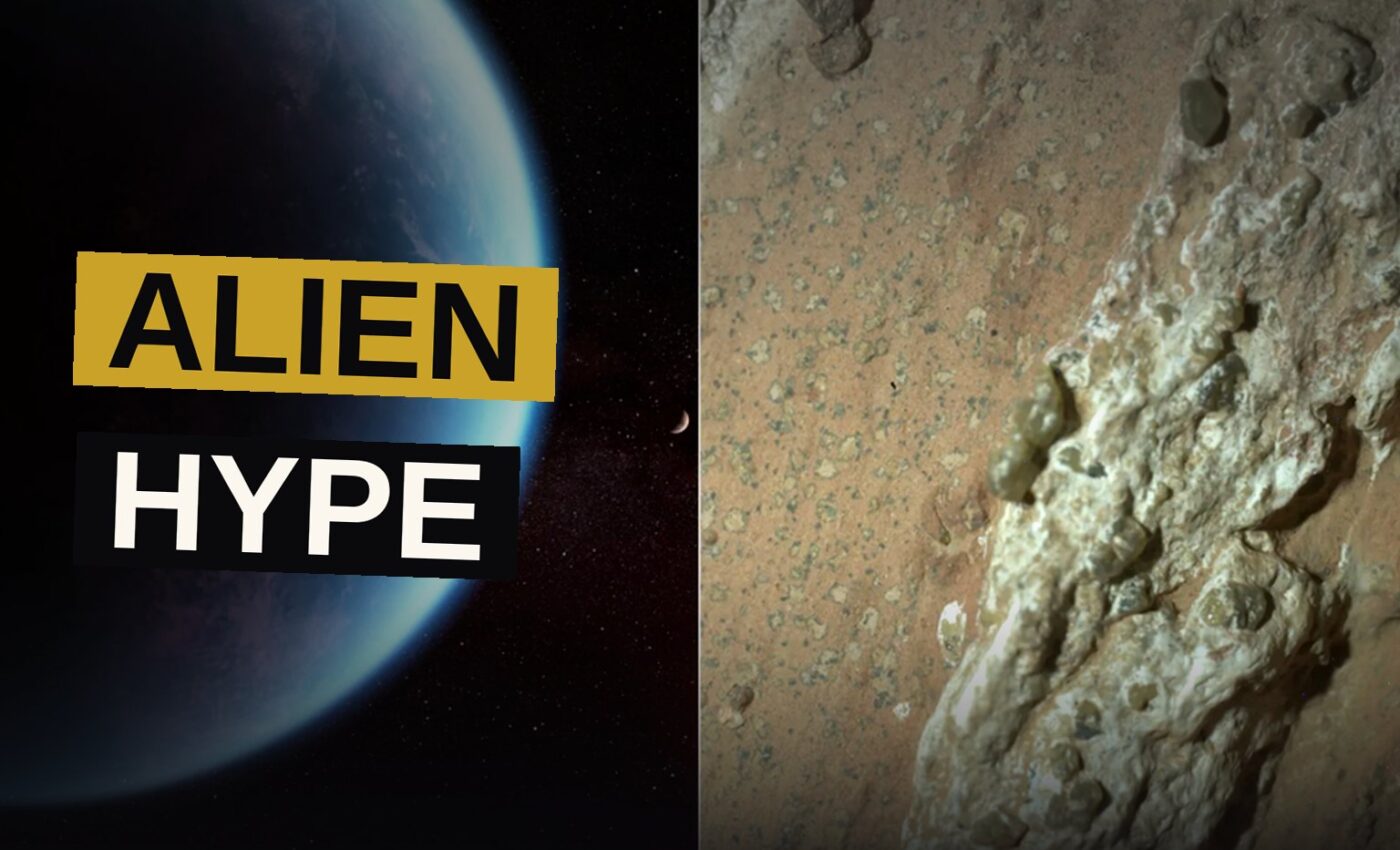
Two major alien-life announcements in 2025 made headlines around the world. But most astrobiologists were not convinced.
A new survey of hundreds of experts found that only 6.6% thought possible biological molecules on the exoplanet K2-18b probably represented extraterrestrial life. For a Martian rock named Cheyava Falls, 15.1% said the same.
The findings come from researchers at Durham University’s C-Scope, the Centre for Scientific Community Opinion Polling and Evaluation.
The K2-18b announcement
In April 2025, researchers reported possible traces of molecules called dimethyl sulfide and/or dimethyl disulfide on K2-18b. On Earth, these are associated with biological activity.
A press release called the finding the “strongest hints yet” of alien life.
The Cheyava Falls announcement
In September, NASA announced that Cheyava Falls appeared to preserve a potential biosignature. The rock contains so-called “leopard spots” — mineral rings that on Earth are often formed by microbial activity.
NASA Administrator Sean Duffy said this was the “closest we have ever come” to discovering life on the red planet.
Expert agreement stays low
The survey asked astrobiologists a simple question: did they think extraterrestrial life had probably been found?
For K2-18b, nearly two-thirds disagreed. 28.0% remained neutral.
For Mars, confidence was higher but still cautious. Disagreement fell to 44.6% and neutrality rose to 40.3%.
Strong disagreement fades
The proportion who strongly disagreed fell sharply, from 35.1% for K2-18b to just 11.1% for Mars.
The movement was not from rejection to endorsement. Expert opinion moved from strong rejection towards more tentative positions. The community became more open to the possibility without embracing it outright.
Why the shift happened
One possible reason: the evidence differed. The K2-18b claim relied on possible atmospheric signatures detected across interstellar distances. The Martian case concerned a rock that could be studied directly and in much greater detail.
Astrobiologists also know that lifelike features can arise through non-biological processes. The challenge is understanding all the ways nature might produce something similar without life.
Beyond a simple yes or no
Public discussion often treats science as though communities either agree or disagree.
“Scientific opinion is rarely binary,” the researchers note.
A large neutral response can mean several things. Scientists may judge the evidence genuinely inconclusive. They may hold an intermediate level of confidence. Or they may regard a claim as too speculative to endorse or reject decisively.
Treating opinion as simply “for” or “against” flattens these distinctions.
The wider lesson
The lesson extends beyond alien life.
In climate science, pandemics, artificial intelligence and medical research, public conversations frequently invoke scientific consensus. Sometimes strong agreement exists. Sometimes it does not.
But systematic ways of measuring what scientists actually think are often missing. Discussions rely instead on selective quotation, vocal individuals or assumptions about community views.
What C-Scope does next
C-Scope aims to change that. The group studies how expert opinion is distributed and how it changes over time.
“We are not trying to replace evidence with polling, nor to treat majority opinion as truth,” the researchers said. “Our aim is to better understand how scientific communities respond to uncertainty.”
Survey numbers at a glance
- K2-18b agreement: 6.6%
- Cheyava Falls agreement: 15.1%
- K2-18b disagreement: nearly two-thirds
- Cheyava Falls disagreement: 44.6%
- Strong disagreement, K2-18b: 35.1%
- Strong disagreement, Mars: 11.1%
- Neutral, K2-18b: 28.0%
- Neutral, Mars: 40.3%
Announcement timeline
| Announcement | Date | Subject |
|---|---|---|
| K2-18b molecules | April 2025 | Exoplanet atmospheric signatures |
| Cheyava Falls rock | September 2025 | Martian mineral patterns |
The survey was conducted within days of each announcement.
The picture that emerges is cautious. Scientists are open to the possibility of alien life — but they are not ready to say it has been found.
Source: sciencedaily.com
Get the Notebook.
The day's best stories and every fresh verdict, in plain English, in your inbox by seven. One email a day, no more.