
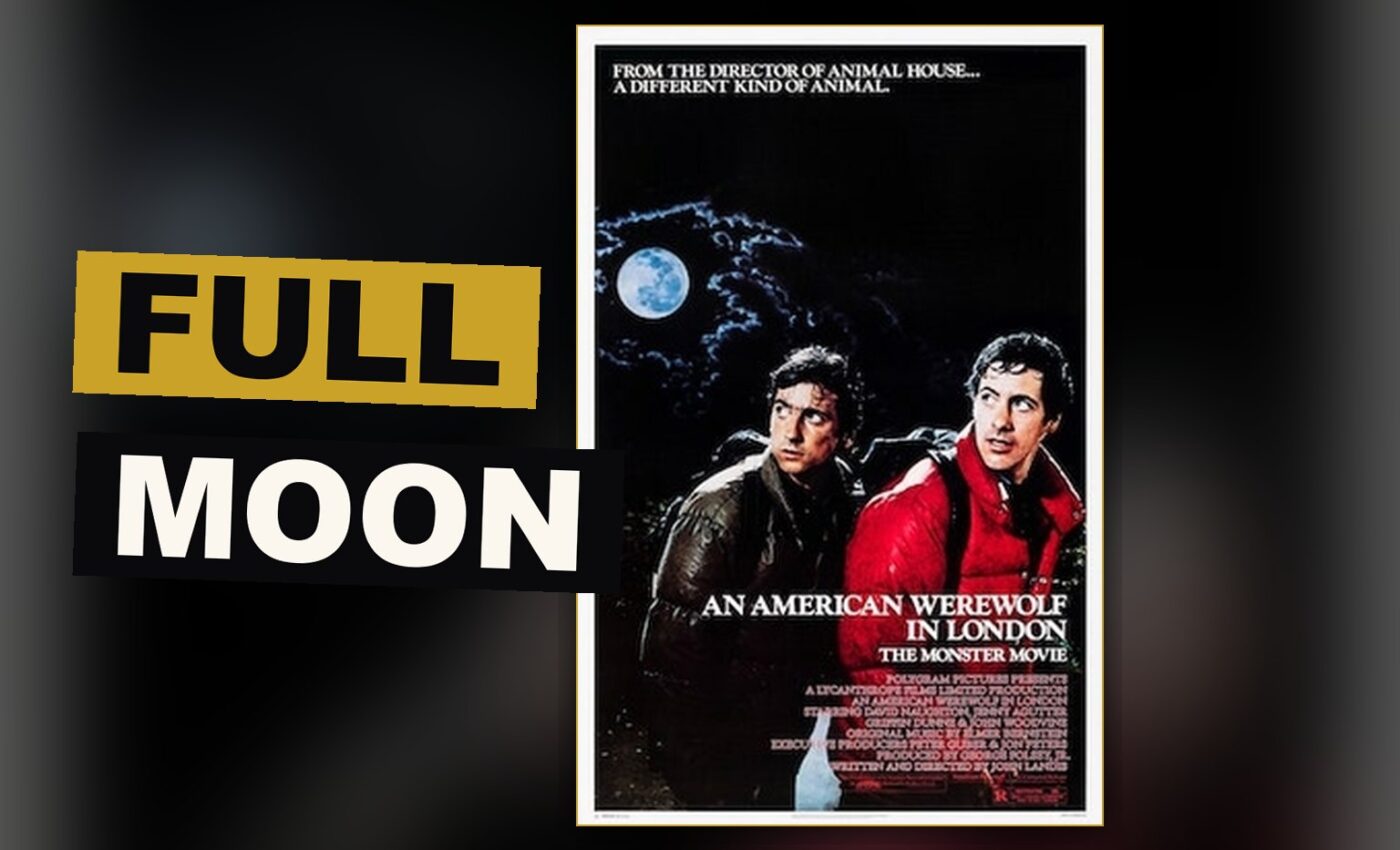
An American Werewolf in London opens with two American graduate students walking off a road they were warned not to leave. That decision costs Jack Goodman his life and turns David Kessler into something that will kill again. John Landis wrote and directed the film, and he never lets the audience forget how fast a joke can curdle into a slaughter.
The Slaughtered Lamb and Its Five-Pointed Star
The North York Moors are the setting, and the Slaughtered Lamb is the pub where David and Jack stop as night falls. Jack spots a five-pointed star on the wall. When he asks about it, the pub-goers turn hostile, so the pair leave. The locals offer three warnings: keep to the road, stay clear of the moors, beware of the full moon. The tagline is “Beware the moon,” and the film earns it.
The attack comes quickly. A vicious creature mauls Jack to death and leaves David severely injured. Pub-goers who followed the pair shoot the beast. David sees no animal carcass — he sees a naked dead man lying next to him before he passes out. Landis stages the horror and the punchline in the same frame, and that is the film’s whole method.
David Kessler Wakes Up in a London Hospital
David wakes three weeks later in a London hospital. Inspector Villiers interviews him and says the locals reported an escaped lunatic attacked the two men. David insists a rabid dog or wolf did it. Neither account is true, and the gap between what David believes and what the audience has already seen is where the film’s dread lives.
An undead Jack appears to David and explains the rules. They were attacked by a werewolf. Because David was bitten, he is now a werewolf too. Jack is cursed to walk the earth in limbo, neither dead nor alive, until the wolf’s bloodline is severed. He urges David to kill himself before the next full moon so he does not harm anyone. Griffin Dunne plays Jack as a corpse with a comedian’s timing, and the scenes work because the film refuses to soften the curse into a metaphor.
Dr. Hirsch Visits the Pub
Dr. J. S. Hirsch, played by John Woodvine, goes to the Slaughtered Lamb to investigate. He suspects David may have been influenced by local superstitions. The pub-goers deny any knowledge of David, Jack or the attack. One distraught pub-goer privately tells Hirsch that David will endanger other people when he transforms. That is the film’s clearest statement of its own stakes, and it arrives from a stranger who will not repeat it.
David is released from the hospital and stays with Alex Price, the nurse who cared for him. Jenny Agutter plays Alex without sentimentality. The film’s central relationship is a man hiding a body count he has not committed yet from the one person trying to keep him alive.
Rick Baker’s Makeup and the Inaugural Oscar
The transformation sequence is the film’s headline achievement, and Rick Baker’s makeup won the inaugural Academy Award for Best Makeup. Landis wrote the first draft of the screenplay in 1969 and shelved it for over a decade. Prospective financiers thought the script was too frightening to be a comedy and too humorous to be a horror film. After The Kentucky Fried Movie, National Lampoon’s Animal House and The Blues Brothers, Landis secured financing from PolyGram Pictures.
An American Werewolf in London was released in the US by Universal Pictures on August 21, 1981. It won the 1981 Saturn Award for Best Horror Film and has become a cult classic. A sequel, An American Werewolf in Paris, followed from Hollywood Pictures in 1997. The title is a cross between An American in Paris and Werewolf of London. The cast includes:
- David Naughton as David Kessler
- Griffin Dunne as Jack Goodman
- Jenny Agutter as Nurse Alex Price
- John Woodvine as Dr. J. S. Hirsch
- Don McKillop as Inspector Villiers
- Brian Glover as Chess Player
- Rik Mayall as Second Chess Player
- Frank Oz as Mr. Collins
The film runs 97 minutes and carries three genres at once: comedy, horror and fantasy. Here is the order in which those elements actually do the work:
- Horror — the moors attack and the transformation carry the film.
- Comedy — the pub and the undead Jack scenes break the tension on purpose.
- Fantasy — the werewolf curse supplies the rules the plot obeys.
What the Film Gets Right and What It Does Not
The pub scene is the best thing in An American Werewolf in London. A room full of people who know exactly what is coming refuse to say it, and the film trusts the audience to feel the weight of that silence. The transformation holds up because Baker built it practically, and because Landis shoots it as pain rather than spectacle.
The weakness is the middle stretch. Once David settles into Alex’s flat, the film drifts. The undead Jack scenes are funny, but they repeat the same warning without adding new information, and the movie stalls before the next full moon. Landis also lets the comedy and horror sit side by side rather than fuse, so a few beats land as tonal whiplash rather than control.
Still, this is a film that understood something most werewolf movies miss: the curse is not the transformation, it is the waiting. David spends the back half of the movie knowing what he will do and unable to stop it. The pub-goers knew too, and they chose silence over warning a stranger. That is the real monster in An American Werewolf in London, and Landis knows it.
Get the Notebook.
The day's best stories and every fresh verdict, in plain English, in your inbox by seven. One email a day, no more.


