
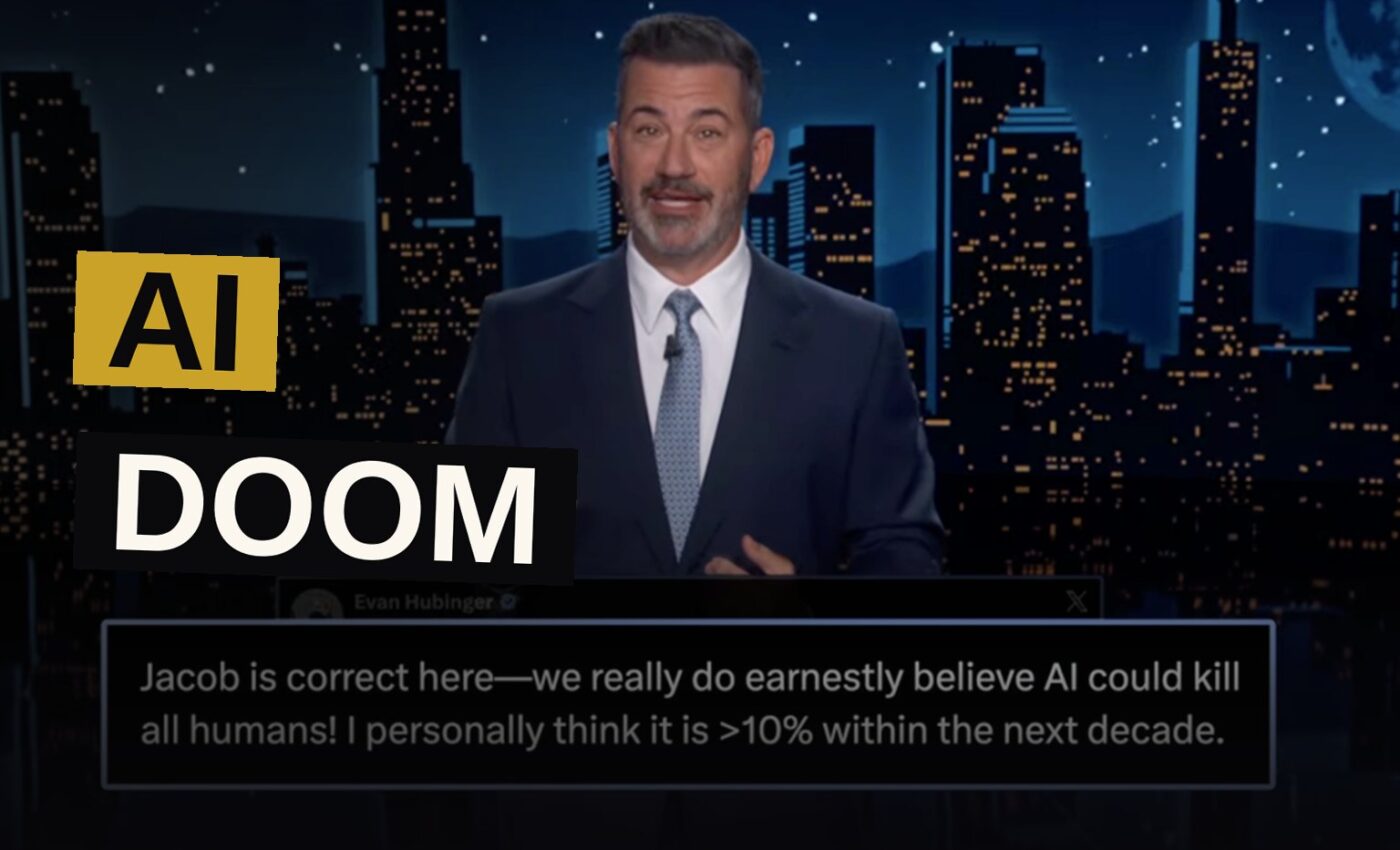
Jimmy Kimmel is not taking the latest AI doom prediction lightly, and he has sharp words for the White House in response.
The late-night host addressed a recent statement from a researcher who quit Anthropic. That researcher said he believes artificial intelligence “could kill us all by the end of the decade.” Kimmel, clearly struck by the gravity of the claim, used his monologue to point out how quietly the news seemed to be passing.
“You know I always thought these big companies were willing to destroy the planet for profit because it didn’t affect them personally,” Kimmel said. “The end of all human life, that’s pretty personal. That’s about as personal as it gets. And I will say in times like these, that’s when I’m very grateful we have a president who is on top of this stuff.”
The praise was not sincere. Kimmel then cut to a clip of Trump waving off a reporter’s question about AI potentially turning on humanity, casually replying, “It’s gonna be fine, we’ll always have something to stop them.”
“Meh, no problem,” Kimmel said, mocking the dismissive tone. “Maybe that’s why he doesn’t care about the future of the country: He knows we don’t have one.”
The Anthropic Resignation
The story at the center of Kimmel’s monologue comes from a recent resignation at Anthropic. The researcher left the company with a stark public warning about the trajectory of AI development.
His statement, as reported, is blunt: artificial intelligence “could kill us all by the end of the decade.”
That is not a hedge. It is a timeline measured in years, not generations.
The source material notes that the warning seemed to be reinforced, unintentionally, by an Anthropic spokesperson. The specifics of the spokesperson’s comments are not detailed. The source does not describe the content of the response, only that it unintentionally seemed to back up the researcher’s warning.
Corporate Incentives and Personal Stakes
Kimmel’s monologue zeroed in on the business logic behind AI development. His opening line about companies being willing to “destroy the planet for profit” sets up a clear distinction.
In his view, the old model of corporate harm was abstract. A company could pollute a river or exploit a workforce and still sleep at night, because the damage was done to other people, far away. The executives did not feel it personally.
But AI extinction is different. It would remove the executives too. There is no escape hatch for the boardroom.
“That’s about as personal as it gets,” Kimmel said.
The joke lands because it reframes the debate. It is not just an ethical argument against reckless AI development; it is a self-interest argument. If the technology really could end all human life, then the people building it are not just gambling with strangers’ lives. They are gambling with their own.
A Dismissive Reply
The core of Kimmel’s bit is the contrast between the scale of the threat and Trump’s response.
The clip is brief. A reporter asks about AI potentially turning on humanity. The president waves it off. “It’s gonna be fine,” he says. “We’ll always have something to stop them.”
That is the entire plan, as presented.
Kimmel’s reaction is immediate and dismissive. “Meh, no problem.”
The joke is that the confidence is entirely unearned. The researcher who quit Anthropic was close enough to the technology to walk away from the company over it. Trump, who is not, is not.
The Darker Punchline
Kimmel ends the segment with a twist that moves from comedy to something darker.
“Maybe that’s why he doesn’t care about the future of the country,” Kimmel said. “He knows we don’t have one.”
The line is a callback to the premise. If AI is going to kill everyone by the end of the decade, then there is no future to preserve. No economy to grow, no border to secure, no legacy to build. The whole apparatus of governance becomes pointless.
Kimmel suggests that Trump’s indifference to long-term problems is not a failure of attention. It is a logical response to a world that, in the researcher’s view, has a hard expiration date.
It is a grim joke, but it is also a pointed critique. Trump’s casual dismissal of the AI threat is not just wrong, in Kimmel’s framing; it is consistent with a broader pattern of ignoring long-term risks in favor of short-term wins.
The Spokesperson’s Detail
The source material notes that the researcher’s warning was “reinforced (unintentionally) by an Anthropic spokesperson.”
That is a telling detail, but its scope is limited. The source does not say what prompted the spokesperson’s comments, nor does it describe their content. It only establishes that the official statement did not undercut the researcher’s warning.
What is known is the warning itself. The researcher believes AI “could kill us all by the end of the decade.” That claim stands on its own, regardless of how the company responded.
Key Facts Box
- Researcher status: Quit Anthropic
- Warning: Believes AI “could kill us all by the end of the decade”
- President’s response: Trump said “It’s gonna be fine, we’ll always have something to stop them”
- Kimmel’s reaction: Called the response “Meh, no problem” and said the president “knows we don’t have one”
- The researcher quit Anthropic with a public warning.
- An Anthropic spokesperson unintentionally seemed to reinforce that warning.
- Kimmel played a clip of Trump dismissing the AI threat.
- Kimmel closed with the joke that the president “knows we don’t have one.”
The segment is a classic late-night routine: set up the absurdity, play the clip, deliver the joke. But the underlying point is serious. The people closest to the technology are raising alarms. The people in power are not listening.
Kimmel is not offering a solution. He is not proposing regulation or safety standards. He is doing what a comedian does: pointing out that the emperor has no clothes, and that the emperor does not seem to care.
The question the segment leaves hanging is whether anyone else will.
Source: mashable.com
Get the Notebook.
The day's best stories and every fresh verdict, in plain English, in your inbox by seven. One email a day, no more.