
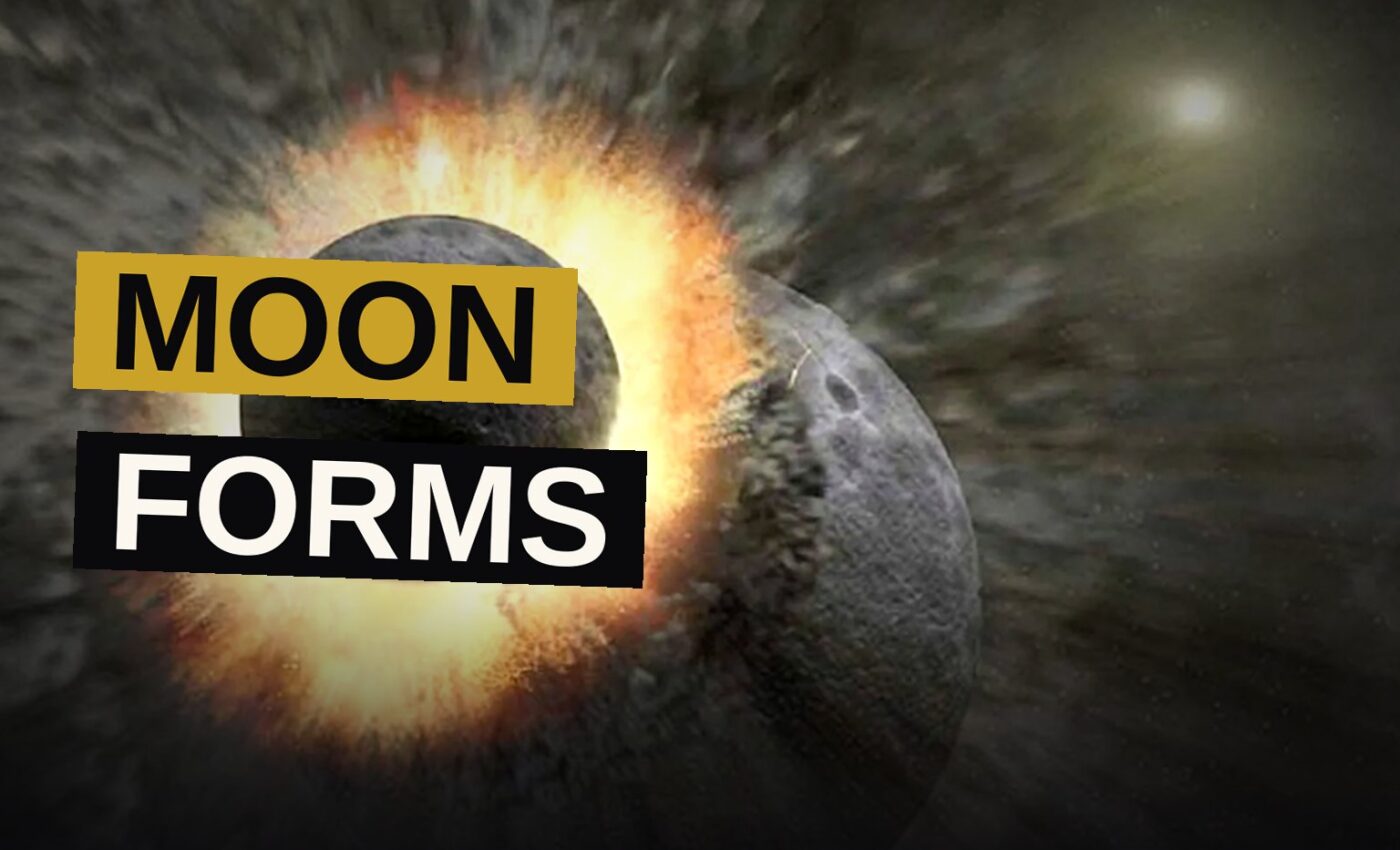
A new set of computer models suggests the Moon may have formed as a single, whole object hours after a collision with early Earth, rather than assembling slowly from a wide ring of debris. The finding challenges decades of accepted models of how our satellite came to be.
The Giant Impact Scenario
The leading explanation for the Moon’s origin is the giant impact hypothesis. About 4.5 billion years ago, a Mars-sized object called Theia collided with the young Earth. The impact destroyed Theia and sent its remains into orbit, where they coalesced into the Moon.
Old Simulations Treated Worlds as Fluids
Early studies, including a foundational 2001 paper led by Robin Canup of SwRI’s Solar System Science and Exploration Division in Boulder, Colorado, and Erik Asphaug, a professor at the Lunar and Planetary Laboratory, assumed both bodies behaved like fluids during the collision. The heat from the crash was so great that scientists treated the rocky surfaces as melted and vaporized.
A New Model Adds Strength
Adeene Denton, a former postdoctoral researcher at the Lunar and Planetary Laboratory who is now at SwRI, and her colleagues took a different approach. They used advanced computer simulations that account for the actual strength of the materials involved. This version of SPH, developed at the University of Arizona and the University of Bern in Switzerland, lets simulated planetary material resist deformation in ways closer to real geologic substances, including rock, metal and solid ice.
Temperature Changes Everything
The simulations revealed strikingly different outcomes depending on how hot the two bodies were. Hotter planetary bodies are mechanically weaker than colder ones, and that difference matters greatly after impact.
| Condition | Outcome |
|---|---|
| High temperatures, weak materials | Theia destroyed, debris forms a wide disk |
| Equal temperatures, strong materials | Intact Moon appears within about five hours |
The Moon Forms Whole
Under some conditions, the collision destroys Theia and creates a broad ring of debris around Earth. Material in that ring gradually comes together to form the Moon.
But other simulations produced a very different result. Instead of forming slowly from debris, a fully intact Moon appeared within only a few hours.
A Link to the Timing of the Moon’s Birth
Young protoplanets generally begin hot and gradually cool as they age. The new results create a potentially important link between the timing of the giant impact and the way the Moon initially formed.
What This Changes
The findings could help narrow down when the collision happened. Because the Moon’s formation depends on the temperature and strength of the two bodies, scientists can now test whether certain ages of the Earth and Moon fit the model.
The research was published in The Astrophysical Journal Letters.
The Takeaway
The old assumption was that the collision was so violent everything acted like liquid. This new model shows that is not necessarily true. The strength of the rocks themselves matters, and it can determine whether the Moon forms whole or piece by piece.
It is a small step, but it is a step toward understanding a collision that shaped our planet billions of years ago. The Moon may have formed intact just hours after a giant collision, and that changes how we think about the event entirely.