
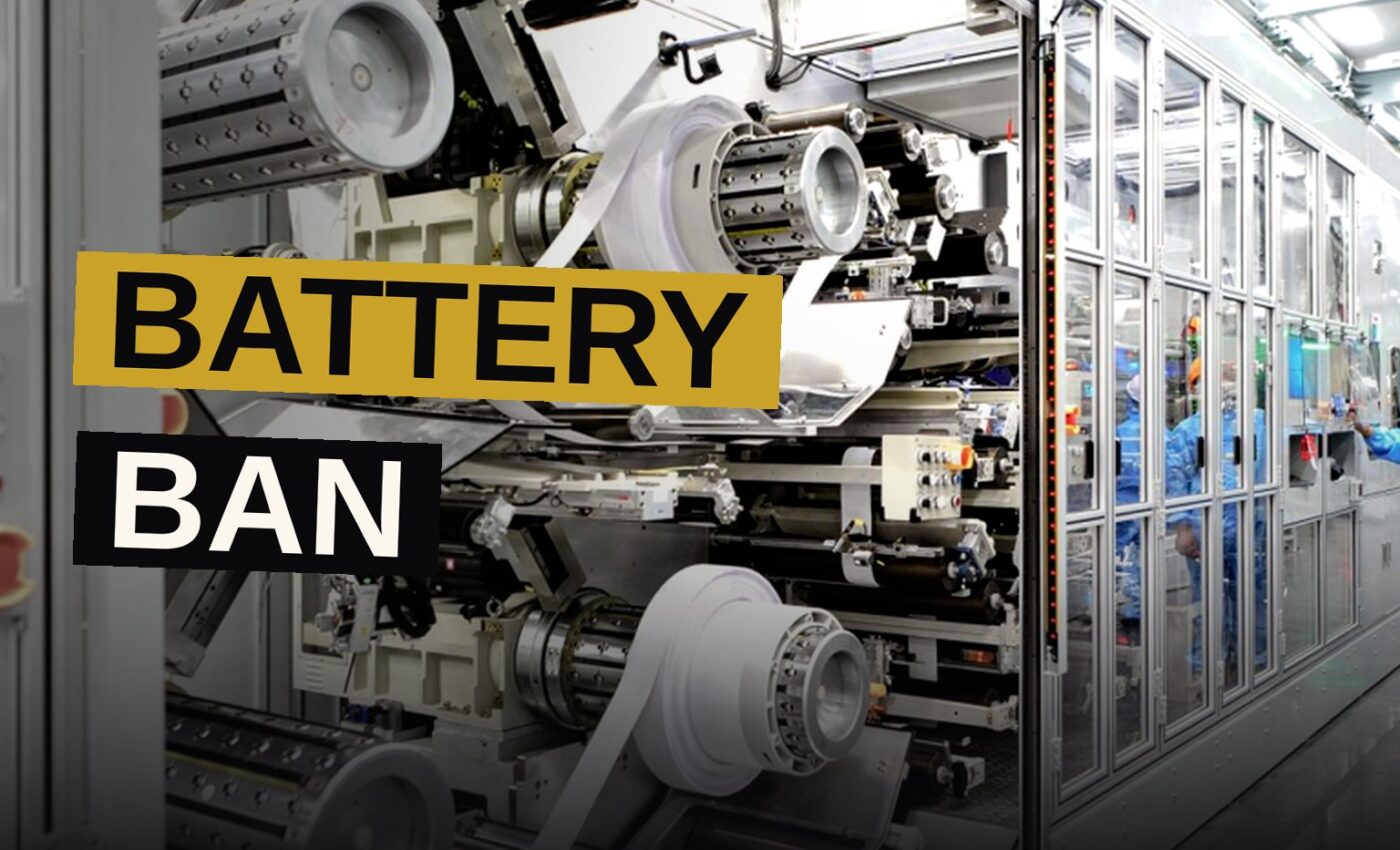
An executive order issued in late August has shut Chinese batteries out of the US grid-scale storage market, barring them from such systems. That ban comes as the American energy storage market is expanding rapidly, with low-cost Chinese batteries playing a major part in that growth.
A national emergency has been proclaimed, and the directive bars “any foreign-produced bulk-power system electric equipment” from entering the country if it poses a national security threat. The ban covers battery energy storage systems, as well as inverters and transformers.
This marks a significant step up in a long-running push to separate the US battery supply chain from China. The change will probably slow progress at least for now.
Inside the Executive Order
The executive order went further than many in the industry had anticipated. Prior policy had relied on tax credits and tariffs to push the market toward avoiding Chinese components. A complete prohibition changes that approach entirely.
Shan Tomouk, energy storage and energy lead for Benchmark Mineral Intelligence and an energy industry analyst, says that a complete prohibition came as something of a shock and raises worries for companies based within the United States.
The directive still covers energy storage facilities that already exist, but it is improbable that any of them will be shut down due to the batteries they contain. Most of these facilities rely on Chinese batteries today, which means that enforcing the rule strictly would amount to taking almost all installed battery energy storage off the US grid, according to Isshu Kikuma, an analyst with BloombergNEF, an energy consultancy.
Years of Restrictions
America has tried before to cut down on Chinese influence in its battery supply chain, and one of the main policy tools used in recent years has been restricting the tax credits meant to encourage the adoption of new technologies.
The federal government set up those restrictions back in 2022, when it created the tax credits tied to the Inflation Reduction Act. The rules limited where battery minerals could be pulled from the ground, treated, or broken down. They also kept tight control over where batteries and their parts got put together.
The tax credits received a major overhaul in 2025, yet the Trump administration has moved in a comparable direction. Under new legislation, beginning in 2026, at least 55% of the cost of materials employed for fresh energy storage projects must originate from sources outside China and other restricted nations if the projects are to receive tax credits at all.
The import tax on batteries has risen sharply as part of the broader strategy. The tariff on these products jumped to 25% at the start of January, having stood at just 7.5% before that point.
Slower Deployment Ahead
BloombergNEF’s analysis suggests that the new executive order will probably slow the rollout of grid-connected energy storage projects in the short run. Developers may have to sit tight while waiting for more details on how the rules will work.
The Department of Energy’s detailed guidance, expected by the end of the year, could force some projects to look for other cell suppliers, either made at home or brought in from other nations. Kikuma says these substitutes will probably cost more than Chinese imports.
“Worst case, those projects could get canceled,” he says.
Building Domestic Supply
The United States will eventually be able to produce enough batteries to satisfy its own demand, but not immediately. The nation could achieve sufficient capacity by roughly 2030, although certain manufacturing plants might fail to scale up or operate at full capacity, which would push actual domestic production matching demand into the later 2030s.
Factories from LG Energy Solutions, Samsung SDI, Ford, and SK On are scheduled to begin operation or increase production by next year. The irony comes from a weakening EV market, which is actually aiding the situation, since some facilities originally built for vehicle batteries are being repurposed to manufacture cells for grid storage instead.
The price will rise as a result. Right now, batteries manufactured in the US remain considerably pricier than those produced in China. Even moving to imports from other nations such as South Korea would probably prove more costly.
At the heart of the matter lies a straightforward dilemma: nations must decide whether to fully exploit inexpensive, readily accessible technology, or instead cut off major suppliers to compel the creation of their own manufacturing plants, even when that approach proves more expensive.
A Global Question
The problem isn’t limited to the United States or to batteries alone. China has pulled far ahead of most other countries when it comes to solar panels and battery technology. Thanks to sustained government backing and a long track record of building both factories and labs, the country now leads the world in energy production.
The world is trying to work out how to handle this situation while keeping a careful balance of power. There are low-cost tools available that could cut emissions and lower energy bills greatly. However, there are dangers tied to depending too heavily on any single supplier for important technologies.
The US energy storage market has set record after record for quick expansion, and cheap Chinese cells have played a major part in pushing that growth forward. Batteries give renewable sources such as wind and solar a way to hold onto power so it can be used later, which makes the grid more reliable, cuts emissions, and keeps the lights on.
| Policy Tool | What It Does | When It Takes Effect |
|---|---|---|
| Executive order | Bans Chinese batteries from grid-scale storage | Late August, declared national emergency |
| Tax credit restrictions | Requires 55% of material costs from outside China | Starting 2026 |
| Import tariffs | Increased from 7.5% to 25% on batteries | January |
In the short term, doubt surrounds the field, with projects possibly facing delays and some being abandoned altogether. Over the longer horizon, however, change takes shape: domestic manufacturing plants increase their output, and the market adjusts to a new situation.
The prohibition is currently in effect, and the sector is watching closely to learn precisely how it will be put into practice. The consequences are significant, affecting both the firms constructing these ventures and the power system that relies upon them.
Source: technologyreview.com
Get the Notebook.
The day's best stories and every fresh verdict, in plain English, in your inbox by seven. One email a day, no more.