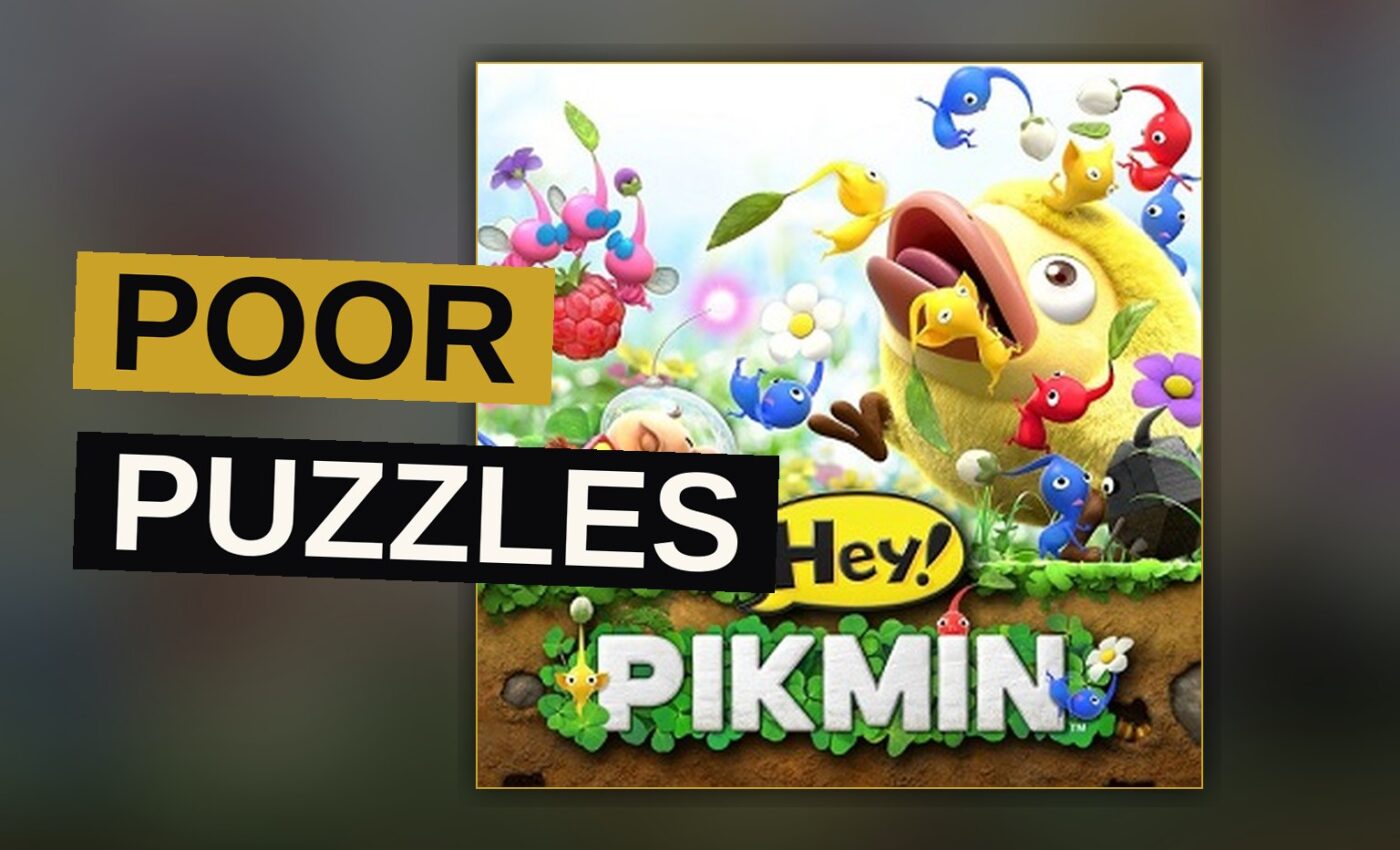
Hey! Pikmin arrives on the 3DS in 2017 as a spinoff built around the Pikmin series, and it asks players to switch between three characters while solving puzzles. The idea sounds clever on paper. In practice, it feels like a puzzle game dressed in Pikmin clothing, and not always a very good one.
Trailer, via Nintendo of America.
The Three Characters
The core mechanic is simple. Players pick one of three characters — Captain Olimar, Louie and Brittany — each with a different ability. Olimar throws Pikmin. Louie can dig through soft ground. Brittany can float over water and push heavy objects with her tail. Switching between them is meant to solve puzzles that none of them can handle alone.
It sounds elegant. It rarely plays that way. Some puzzles require a specific character early on, forcing players to backtrack to find the right one. Others ask for a character’s ability at a moment when the player has already moved past it. The result is a game that constantly asks you to undo your work, and the backtracking rarely feels rewarding. That constant undoing becomes a major part of how the game plays, and it shapes nearly every level.
Level Design and Pacing
The levels themselves are small, tight spaces packed with obstacles and switches. They look bright and cheerful, with grass, dirt and small creatures scattered across each area. The presentation is solid, and the 3D effect holds up well on the 3DS screen. But the puzzles within those levels are often more frustrating than clever.
Some puzzles depend on a precise sequence of moves that is easy to miss the first time. Others reward patience and trial-and-error over actual insight. The game rarely explains its logic clearly, leaving players to guess which button combination might finally work. That guesswork can be satisfying in a few moments, but it drags out the feeling of discovery across most of the game. The constant guessing adds time to every puzzle, and it makes the game feel longer than its short length would suggest.
Difficulty and Frustration
Difficulty is uneven across the game. Early puzzles ease players into the switching system gently, giving them room to learn each character’s abilities without too much pressure. Later puzzles ramp up the complexity, demanding exact timing and careful planning. The problem is that the difficulty curve doesn’t always feel fair. Some puzzles punish a mistake harshly, sending the player back to the start of a lengthy sequence.
That frustration compounds when the game forces players to backtrack to find the right character. A puzzle that requires Brittany to push a heavy object might force a return trip to the level’s entrance, erasing any sense of progress the player had just made. The pacing suffers as a result. Levels that should take five minutes can stretch to ten, and the difference isn’t in depth so much as repetition. The game’s short length only makes the repetition more noticeable, since there’s little other content to pad out the experience.
Sound and Presentation
The music is cheerful and light, matching the game’s visual tone. It doesn’t stand out much, but it does its job of making the world feel welcoming. The sound effects for throwing Pikmin and digging are well done, adding a small layer of physicality to actions that otherwise feel abstract. The 3D rendering holds up well, especially in outdoor areas where the camera has room to move.
None of this saves the game from its central flaw. The presentation is competent, but it doesn’t compensate for a design that keeps asking players to repeat themselves. The visuals and audio are pleasant, but they can’t make up for puzzles that keep asking the same questions.
Comparing the Three Characters
| Character | Ability | Strength | Weakness |
|---|---|---|---|
| Captain Olimar | Throws Pikmin | Simple, familiar | Limited range |
| Louie | Digs through soft ground | Accesses new paths | Slow movement |
| Brittany | Floats over water, pushes objects with tail | Versatile | Unsteady controls |
The table shows the strengths and weaknesses of each character, but it also points to the problem the game never fully solves. Each character’s ability is useful in certain situations, but none of them feels essential to the whole game. Players can often complete a level with any of the three, which undercuts the idea that switching between them is the game’s defining feature. The game’s central promise — that you need all three characters to finish it — turns out to be less true than expected.
Shortcomings and Omissions
The game is short by modern standards. It can be finished in a handful of hours, though the difficulty means some players will spend longer than that. There’s no multiplayer mode, no additional content beyond the main campaign, and no way to replay levels with a different character once the game is completed. For a spinoff, it doesn’t offer much beyond what’s on the cartridge. Those omissions mean there’s little reason to return to the game after finishing it.
“Hey! Pikmin” tries to be a fresh take on a beloved series, but its puzzles often feel more like roadblocks than challenges.
That quote sums up the experience. The game is trying to do something new, but the execution falls short of its ambition. The idea of switching between three characters is promising, but the puzzles built around it are inconsistent, punishing and frequently unclear about what they’re actually asking of the player.
Final Verdict
Hey! Pikmin is a game with a good idea at its core. The switching mechanic could have supported a tight, clever puzzle game if the puzzles were designed with more care. Instead, the game leans on repetition, backtracking and vague objectives to fill out its levels. The presentation is solid, the music is pleasant, and the 3D effect works well. None of that changes the fact that the core gameplay is flawed.
Players looking for a quick, light puzzle game will find moments to enjoy here. Players hoping for a deep, rewarding experience will likely come away disappointed. The game never quite earns its ambition, and its best ideas are buried under a pile of poorly designed puzzles.