
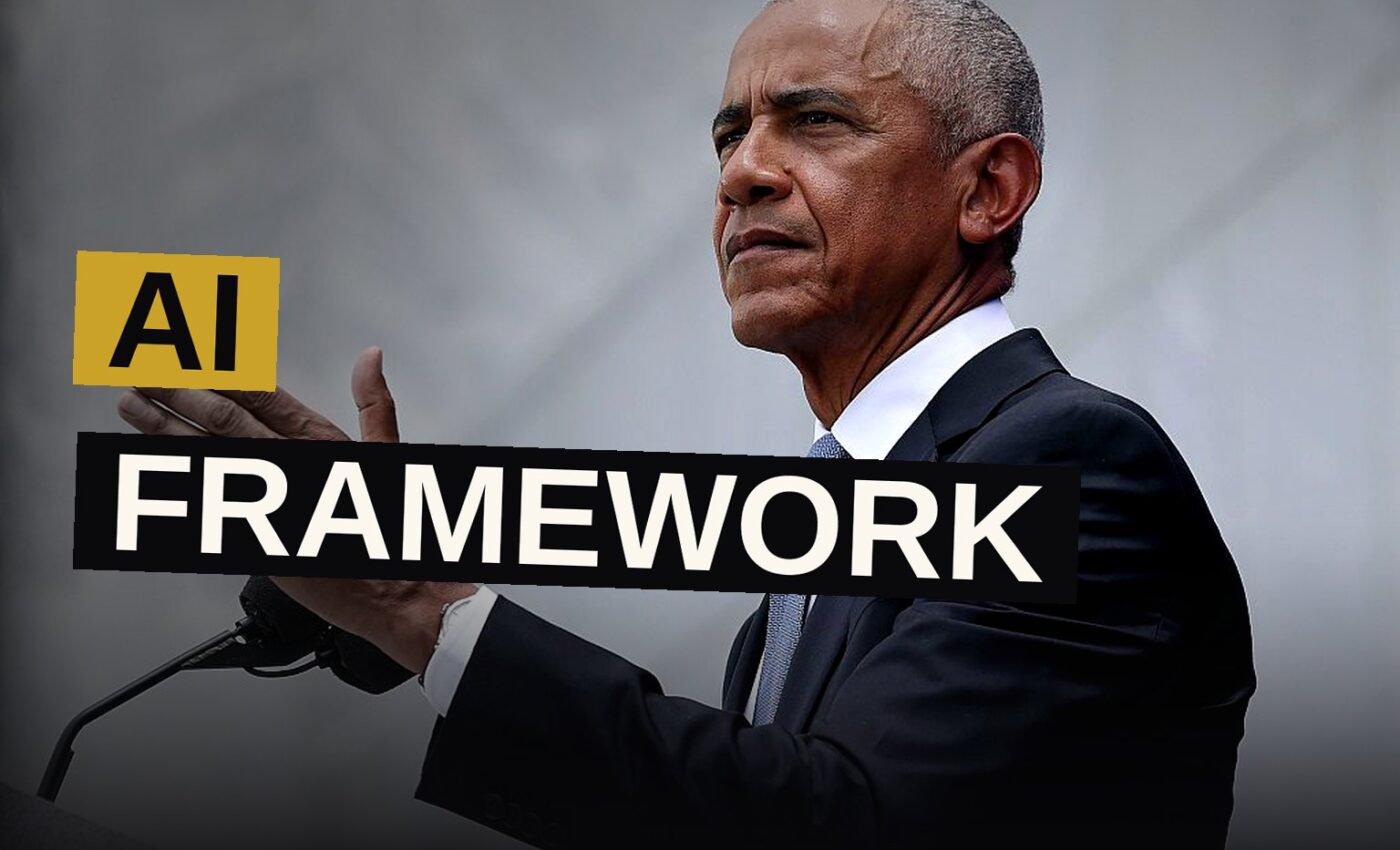
Barack Obama is making the case for Democrats to treat artificial intelligence as a political priority, telling fellow party members they need a “very clear plan” to address the technology’s economic risks and safety problems. The former president spoke at a Democratic fundraising event on Thursday, where he was interviewed by House Minority Leader Hakeem Jeffries. Obama’s office provided a partial transcript of the session, in which Jeffries asked Obama how congressional Democrats should approach AI.
Obama argued that once Democrats regain control of the House, they should “put together a framework for a very public conversation.” He warned that the technology is advancing rapidly in private hands and could become dangerous if left unregulated. But he also said that careful management of AI could produce real benefits, including faster drug development that could help cure diseases.
“This is something that is moving very fast in private hands, and if we don’t get on top of it, I think can be dangerous,” Obama said. “If we do get on top of it, I do think it’s beneficial. I genuinely think it’s going to accelerate, for example, drug development in ways that can help us cure diseases.”
The Public Conversation Obama Wants
Obama’s framing puts AI squarely on the agenda for the next Democratic Congress. He described the need for a “framework” that would allow the public to see and weigh in on how AI develops.
His remarks come as AI companies race to build more powerful systems, and as researchers raise warnings about the technology’s direction. Obama’s call for a public framework suggests he wants Democrats to move faster than the private sector, rather than chase behind it.
Jeffries Responds
In a statement, Jeffries said Obama “is correct that decisive action must be taken on artificial intelligence.” He added that “Republicans have abdicated their responsibility to govern on behalf of the American people.”
Jeffries framed the issue as one of leadership failure. By saying Republicans have abandoned their duty to govern, he suggested that Democrats should step in to fill the gap. The statement does not offer a detailed plan of its own — it simply agrees with Obama’s assessment.
The two men appear to share a common view of the problem. Obama has spent recent months engaging with AI executives directly, offering himself as a “sounding board” to Anthropic CEO Dario Amodei and OpenAI CEO Sam Altman. Jeffries now echoes that urgency in public.
Obama’s Sounding Board Role
Obama has not been passive on AI. He has reached out directly to the people building the technology, offering himself as a sounding board for Anthropic CEO Dario Amodei and OpenAI CEO Sam Altman. The NYT reports that he has spoken to both executives.
That engagement gives his public statements more weight than they might otherwise carry. A politician who has only read about AI speaks one way. A politician who has spoken to the CEOs speaks another. Obama’s direct contact with Amodei and Altman means his call for a public framework is coming from someone who has heard from the industry leaders themselves.
The pattern suggests Obama sees himself as a bridge figure — someone who can translate technical concerns into political language. His role as a sounding board allows him to hear what the companies are thinking, then report back to Democrats about what questions they should be asking.
The Anthropic Resignation
The timing of Obama’s remarks matters. They come amid growing concern over AI safety, particularly after an AI researcher resigned from Anthropic and claimed the leading AI companies are “racing straight to self-improving superintelligence and gambling with our lives.”
The resignation is notable because it comes from someone inside one of the companies at the center of the debate. The researcher’s warning about self-improving superintelligence is a serious charge. It suggests that some people working inside these companies believe the direction of the field is heading toward a point of no return.
The resignation adds urgency to Obama’s call for public oversight. If the people building the technology are worried about where it is headed, the public has a right to know too. Obama’s push for a public conversation now looks like a response to that warning.
Amodei’s Pacing Plan
On Saturday, Amodei outlined a broad approach to “pacing the frontier.” The plan includes giving independent safety evaluators access to leading AI companies and models, as well as developing “common safety standards” between companies.
The proposal is significant because it offers a concrete path forward. Rather than leaving AI development entirely in private hands, Amodei’s plan would bring outside eyes into the process. Independent evaluators would have access to the companies and their models, allowing them to check whether the technology is being developed safely.
Amodei’s proposal also calls for common safety standards between companies. That would mean multiple firms agree on a shared set of rules, rather than each operating in isolation. The idea is that shared standards can reduce the risk of unintended consequences.
The plan has drawn attention from other figures in the field. In social media posts, Altman and Musk seemed to respond positively to Amodei’s plan. Altman said that OpenAI would also commit to “having independent evaluators with employee-like access.”
What Trump Said
President Donald Trump weighed in on AI safety concerns on Sunday, discussing the topic with reporters at an Irish golf event. Bloomberg reports that Trump boasted that the United States is “the most sophisticated country in the world,” adding that he wants “to keep it that way because whoever wins AI wins.”
“And we can put guardrails,” Trump said. “We can do this and that. But I think you have a lot of negative forces that are bringing it up that shouldn’t be bringing it up.”
Trump’s remarks reflect a different approach to AI than Obama’s. Obama wants a public conversation led by Democrats. Trump wants guardrails and dismisses critics as negative forces. The two presidents are talking past each other, even as both acknowledge the stakes.
Trump’s comments also come with context. Earlier this year, the Trump administration released a legislative framework for AI that would preempt state laws and shift the child safety burden to parents. That framework is a policy position, but it does not directly address the safety concerns raised by researchers and executives alike.
Comparing the Two Approaches
| Approach | Leadership | Focus |
|---|---|---|
| Obama’s public framework | Obama as sounding board | Economic impact, safety |
| Trump’s guardrails | Preempt state laws, shift child safety to parents | National dominance |
The comparison shows the gap between the two approaches. Obama wants Democrats to lead a public conversation and develop a plan. Trump wants guardrails and dismisses critics as negative forces.
Obama’s plan is built on engagement with industry leaders. Trump’s plan is built on legal authority. One is a conversation; the other is a directive.
What Comes Next
Obama’s call for a public framework is a statement of intent, not a finished plan. The question is whether Democrats can turn that intent into action.
The stakes are high. Obama’s warning about the dangers of letting AI develop in private hands is not hypothetical. He has engaged with Amodei and Altman on the subject. He has heard the concerns from the researcher who resigned from Anthropic.
The resignation is one person’s account. It is not a settled judgment, but it is a warning from someone who worked inside one of the companies at the center of the debate. That warning now sits alongside Obama’s public call for a framework.
Obama’s plan is ambitious. It asks Democrats to lead a national conversation and produce a coherent response to a technology that is reshaping the economy. Whether the party can deliver on that promise remains to be seen.
The next few months will test whether Obama’s vision survives the transition from speech to policy.