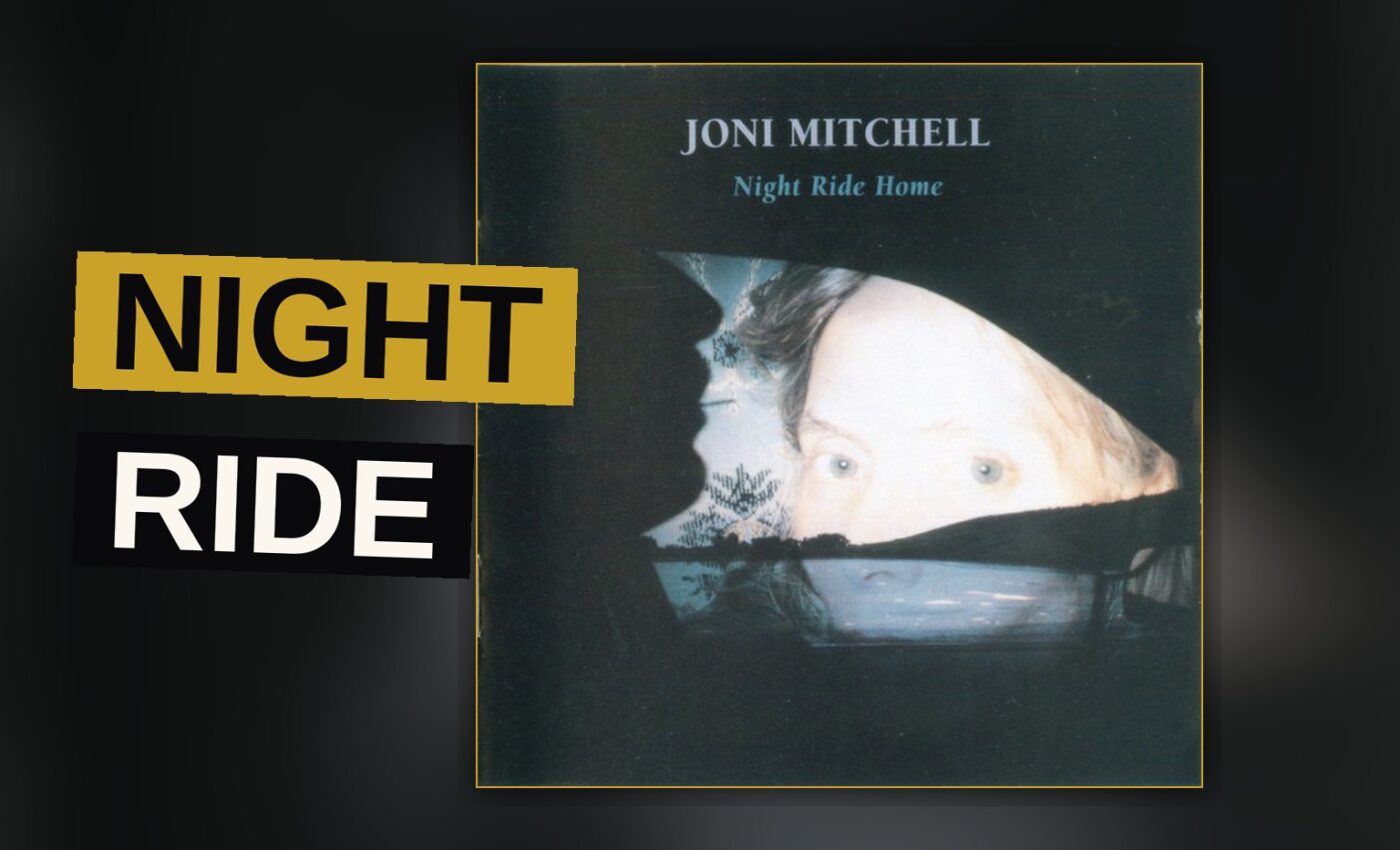
Joni Mitchell spent the 1980s buried in synthesizers, and those records have aged poorly. Night Ride Home is the sound of her walking back out of that fog. Released in 1991, it is an acoustic, intimate record that puts her voice and her lyrics exactly where they belong: at the front of the mix, with nothing to hide behind.
The album runs 51 minutes across ten tracks. It is not a loud record, nor a flashy one. It is the work of a songwriter who has nothing left to prove and who is, for once, content to sit still and tell the truth.
The Track List in Order
| # | Track | Length |
|---|---|---|
| 1 | Night Ride Home | 3:22 |
| 2 | Passion Play (When All the Slaves Are Free) | 5:25 |
| 3 | Cherokee Louise | 4:33 |
| 4 | The Windfall (Everything for Nothing) | 5:16 |
| 5 | Slouching Towards Bethlehem | 6:55 |
| 6 | Come In From the Cold | 7:32 |
| 7 | Nothing Can Be Done | 4:55 |
| 8 | The Only Joy in Town | 5:12 |
| 9 | Ray’s Dad’s Cadillac | 4:34 |
| 10 | Two Grey Rooms | 3:59 |
The title track opens the record and sets the entire tone. “Night Ride Home” is a slow, rolling song about driving through darkness toward a warm house. Mitchell’s voice is lower now, worn in places, but it carries a weight that her younger self could not have faked. The acoustic guitar is front and center, and the arrangement leaves room for the song to breathe.
“Passion Play (When All the Slaves Are Free)” follows with a heavier, more political lyric. It is not one of the record’s best moments — the title promises more than the song delivers — but it holds its place in the sequence without dragging.
“Cherokee Louise” is a quiet standout. The song tells a story about a woman who has been hurt, and Mitchell sings it with a tenderness that feels earned rather than performed. The melody is simple, almost folk-like, and it is one of the few tracks here that feels like it could exist in a coffeehouse decades earlier.
“The Windfall (Everything for Nothing)” picks the tempo up slightly. It is a wry, knowing song about getting what you pay for, and Mitchell’s vocal phrasing is sharp enough to cut. The production here is clean, and the traditional instruments — guitar, bass, a little piano — sit comfortably next to the subtle electronic textures that Mitchell still uses.
“Slouching Towards Bethlehem” is the record’s centerpiece. The song stretches past six minutes without ever feeling long. It is a dense, literary lyric set to a patient melody, and it rewards attention. This is Mitchell at her most ambitious, and it works.
“Come In From the Cold” is the longest track on the record at 7:32. It is also the most personal. Mitchell sings about aging, about memory, about the people she has loved and lost. The song is not an easy listen — it demands patience — but it is the emotional heart of the album.
The Second Half
“Nothing Can Be Done” is the weakest track on the record. The melody is forgettable, and the lyric does not land the way the rest of the album does. It is not a disaster, but it is the track you will skip on repeat listens.
“The Only Joy in Town” recovers the momentum. It is a bluesy, swinging number with a sharp lyric about loneliness and desire. Mitchell sounds like she is having fun here, and that energy carries the song.
“Ray’s Dad’s Cadillac” is a memory piece, a song about childhood and class and the cars we used to ride in. It is charming and specific, and it shows Mitchell’s gift for turning a small detail into a whole world.
“Two Grey Rooms” closes the record on a quiet, unresolved note. It is a song about longing from a distance, about watching someone you cannot have. The piano is spare, the vocal is restrained, and it ends the album without offering any easy answers.
What the Record Does
The album’s strengths are its lyrics and its mood. Mitchell is writing about her own life here — her relationships, her regrets, her view of the world — and she does not hide behind metaphor or irony. The songs are self-disclosing in a way that her 1980s records never were.
The blend of instruments and technology is also worth noting. There are synthesizers on this record, but they are used as seasoning, not as the main course. The acoustic guitar, the bass, the drums, and Mitchell’s voice are the foundation, and that is the right call.
- The best tracks: “Night Ride Home,” “Cherokee Louise,” “Slouching Towards Bethlehem,” “The Only Joy in Town”
- The weakest track: “Nothing Can Be Done”
- The longest track: “Come In From the Cold” at 7:32
Verdict
Night Ride Home is not Mitchell’s greatest album. But this record is a return to form in the truest sense: it is Mitchell stepping back onto her home turf and sounding like herself again.
The best songs on this album are as good as anything she wrote in her prime. The lesser ones are merely fine, which is no great crime. As a whole, the record is coherent, personal, and quietly confident. It is the sound of an artist who stopped chasing the future and remembered what she was good at.
8 of 10.
- Night Ride Home3:22
- Passion Play (When All the Slaves Are Free)5:25
- Cherokee Louise4:33
- The Windfall (Everything for Nothing)5:16
- Slouching Towards Bethlehem6:55
- Come In From the Cold7:32
- Nothing Can Be Done4:55
- The Only Joy in Town5:12
- Ray’s Dad’s Cadillac4:34
- Two Grey Rooms3:59