
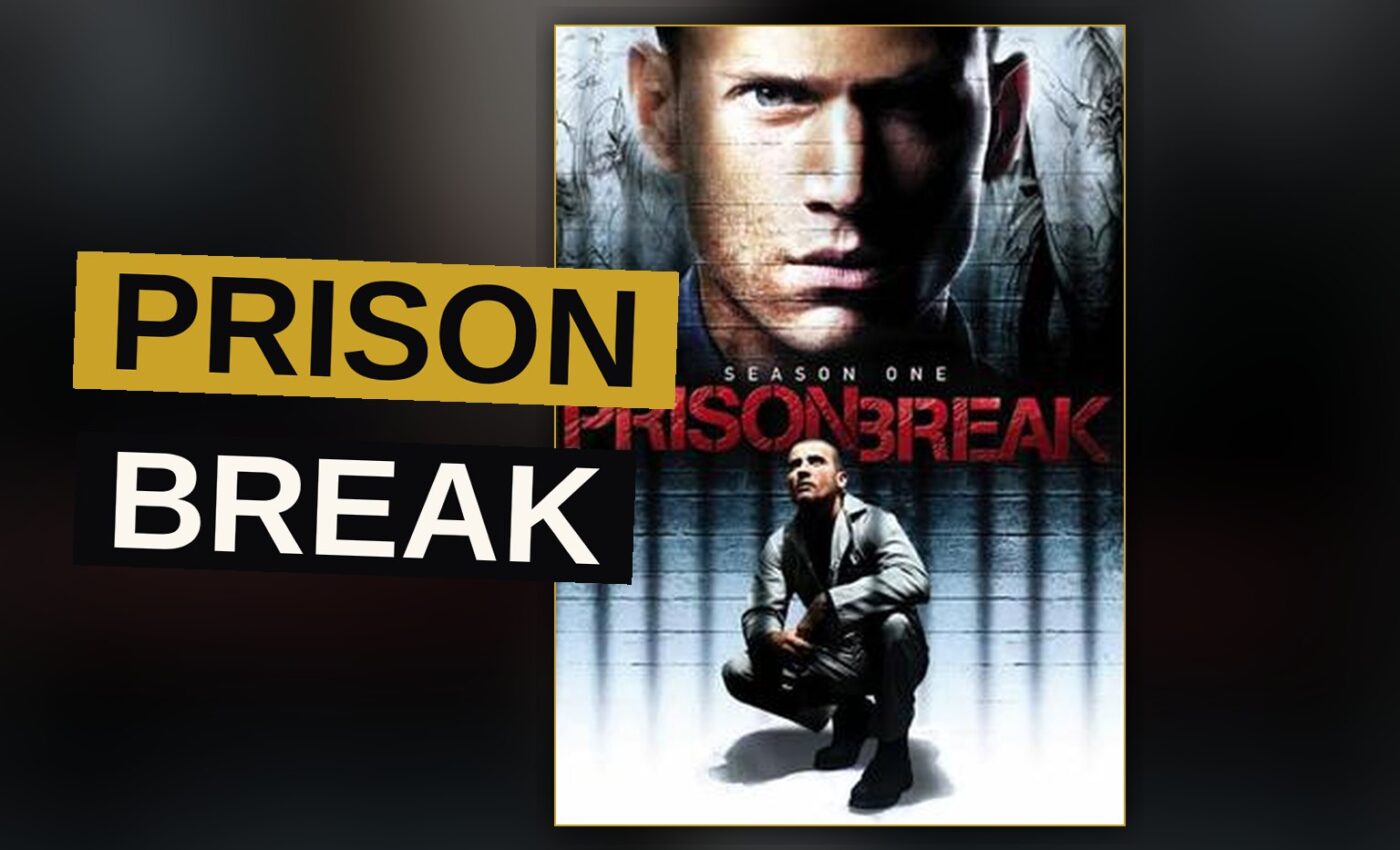
Prison Break ran for five seasons and 88 episodes on Fox, from August 29, 2005 to May 30, 2017. It was created by Paul T. Scheuring, who built the whole thing on a single clean idea: a man gets himself locked up on purpose so he can break his brother out.
That idea carried the show further than it had any right to go. The first season is still the best argument for it. What follows is a longer, messier run that keeps the brothers moving but loses the thing that made the premise work. Prison Break earns a 6.5/10.
Trailer, via Konstantin Pichugin.
Michael Scofield Gets Himself Arrested
The setup is the show’s best asset. Lincoln Burrows, played by Dominic Purcell, is a high school drop-out and convicted felon sentenced to death for the murder of Terence Steadman, the brother of the vice president of the United States. He did not commit it. A political conspiracy put him there.
His brother Michael Scofield, played by Wentworth Miller, is the one with a plan. He deliberately gets himself sent to the same prison so he can break them both out, from the inside. The show never pretends this is sane. It treats the plan as an elaborate piece of engineering, and that is where the first season gets its pull.
Purcell was cast three days before production started, making him the last actor to join the original cast. He auditioned while he had a recurring role as Tommy Ravetto on North Shore. Scheuring’s first impression did not convince him Purcell fit the part — the actor showed up with styled hair and a tan. Purcell’s acting won the role anyway. He arrived on the first day of filming with a shaved head.
That is the kind of detail that tells you the show was built fast and cast on instinct. It mostly worked.
Fox River State Penitentiary and the First Season
The first season keeps its cast based in Chicago or at Fox River State Penitentiary, and it features ten actors with star billing. That is a lot of people to service, but the prison setting gives them a reason to be in the same rooms. The walls do the structural work.
Fox had rejected the series in 2003, worried about its long-term prospects. The popularity of serialized prime time shows 24 and Lost changed the calculation, and Fox backed production in 2004. The first season drew mostly positive reviews and performed exceptionally in the ratings. It was planned for a 13-episode run and extended by an extra nine episodes because of the response.
The extension is the tell. A 13-episode run is a closed story. A longer one is a franchise, and the show spent the extra room on characters who would matter later, for better and worse.
T-Bag, C-Note and the Ensemble
The cast is the show’s second-best asset, and it is the reason people who stopped watching still remember it. Robert Knepper plays Theodore “T-Bag” Bagwell, and the character became the show’s most durable export. Rockmond Dunbar plays Benjamin “C-Note” Franklin. Sarah Wayne Callies plays Sara Tancredi.
The show keeps an ensemble cast each season alongside recurring guest stars, and it churns that cast on purpose. Scheuring has said killing off major characters “makes the audience that much more fearful for our protagonists” and that it “actually does help us in terms of reducing story lines.”
Both halves of that are true, and the second half is the problem. Killing people to cut story lines is a production decision, not a narrative one. When the deaths land, the show is brutal and effective. When they do not, the show is just clearing a desk.
“makes the audience that much more fearful for our protagonists”
Only two characters appear in every episode: Michael Scofield and Lincoln Burrows. That is the spine, and it is also the limit. Everyone else is expendable by design.
The Seasons After the Escape
The later seasons keep the ratings strong, and some critics claimed the show had overstayed its welcome. That claim is correct, and the reason is structural. The first season works because the prison is a closed system with rules. Once the brothers are out, the show has to invent new systems, and each one is looser than the last.
The second season has nine actors with billing. Three characters drop from series regular to recurring, one gets upgraded, and a new character arrives. The third season adds four new characters, two of them prisoners at Penitenciaría Federal de Sona. Most of the cast changes come down to character deaths.
The fifth season brings in Inbar Lavi as Sheba, Augustus Prew as David “Whip” Martin, and Mark Feuerstein as Jacob Ness. By then the show is a reunion tour. It knows what the audience came for and it delivers that, but the engineering that made season one tense is gone.
Ramin Djawadi’s Theme and the Emmy Nomination
One piece of the show held up better than the plotting. Ramin Djawadi composed the theme music, and it was nominated for a Primetime Emmy Award in 2006.
The nomination is the show’s clearest piece of awards recognition in the material here, and it is deserved. The theme does what the best television music does: it tells you what kind of show you are watching before a single line of dialogue arrives.
The production was a joint effort between Original Film, Adelstein/Parouse Productions for seasons 1 through 4, Dawn Olmstead Productions for season 5, Adelstein Productions for season 5, One Light Road Productions for season 5, and 20th Century Fox Television. Along with Scheuring, the executive producers included Matt Olmstead, Kevin Hooks, Marty Adelstein, Dawn Parouse, Neal H. Moritz, and Brett Ratner, who directed the pilot.
Ratner directing the pilot is worth noting. The pilot had to sell a premise that sounds ridiculous on paper, and it did.
What Actually Holds Up
What the show gets right, and how much each piece matters, comes down to a short list.
- The premise. A brother gets himself incarcerated to save his brother. It is one sentence, it is clear, and it generates everything.
- Wentworth Miller and Dominic Purcell. The show lives or dies on whether you believe these two are brothers, and you do.
- Robert Knepper as T-Bag. The most memorable character in the run, and the one the show is still known for.
- Ramin Djawadi’s theme and its 2006 Emmy nomination.
- The ensemble churn in seasons 2 and 3.
What does not hold up is the length. Five seasons and 88 episodes is more than the idea supports. The first season is a tight machine. The seasons after it are a show looking for a new machine and never quite finding one.
The Verdict on Prison Break
Prison Break is a great first season attached to four more that range from serviceable to unnecessary. The show was rejected by Fox in 2003, revived in 2004 on the strength of the serialized drama boom, and extended from a 13-episode run because people watched. Every one of those decisions was correct commercially and costly creatively.
The show’s real legacy is the premise and the cast, not the plot. People remember Michael Scofield’s plan and T-Bag’s face. The show’s later seasons are the part that faded, and that is not an accident.
The published critical score of 6.5/10 is fair, and it is fair in a specific way. It is a score for the whole run, dragged down by everything after the escape. Watch the first season. Know that the rest exists. That is the honest recommendation.
Get the Notebook.
The day's best stories and every fresh verdict, in plain English, in your inbox by seven. One email a day, no more.