
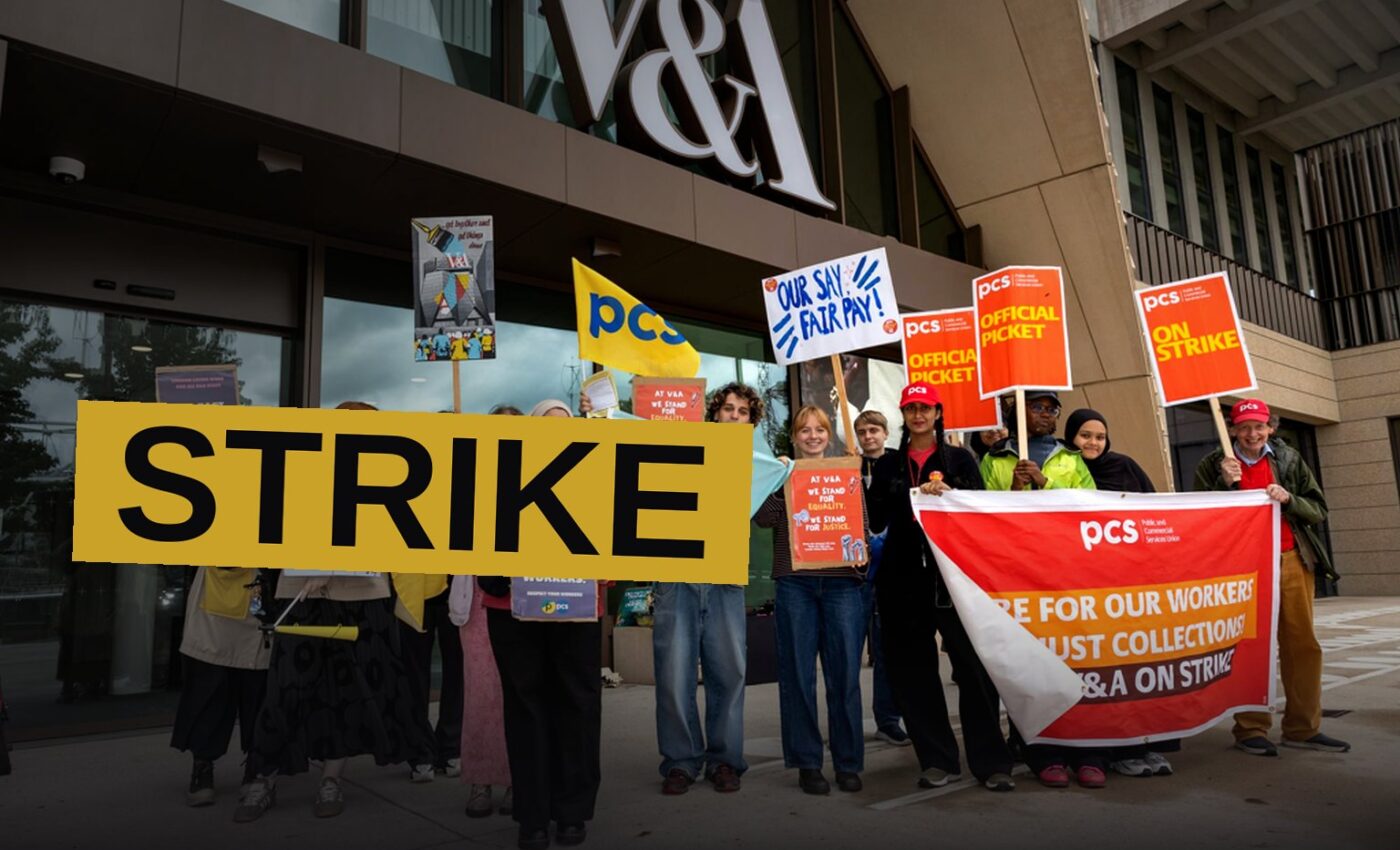
Striking Workers Shutter Three V&A London Locations
Last weekend, workers at the Victoria and Albert Museum walked off the job for two days over what they described as “Amazon-style” working conditions. As a result, the museum shut down three of its London locations.
Last Friday, September 4, the V&A shut down three of its London branches ahead of time, before its unionized workers walked off the job for a two-day strike. The strike involved staff from the museum’s heritage division, who make up more than half of that section of the organization’s workforce, some 700 workers organized under the Prospect Union’, along with members of the Public and Commercial Services Union (PCS). The closures came before the strike began, which suggests the museum anticipated the walkout would disrupt its normal operations across several locations.
Three Sites Shut Down
The walkout forced the V&A to shut down the East Museum, the East Storehouse, and the Young V&A (the institution’s children’s museum in Bethnal Green) through Saturday, September 5. Each of those three venues stayed closed throughout the protest, leaving guests who had booked visits to any of them over the weekend without access. With all three closed at once, the museum suffered a notable blow to both its public offerings and its back-office functions.
Throughout the weekend, staff members gathered outside the three locations, armed with funny and confrontational signs demanding fair wages and water access. These demonstrations formed a noticeable component of the weekend’s activities, with workers assembling in groups outside the closed museums. The fact that workers were present at the shut-down buildings ensured that the strike could not be ignored; it took place publicly, on the doorsteps of the institutions that the workers claim have let them down.
What Paula Lamont Said
The union leadership says the shutdowns were deliberate, not accidental. They were the whole purpose.
“The decision to close three V&A sites underlines the point we have been making; our members are critical to the operation of the museum,” said Prospect’s National Secretary for heritage, Paula Lamont, in a statement shared with Hyperallergic.
The fact that the museum had to shut down three sites at once, rather than just one, proves that the workers are essential to its daily operations. Lamont’s statement framed the weekend’s statement about the closures “underline” a point the union has been making suggests the shutdown was not just a byproduct of the strike but a deliberate demonstration of the workers’ central role. This widespread disruption, affecting multiple locations at the same time, strengthens the argument that the workers cannot be ignored.
The strike at the flagship South Kensington location underscores Lamont’s statement also carried an implicit warning about what could come next. If three sites closing is enough to underline the union’s significance, and the union leadership has made use of that leverage with full awareness. The weekend’s events were a deliberate, restrained demonstration of power.
Demands Behind the Walkout
The workers behind the strike point to “Amazon-style” as the root cause of their action. That phrase captures worries about pace, pressure, and treatment on the job. It sets up a loaded comparison, connecting the experience of working at a prestigious cultural institution with the notoriously demanding environment at a global logistics giant. The workers are arguing that their jobs have drifted far from the genteel image of museum work.
Fair pay was a long-running complaint in the heritage sector, and access to water became another explicit demand, as the signs outside the museums made plain. The workers felt strongly enough about both issues to raise them together. The demand for water stands out because it points to a basic workplace condition that workers feel has not been met. Access to drinking water is about as fundamental a need as exists, and the fact that workers felt driven to put it on a protest sign shows just how badly they believe conditions have fallen.
The specific details of the pay dispute were not detailed, but the workers’ signs and the union’s statements made the core complaints plain: compensation and basic working conditions are not meeting their standards. The combination of these two demands — fair pay and water — frames the dispute as being about both dignity and survival. It is not just about wages; it is about how workers are treated on a day-to-day basis. The “Amazon-style” framing ties these complaints together, suggesting a workplace where efficiency has been prioritized over human needs.
Scale of the Action
Some 700 workers took part in the strike. That number represents over half of the V&A’s entire workforce, making this a substantial action rather than a symbolic one. A strike involving more than half of an organization’s staff is difficult to ignore, and it changes the calculus for management. When that many workers are absent, the institution cannot simply carry on as usual; it has to make decisions about what can remain open and what must close.
Two unions represent the workers at the V&A: the Prospect Union’s heritage division and the Public and Commercial Services Union (PCS). Each union has its own membership in the heritage field, and the fact that they joined forces for the strike demonstrates a notable degree of unity between them. Because two distinct unions were involved, the protest cannot be described as the work of a single small group; instead, it shows a coordinated push from different parts of the workforce. That the unions chose to act together points toward a common set of complaints and a collective determination to address them.
Over the weekend, more than half of the staff were away from their jobs during the strike. This high rate of participation shows that the museum’s workers are strongly opposed to management decisions. It is not a small group acting alone; it is the majority of the workforce. The museum’s own announcement of preemptive closures suggests that management recognized this fact and planned ahead for the disruption, even before the union’s message is that those preparations were a direct consequence of the workers’ made its decision.
Rallies Outside the Museums
Outside the three closed locations, staff members rallied throughout the strike, carrying signs described as punny and confrontational, mixing humor with direct demands. These gatherings kept the issue before the public, giving the striking workers a physical presence even as the museums behind them sat empty. The decision to hold rallies at the closed sites was deliberate; it placed the workers directly in front of the buildings they had been forced to leave, making the disruption visible to anyone walking past.
Empty buildings loomed behind the workers outside the museums, shut down because the people inside them had walked out. The workers themselves stood in front, making their case directly to the public. That contrast — the closed institution and the people who keep it running — formed the visual heart of the strike.
A Warning About South Kensington
Paula Lamont made clear that the union is prepared to escalate. She said that Prospect won’t hesitate to execute further strikes, including one at the V&A flagship in South Kensington, if necessary. That warning carries weight. The South Kensington location is the V&A’s main site and its most prominent public face. A strike there would be far more disruptive than the weekend’s action.
The union’s willingness to target the flagship suggests that the dispute is far from resolved. The weekend strike was a warning shot; the next one could hit the museum’s most visible operation. The South Kensington site is a well-known London institution, and shutting it down, even for a day, would be a major news event.
Lamont’s statement was carefully worded. She did not say that a South Kensington strike was imminent; she said the union “won’t hesitate” to carry one out if necessary. That phrasing leaves the door open for negotiation while making clear that the union is not bluffing. The union has shown it can shut down three locations; it has also shown it is willing to go further.
What Comes Next
The weekend’s shutdowns were brief, but the disagreement behind them remains unresolved. The union demonstrated that it can close three locations at once, and it made clear it is prepared to push even harder. For the workers who walked off the job, the weekend proved how much influence they hold. For the V&A, it served as a reminder that its day-to-day operations rely on the staff the union speaks for.
The conflict has not ended. The staff have demonstrated their capacity to shut down the institution. Now the issue rests on whether the museum will take whatever steps are necessary to get back into operation — and stay running.
The union and Paula Lamont have stated their case. They have shown what they can do to disturb the museum’s work, and they have warned that they are prepared to raise the stakes further if their requests remain unanswered. The V&A now holds the initiative. One way or another, the disagreement has moved into plain sight, and it will not disappear without action.
Source: hyperallergic.com
Get the Notebook.
The day's best stories and every fresh verdict, in plain English, in your inbox by seven. One email a day, no more.