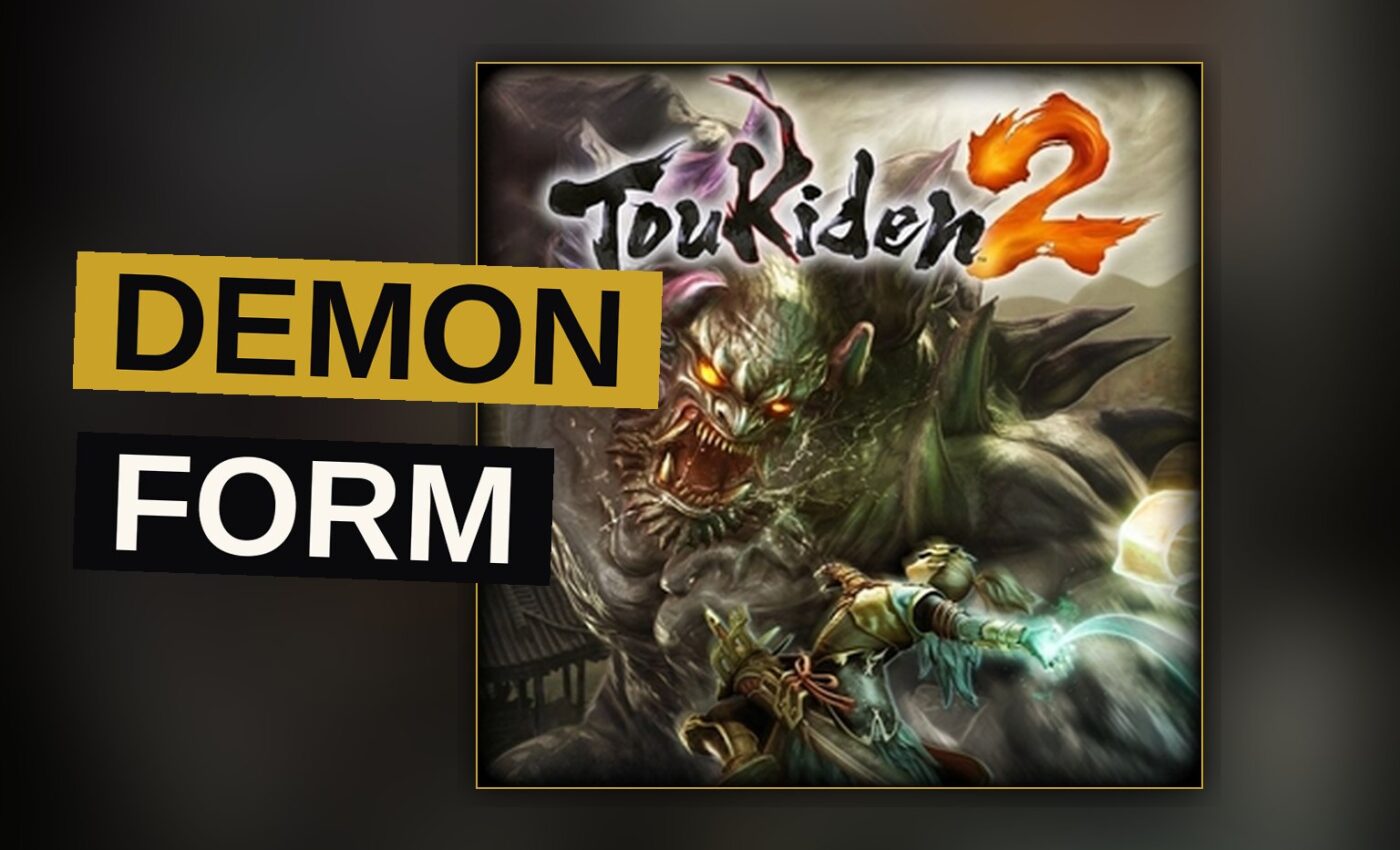
Toukiden 2 opens with a Slayer who has slept for ten years. The world that greets them is dark, rifted, and crawling with Oni. Omega Force built that premise into a hunting action game for PlayStation 3, PlayStation 4, PlayStation Vita and PC in 2016, published by Koei Tecmo. It is the sequel to Toukiden: The Age of Demons, and it moves the series into an open world for the first time. A decade after release, the game still reads as a hunting action title with one strong new idea and a lot of older machinery bolted around it.
The IGDB critic aggregate, drawn from 13 outlets, puts Toukiden 2 at 7.5/10.
Trailer, via IGDBcom.
A Slayer Wakes After Ten Years
The setup is the series’ most interesting. Players take the role of a mysterious Slayer who wakes from a ten-year slumber to find the world shrouded in darkness. The Slayers, a secret clan trained to destroy supernatural threats before they can consume the world, are the same warriors established in Toukiden: The Age of Demons. What changed is the Awakening — an event that tore rifts in space and time, pulled back places that had vanished from the world, and released swarms of Oni that hunt humans without pause.
That is a better hook than most hunting games bother with. The ten-year gap gives the player a reason to feel out of place in their own hub, and the rifts give Omega Force license to drop whatever terrain it wants onto the map. The game’s setting sits two years after Kiwami. Koei Tecmo also published an anime short as a prequel, animated by Studio 4°C and directed by Takahiro Tanaka.
Mahoroba Village Becomes the Base
Mahoroba Village is the new primary hub, and it runs on a day and night system. It is the anchor for everything that happens between hunts, and it is where the open world structure pays off most clearly. The world map is not fully open from the start. Sections stay locked until the player advances the main story, and destinations get marked when requests are fulfilled. That gating is a sensible choice for a hunting game, even if it means the “open world” label oversells the freedom early on.
Scattered chests across the map hold the protagonist’s spare inventory and setups, which cuts down on trips back to town. Players can also raise multiple Tenko, name them, and — if they are well cared for — the creatures will occasionally find items and follow the protagonist around.
It is a small system. It is also the kind of small system that makes a hub feel inhabited rather than functional.
The Demon Hand Changes How Fights Start
Combat in Toukiden 2 is built on seamless encounters that can happen anywhere in the field. The headline addition is the Demon Hand, a secondary tool for travel and combat that hooks onto objects or minor demons to close distance fast or destroy obstacles. Against giant demons it does three things: it stuns them, it locks onto a specific body part, or it obliterates a body part outright.
The Demon Hand is the best thing in the game. Part of that is the targeted destruction it enables, which turns a standard giant-monster fight into a question of which limb you take off first and when. Part of it is that the same tool that rips a demon apart also lets you swing across the terrain. On Vita, the feature is controlled through the touchscreen. Slayers also get a new faster running ability, which matters more than it sounds in a game that now asks you to cross real distance.
Mitama, Boosts and Three Slots
Mitama return, and they carry the game’s deepest progression. Defeating Oni frees the souls of fallen heroes known as Mitama, based on Japanese historical figures, and those souls power up the character, weapons, armour and the Demon Hand.
Control is a new element in the series, and it is empowered by Mitama that specialize in summoning Oni to fight for the player. Mitama grow and develop during battles. Raising the level of a Boost requires meeting that Boost’s upgrade conditions and having enough proficiency with it. The conditions differ for every Mitama and every Boost. Each Mitama can learn up to nine Boosts, but only three can be equipped at once.
That three-slot limit forces a build decision before every hunt. It also means most of the nine Boosts a Mitama learns will sit unused, which is either a reason to keep hunting or a reason to feel like the game is withholding your own progress. Toukiden 2 leans toward the first reading, but not decisively.
Automatons and the Busywork Problem
Automatons deploy to scavenge items in different locations. They can come back damaged, and damaged units can be repaired or made stronger by augmenting them with various materials. Hunting grounds from earlier games return with alterations, which gives returning players something familiar to measure the new map against.
This is where Toukiden 2 starts to strain. The open world, the chests, the Tenko, the automatons and the material augmentation all add up to a lot of maintenance between fights. Some of it feeds back into combat. Some of it is just inventory. The game rarely makes clear which is which, and the result is a hunting loop that occasionally feels like it is asking for bookkeeping rather than skill.
Slayers! Go forth and eradicate the Oni menace!
The line is the series’ own pitch, and it sets the tone the game is reaching for.
What the Open World Actually Buys
The shift to open world is the change most likely to divide people who played The Age of Demons. What it buys is real: seamless encounters, a hub with a day and night cycle, terrain that the rifts justify, and a Demon Hand that turns traversal into a tool rather than a menu. What it costs is focus. Toukiden 2 trades some of the older games’ tightness for scale, and the trade does not always come out even.
The PlayStation Vita version is the one to think hardest about. Touchscreen control for the Demon Hand is a workable compromise on a handheld, but it is a compromise. The PlayStation 4 and PC versions are the ones most players will reach for, and the PlayStation 3 version rounds out the platform list.
None of this is fatal. The Demon Hand, the Mitama Boost system and the ten-year-slumber premise are three real ideas, and two of them land. The third — the open world — lands partially, which is roughly the story of the whole game.
What the Aggregate Says About Toukiden 2
Toukiden 2 is a sequel that knows what it wants to add and is less sure what to cut. The Demon Hand is the strongest new mechanic in the game, and the Mitama Boost system gives the collection loop genuine weight through its three-slot limit. Mahoroba Village and the day and night cycle make the hub feel like a place rather than a staging screen. The anime prequel from Studio 4°C and director Takahiro Tanaka shows Koei Tecmo was willing to spend on the fiction, and the fiction holds up.
What holds it back is everything around the edges. The locked map sections, the automaton repairs, the scattered chests and the material augmentation add up to maintenance that competes with the hunting. The open world is a real expansion of the series’ reach, but it is not yet a real improvement on its focus. Players who want a hunting game with more room to move will find plenty here. Players who wanted The Age of Demons with sharper teeth will find the teeth, and then a lot of paperwork attached to them.
The score reflects that split. Toukiden 2 is a good game with one excellent mechanic and a structure that has not finished settling. It is worth playing for the Demon Hand alone, and worth patience for the rest.
Get the Notebook.
The day's best stories and every fresh verdict, in plain English, in your inbox by seven. One email a day, no more.