
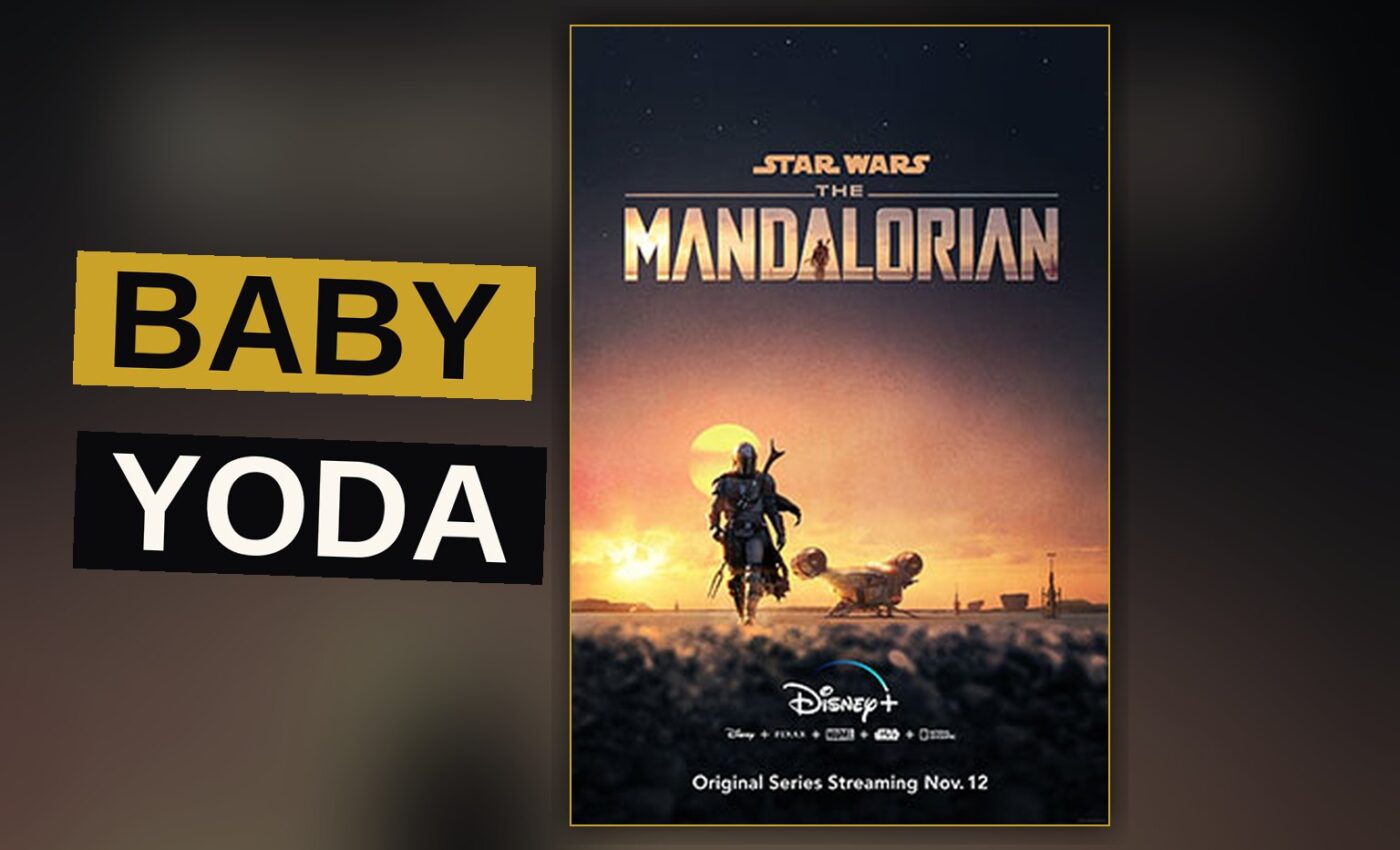
The Mandalorian arrived on Disney+ on November 12, 2019, the same day the service switched on, and it carried a load no other show on the platform had to carry. It was the first live-action Star Wars series ever made. It was the reason a lot of people signed up. And it starred a man whose face stays under a helmet for most of the running time, next to a puppet.
It works. Mostly. The Mandalorian runs three seasons and 24 episodes, from November 2019 to April 2023, and at its best it is the cleanest piece of Star Wars storytelling in decades. At its weakest it is a show that mistakes a very good visual effect for a story. We score it 7.0 out of 10.
Trailer, via Star Wars.
A lone gunfighter and the child Grogu
Jon Favreau created the series and served as writer and showrunner, signing on in March 2018. He executive produces with Dave Filoni, Kathleen Kennedy and Colin Wilson; Rick Famuyiwa joined that group for the third season. The premise is spare by design. Five years after the events of Return of the Jedi and the fall of the Galactic Empire, lawlessness has spread through the galaxy. Din Djarin, a Mandalorian bounty hunter, works the outer reaches for pay.
He is hired by Imperial remnant forces to retrieve a child. He does not hand the child over. He goes on the run to protect him. That is the engine of the whole series, and it is enough.
The child is Grogu, an infant of the same species as Yoda, built from animatronics and puppetry and augmented with visual effects. Viewers called him Baby Yoda long before the show gave him a name in “Chapter 13: The Jedi.” The character’s real name, Din Djarin, does not arrive until “Chapter 8: Redemption” — though Pedro Pascal let it slip in November 2019, ahead of schedule.
Pedro Pascal under the helmet
Pascal stars as the title character. He compared Djarin to Clint Eastwood, describing a lone bounty hunter with advanced combat skills and, in his words, “questionable moral character.” Favreau called Pascal “a classic movie star” who “had the presence and skill[s]” to hold a role largely hidden under a helmet.
That is the central bet of The Mandalorian, and it pays off more often than it should. Pascal records the character’s dialogue later, working with Favreau and Filoni, and the voice does the work the face cannot. He is also not always the body in the armor: stunt doubles Brendan Wayne and Lateef Crowder portray the Mandalorian, with Barry Lowin also credited in that work.
Pascal has said he initially thought he was being cast as Boba Fett, because the two characters look alike. They are not the same person. That confusion is a fair summary of how the show operates — it trades on recognition and then asks you to care about someone new.
He is hired by Imperial remnant forces to retrieve the child Grogu, but instead goes on the run to protect the infant.
Greef Karga, Kuiil and the Armorer
The first season builds a real supporting cast. Carl Weathers plays Greef Karga, leader of a bounty hunter guild. Werner Herzog plays the Client, an enigmatic man whose motives stay cloudy. Omid Abtahi is Dr. Penn Pershing, a scientist in the Client’s employ. Nick Nolte voices Kuiil, an Ugnaught moisture farmer who helps the Mandalorian. Taika Waititi voices IG-11, a bounty hunter droid. Emily Swallow is the Armorer, who forges armor and equipment from beskar steel.
Giancarlo Esposito plays Moff Gideon, a former Imperial officer who wants Grogu for his connection to the Force. That is the show’s cleanest piece of casting. Esposito plays menace without raising his voice, and he gives the series a face to chase.
Season two widens the frame. Timothy Olyphant appears as Cobb Vanth. Temuera Morrison returns as Boba Fett. Katee Sackhoff plays Bo-Katan Kryze, and she co-stars in the third season. Rosario Dawson is Ahsoka Tano. Mark Hamill appears as Luke Skywalker. Amy Sedaris returns as Peli Motto, and Weathers, Esposito, Abtahi and Gina Carano all come back.
Cara Dune and the Carano exit
Carano played Cara Dune, a former Rebel shock trooper turned mercenary, across the first two seasons. In February 2021, Lucasfilm said she was no longer employed by the company. The statement followed a social media post in which Carano compared being a Republican in the United States to the treatment of Jewish people during the Holocaust. Lucasfilm called the post “abhorrent and unacceptable.”
Carano had been warned repeatedly about her social media posts, and executives had reportedly been looking for a reason to dismiss her for two months. The February 2021 posts were described as the final straw, and the decision was made by Lucasfilm executives rather than by Favreau. Then-Disney CEO Bob Chapek said she was fired because her posts did not align with Disney’s values, which he called “universal” and not political. The Hollywood Reporter reported that the role was not expected to be recast, though industry insiders thought that remained possible for story and merchandising reasons.
The show lost a character and kept going. That is the correct call and also the honest one.
StageCraft and the 360-degree wall
Industrial Light & Magic built the StageCraft technology for The Mandalorian, displaying digital backgrounds on a 360-degree video wall. Filming began in October 2018 at Manhattan Beach Studios in California, when the title was announced. The system has since been adopted by other film and television productions.
This is the part of the show that changed the industry. It lets actors see the world they are standing in, and it shows. The outer reaches look like places rather than backdrops. George Lucas had begun developing a live-action Star Wars series by 2009, but it was deemed too expensive to produce. He sold Lucasfilm to Disney in October 2012, and work on a new series began for Disney+.
The schedule the show kept
| Season | Episodes | Release window |
|---|---|---|
| Season 1 | 8 | November 12 – December 27, 2019 |
| Season 2 | 8 | October – December 2020 |
| Season 3 | 8 | through April 19, 2023 |
The first season premiered with the launch of Disney+ on November 12, 2019, and the rest of the season ran through December 27. The second season ran from October to December 2020. The third season closed on April 19, 2023.
That is three seasons in three and a half years, with a long gap between the second and third. The wait mattered. The third season sends Djarin and Grogu to Mandalore so Djarin can redeem himself for the transgression of removing his helmet — a rule the show spent two seasons treating as sacred and then had to build a season around.
What holds and what slips
The helmet rule is the clearest example of the show’s problem. It is a strong idea in season one, a complication in season two, and a plot engine in season three that the series has to keep feeding. The redemption arc is thin. The show is better at the lone gunfighter than at the institution he belongs to.
The Mandalorian works best when it is episodic — a job, a stranger, a fight, a departure. It works least when it is asked to carry the weight of the wider Star Wars franchise, which it increasingly is. Bringing in Ahsoka Tano, Boba Fett and Luke Skywalker gives the series a sugar rush and takes something away. The show’s own characters are the reason to stay.
Grogu is the exception, and the reason the series broke through. A puppet with visual effects should not carry a flagship streaming show. He does, because the show treats him as a person with a will rather than a mascot, and because the Mandalorian’s decision to protect him is made early and never re-litigated.
Pascal is the other reason. He plays a man who says little and means all of it. The comparison to Eastwood is not marketing; it is a working method, and it survives a helmet, a stunt double and a digital wall.
The score is 7.0 out of 10. The Mandalorian is the best argument Disney+ had in 2019 and still one of the better things Star Wars has made. It is also a show that has not yet decided whether it wants to be a Western about one man or a franchise delivery system. The first is what it is good at. The second is what it keeps choosing.
Get the Notebook.
The day's best stories and every fresh verdict, in plain English, in your inbox by seven. One email a day, no more.