
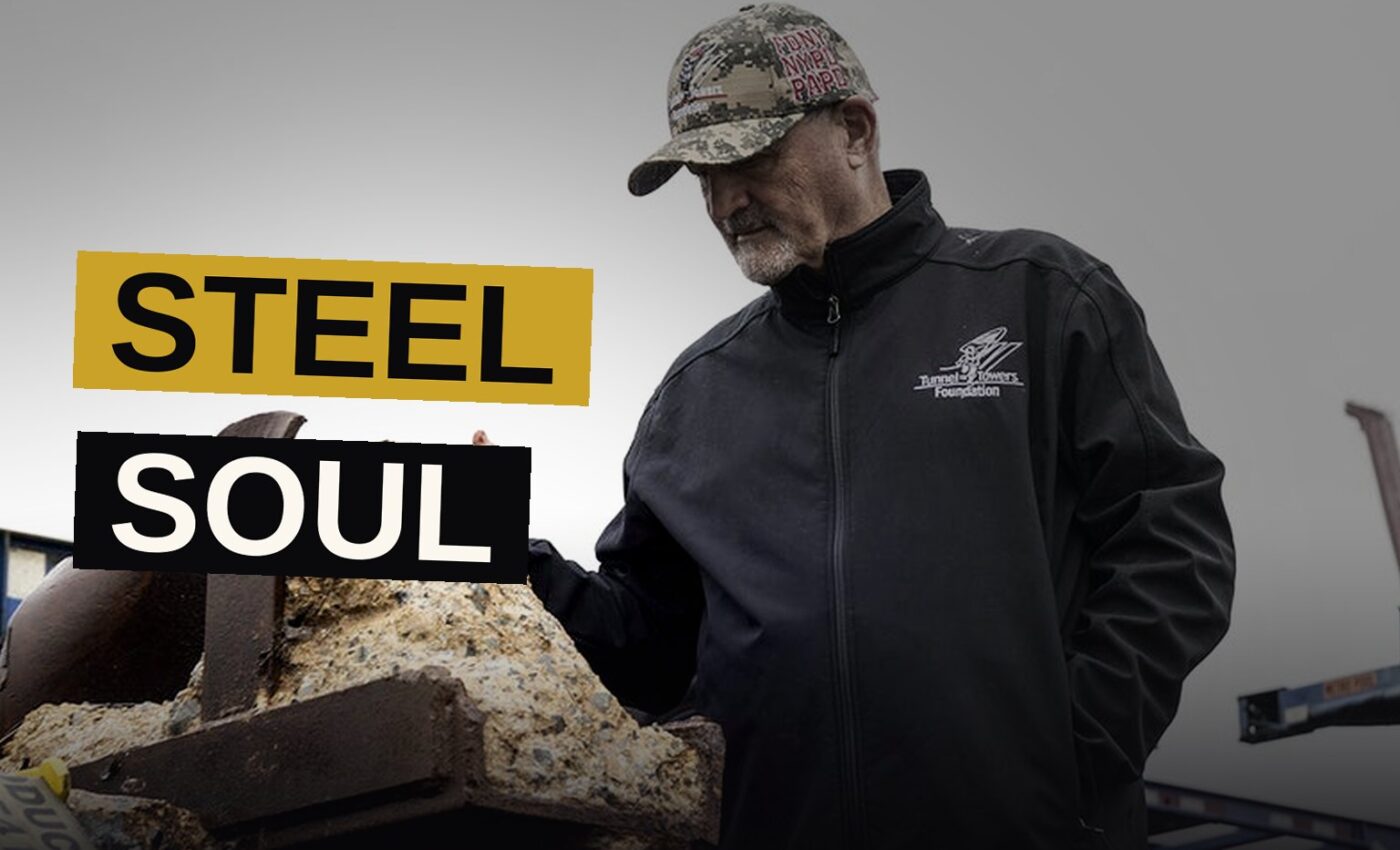
Last month, a 21-foot, 16,900-pound steel beam taken from the World Trade Center’s South Tower reached Indianapolis on a nationwide journey marking the 25th anniversary of the Sept. 11 terrorist attacks. That piece of metal stands for the roughly 3,000 civilians, firefighters, police officers, emergency workers and military personnel killed that day. It covered more than 10,500 miles across 21 states and Washington, D.C. before heading back to New York City.
On Aug. 19, the tour’s 31st stop in Indianapolis, the ceremony opened with a color guard and a Pipes and Drums procession. The Voices of the Indianapolis Fire Department sang the national anthem, followed by an invocation from Indianapolis Fire Department Chaplain Mike Gatliff. Indianapolis Fire Division Chief Tom Neal and Timothy Winslow, a retired major general who serves as executive director of the Indiana War Memorial and Museum, then spoke to the crowd about how the city’s first responders connect to veterans and the legacy of 9/11.
Steel Across America
The Tunnel to Towers Foundation is behind the tour, and its chairman and CEO, Frank Siller, has noted how strongly people have reacted to the beam. In a press release, he said, “For the past four months, communities across the country have welcomed this sacred piece of American history with incredible emotion.” He added, “Watching people stand in front of that steel, hugging it, praying over it, weeping, reminds me every single day of why we do this work.”
Jack Kielty, an FDNY lieutenant who sits on the board of the Tunnel to Towers Foundation, spoke highly of the Indianapolis visit. He said that bringing the steel to a museum that has stood for more than a century as a memorial to American sacrifice was deeply moving. He added that Indiana veterans and first responders know what it means to serve.
The Indiana ceremony honored its own dead as well. Nine residents of the state perished on Sept. 11, while Indianapolis Task Force One deployed rescuers to Ground Zero. The memorial notes that six members of the team later died from illnesses tied to their work in the toxic environment.
The Beam’s Weight
A Marine Corps veteran and Tunnel to Towers recipient named Scott Nokes addressed the crowd about why letting people see the steel in person matters. He pointed out that among the 2,977 lives lost, over 1,000 bodies were never recovered from Ground Zero in New York. “Their souls are in that steel, and if you touch it, you feel it,” he said.
One purpose of the foundation’s tour is to link younger Americans with an occasion that many did not live through or were simply not around for. Nokes stated that viewing the item in person provides a bond that no book or documentary can match.
“Their souls are in that steel, and if you touch it, you feel it.”
After visiting Indianapolis, the tour made a stop at the Cincinnati Fire Museum. The remaining stops on the schedule take in West Point, Boston and Washington, D.C., before the steel heads back to New York City.
A Final Run Through the Tunnel
On Sept. 11, Frank Siller and members of the Siller family will bring the steel back to New York City by carrying it through the Brooklyn-Battery Tunnel. The route mirrors the one Stephen Siller followed 25 years ago, having strapped 60 pounds of gear to his back before running toward the World Trade Center.
While the steel will join the procession as it passes through the tunnel, it will neither enter nor come to a halt at the World Trade Center site.
Why Indianapolis Matters
The visit to Indianapolis stood out due to the city’s direct connection to the attacks. Nine residents of Indiana lost their lives on Sept. 11, and Indianapolis Task Force One dispatched rescue workers to Ground Zero. Six members of that team later died from ailments tied to their exposure in the poisonous setting, as reported by the Indiana War Memorial.
During the ceremony, the contributions of first responders and veterans in Indianapolis were recognized. Division Chief Tom Neal and Timothy Winslow each addressed the bond between the city’s first responders, veterans and the legacy of 9/11.
The steel carries the souls of the 1,000 bodies never recovered from Ground Zero, according to Nokes’ remarks.
The Tour’s Final Leg
The closing leg of the journey includes a stop in Cincinnati, followed by West Point, Boston and Washington, D.C., with the steel making its way back to New York City on Sept. 11.
A procession through the Brooklyn-Battery Tunnel marks the conclusion of a trip that has carried the beam across 21 states and Washington, D.C. The route follows the path that Stephen Siller traveled 25 years ago, running toward the World Trade Center with 60 pounds of equipment strapped to his back.
The foundation continues its efforts beyond the tour itself, aiming to keep younger Americans engaged with the events of Sept. 11. The tour has served as one means of achieving that connection.
The gathering in Indianapolis demonstrated how a community can unite behind a single piece of steel. The color guards, the Pipes and Drums, and a rendition of the national anthem delivered by the Indianapolis Fire Department — none of these elements exist merely as ceremonial duties. Instead, they serve as means of bringing back the memory of 9/11, of allowing people to face the steel and grasp what it represents.
On Sept. 11, the beam will make its way back to New York City, following the route that Stephen Siller traveled 25 years ago. The last leg through the Brooklyn-Battery Tunnel marks an appropriate conclusion to a trip that started with a recovered piece of steel and concluded with the nation recalling.