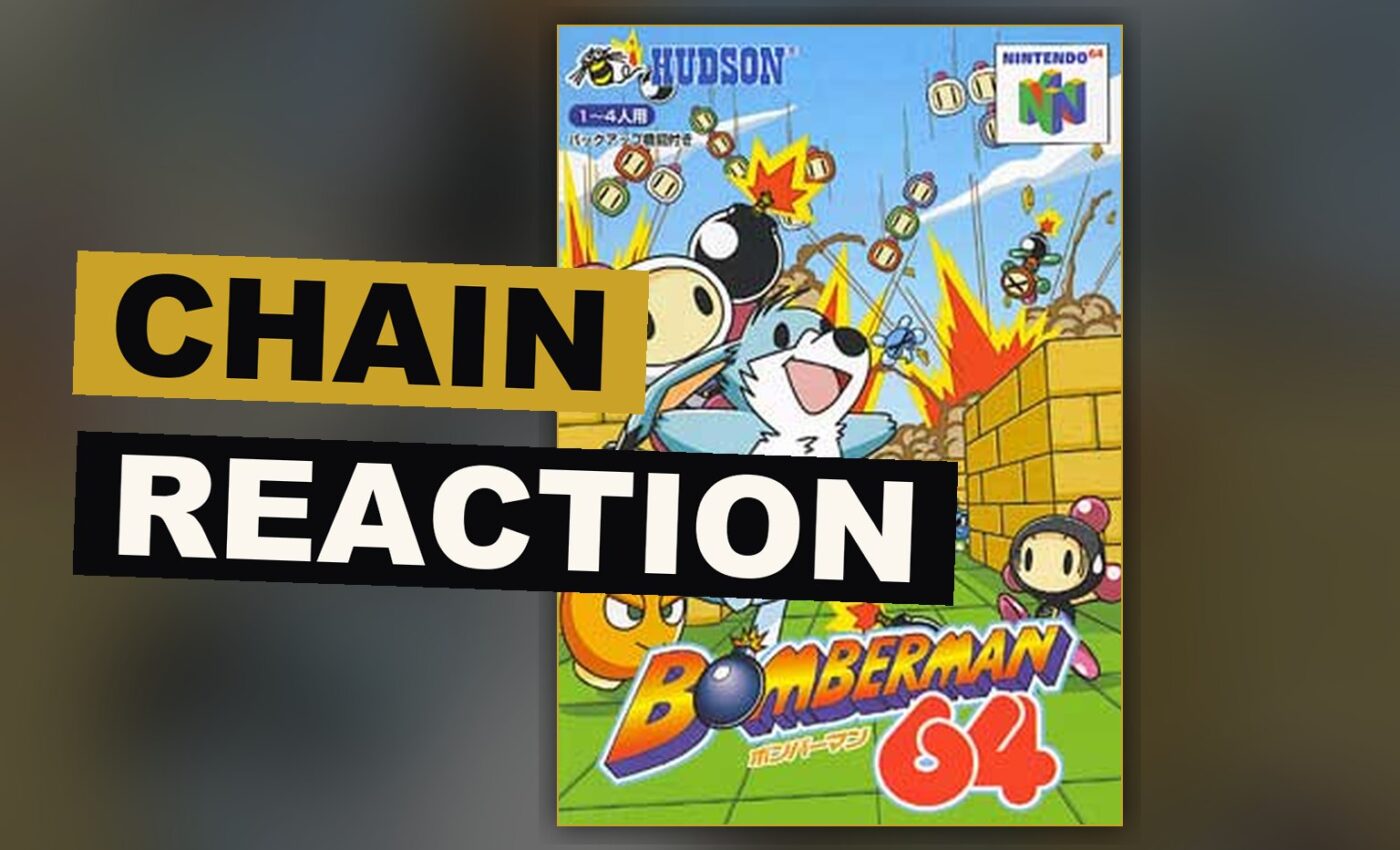
Bomberman 64 arrived on the Nintendo 64 in 2001 carrying a name that had already been spent. Hudson Soft had published a different Bomberman 64 in North America and Europe in 1997 — the first 3D entry in the series, released as Baku Bomberman in Japan. That game reached the Wii U Virtual Console in March 2017 in Europe and North America, then Japan in June 2017. It never came to the original Wii’s Virtual Console. The 2001 Bomberman 64, developed by Racjin and published by Hudson Soft, is a 2D game. It is also the last Nintendo 64 title ever released in Japan.
That distinction carries more than trivia weight. The 2001 game is a farewell to the console, and it plays like one — a stripped-back, single-screen Bomberman that trusts the original formula and never tries to be the 3D game sharing its name.
A Flat Grid After Four Years of Depth
The 2001 Bomberman 64 is a bird’s-eye, isometric 2D Bomberman. It supports single-player and multiplayer, and it sits in the adventure and arcade genres with an action theme. Racjin handled development; Hudson Soft published. The platforms line is just the Nintendo 64.
There is no 3D camera here, no rotating view with eight directions and three zoom levels. That was the 1997 game. The 2001 game returns to the flat grid, and for a series that had already spent years in three dimensions on this hardware, the retreat is deliberate.
Spherical Blasts and Free Bomb Throws
The 2001 game keeps the traditional Bomberman loop but alters it in ways worth naming. The bombs do not explode in the cross-shaped pattern the series had used for years. The explosion waves are spherical. That single change reshapes how you read a room. A cross leaves the diagonals safe; a sphere does not.
Bomberman can kick, pick up and throw bombs in both single-player and multiplayer without needing a power-up first. In earlier games those were upgrades. Here they are default tools.
There is also a pump mechanic. Bomberman can hold a bomb and pump it, which makes the explosion more powerful. Once a bomb is pumped, it cannot be kicked or picked up again. That is a commitment, and it forces a decision every time you hold one.
Bomb Jumping Replaces the Jump Button
Bomberman cannot jump in this game. He also cannot swim, though he can wade through shallow water. Since he cannot jump, higher ground with no path to it must be reached by bouncing across bombs. That usually requires the remote power-up so the bombs do not explode on their normal timer before you finish crossing.
Bomb jumping is not optional decoration. It is required to fully explore most levels, to retrieve certain power-ups, and to cross many obstacles. A game that removes jumping and then builds its level design around the absence is making a statement about what Bomberman is.
Dizzy, Hoisted and Thrown Off the Map
Combat has a physical comedy to it. If Bomberman runs into an enemy NPC, or takes a small object on the head — an unexploded bomb, for instance — he becomes temporarily dizzy. In that state an enemy can hoist him up and throw him around, or finish him by throwing him off the map or into a bomb explosion. Bomberman can do the same to an enemy.
Damage normally kills him. If he is carrying a heart power-up when he is hit, he survives, but he loses the heart. Taking damage makes him drop it. If the heart does not bounce off the level, he can pick it up again.
Artemis, Altair and the Omni Cube
The opening sequence shows a peaceful planet with gardens, rivers and residential buildings. That planet is Blue Resort. Then the space pirate Artemis drops from the sky with a band of soldiers and raids it. Altair, leader of the space pirates, watches from the Black Fortress and uses his coveted weapon, the Omni Cube, to drain the planet’s energy completely, leaving it in a zombie-like state.
Artemis returns to the Black Fortress and meets her partners, Orion and Regulus, and her superior, Altair. They set their sights on Planet Bomber, home of Bomberman. They move the fortress into the atmosphere. Bomberman watches the descent from a cliff. The fortress opens fire on populated areas with destructive energy rays.
A warrior in white flies out to him and asks if he plans to defeat the assailants. Bomberman says yes. The stranger, later introduced as Sirius, explains that a force field protects the fortress from outside attack. It can be deactivated by destroying four anchors:
- Green Garden, a ruin-filled natural world
- Blue Resort, a fortress surrounded by water
- Red Mountain, a large volcano fraught with danger
- White Glacier, a large snowy mountain covered in ice
Once inside the fortress, the goal is to find and destroy Altair. Bomberman climbs onto and destroys all four anchors with Sirius supplying power-ups and teaching him new techniques. Along the way he kills Artemis and Orion.
Four Anchors Give the Campaign a Spine
Four anchors, four distinct worlds, one fortress. That is a clean spine for a game that has to hold a player across a full campaign on aging hardware. Green Garden, Blue Resort, Red Mountain and White Glacier are not interchangeable backdrops — a ruin world, a water fortress, a volcano and an ice mountain each push the spherical blast radius and the bomb-jumping traversal in different directions.
Sirius is a smart piece of design. He supplies power-ups and teaches techniques, which means the game can introduce its own unusual rules — pumping, bomb jumping, the loss of jumping — through a character rather than a tutorial screen. The story gives the mechanics a reason to exist.
A Late Arrival With a Borrowed Name
The 2001 game is the fourth Bomberman on the Nintendo 64. The first was the 1997 Bomberman 64, followed by Bomberman Hero in 1998 and Bomberman 64: The Second Attack in 2000. By the time this one arrived, the console was finished. Being the last N64 game released in Japan is a distinction, but it is also a sign of timing. This is a game arriving after its platform’s audience has moved on.
The name does it no favors either. Calling a 2D game Bomberman 64 in a market that already knows a 3D game by that title invites confusion, and the confusion is permanent. The 1997 game is the one people remember, the one that got the Wii U Virtual Console release in March 2017 in Europe and North America and in June 2017 in Japan. The 2001 game is the one that gets explained.
The mechanics themselves are a mixed bag. Removing jumping and rebuilding traversal around bomb bouncing is bold, but it also means the remote power-up becomes close to mandatory for full exploration. A design that leans that hard on one item is a design with a bottleneck. The pump mechanic is the better idea — it adds a real cost to powering up a bomb, since a pumped bomb cannot be kicked or picked up again.
What This One Is Worth
Bomberman 64 on the Nintendo 64 is a competent, traditional Bomberman that chose the flat grid over the 3D experiment that preceded it, and in this paper’s view it mostly works. The spherical explosions, the default kick-throw-pickup set, the pump mechanic and the bomb-jumping traversal give it a distinct feel within its own series. The four anchors give it structure, and Sirius gives it a way to teach without lecturing.
It is not the Bomberman 64 most people mean. It is the last one the Nintendo 64 ever got, and in our reading it carries that weight — a small, clean, slightly late goodbye to a console that had already said most of its goodbyes. Worth playing for anyone who wants the series at its most traditional, and worth knowing about for anyone who has ever been confused by the two games sharing one name.
IMDb lists its published critical score at 6.8 of 10.
Get the Notebook.
The day's best stories and every fresh verdict, in plain English, in your inbox by seven. One email a day, no more.