
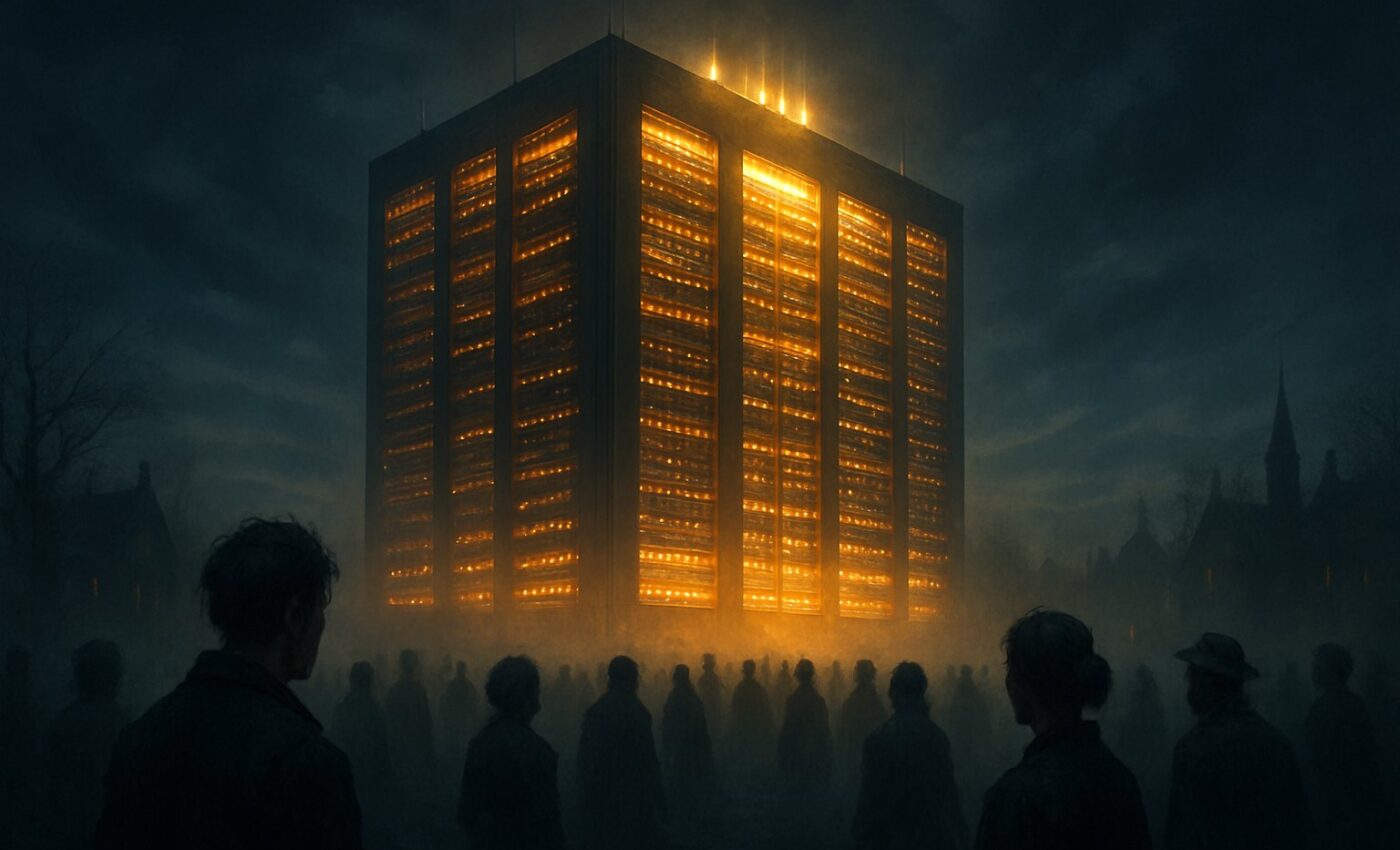
There is a season, my dear readers, for every species of vexation, and the present season belongs wholly to those vast, humming edifices men call data centers. The generality of souls despises them with a passion scarcely to be doubted—yet the defenders of these edifices, rather than confessing the plain and dreadful reasons for such loathing, have discovered a more convenient villain to name. It is, one must confess, a most cheap and ready object of blame.
A Melancholy Turn
The temper of the people has darkened yet further. Where once but 42 in a hundred souls professed opposition to a data center rising near their dwelling, now some 75 in a hundred voice the same dread. Politicians who formerly sang the praises of this infrastructure—Governor Greg Abbott of Texas, Governor Josh Shapiro of Pennsylvania—now turn their coats as the coming elections draw near.
They are eager to appear stern defenders against the very machines they once welcomed. Even among Republicans, that party so devoted to President Donald Trump’s ardent support of these constructions, there is a wavering plain enough to see.
The Ready Villain
Yet not all waver. Some, standing beside the great personages of the mechanical world, have seized upon an older and more wretched tale: that the Communist authorities of China are the true authors of America’s discontent. In the closing days of August, the platform once devoted to brief public messages gave word that it had found some 200 accounts, of Chinese origin, laboring to carry sentiments unfriendly to data centers unto the mass of souls.
This revelation set off a great tumult of alarming headlines, Axios among them, declaring with much drama that “China is quietly stirring America’s data center rage.” This word was seized upon with haste by politicians and partisans favorable to the infrastructure, who carried it forth—with no apparent irony—upon the very platform that had made the accusation.
Even the President himself could not withstand the temptation, writing upon his own Truth Social that “China could not be happier with this unfriendly Data Center feeling,” and calling, in the same dark breath, for Americans to “let Data Reign.” One wonders whether Truth or Data occupies the higher throne in such speeches.
A Device of Excuses
Here WIRED’s own Molly Taft, writing in the maiden edition of a new weekly column titled Power Play, offers a most sober account of this fevered tale. With correspondent Hugo and business writer Max Zeff at her side, Taft has undertaken to examine this matter through the autumn and into the coming elections. A livestream is promised for the tenth of September, wherein readers may pose their own inquiries.
The notion that ordinary Americans despise these vast machines chiefly on account of some shadowy foreign scheme—rather than genuine dread of ruin to land and air, resentment of a system too friendly to the wealthy few, or plain trouble before the rising tide of artificial intelligence—serves as a most convenient shield for the machines’ defenders.
This tale has circulated for months already. In the spring, certain conservative houses of learning issued reports pointing an accusing finger at the Communist Party, reports which men of government and men of opinion seized upon with excessive haste. In June, OpenAI itself cast out a company of users believed linked to the Chinese government, declaring they had been “testing narratives against AI infrastructure.”
Proof Thin as Shadow
Yet when one examines the foundations of these claims, they prove exceedingly weak. Those learned in Chinese affairs, consulted earlier this year, found the report most spoken of, circulating through Washington, to rest upon insinuation and idle fancy rather than any solid proof.
Even OpenAI, in its own June account, was compelled to admit that the company it discovered offered little certainty of the grand conspiracy so many wished to believe in.
Thus we arrive at a curious and rather dreadful truth: it is far more convenient to blame a distant and mysterious adversary than to face honestly one’s own machines, one’s own government, and one’s own discontented neighbors. The bogeyman of China persists not because the proof commands it, but because the alternative—admitting that Americans simply dislike what data centers bring to their very neighborhoods—proves altogether too bitter a draft to swallow.
Get the Notebook.
The day's best stories and every fresh verdict, in plain English, in your inbox by seven. One email a day, no more.