
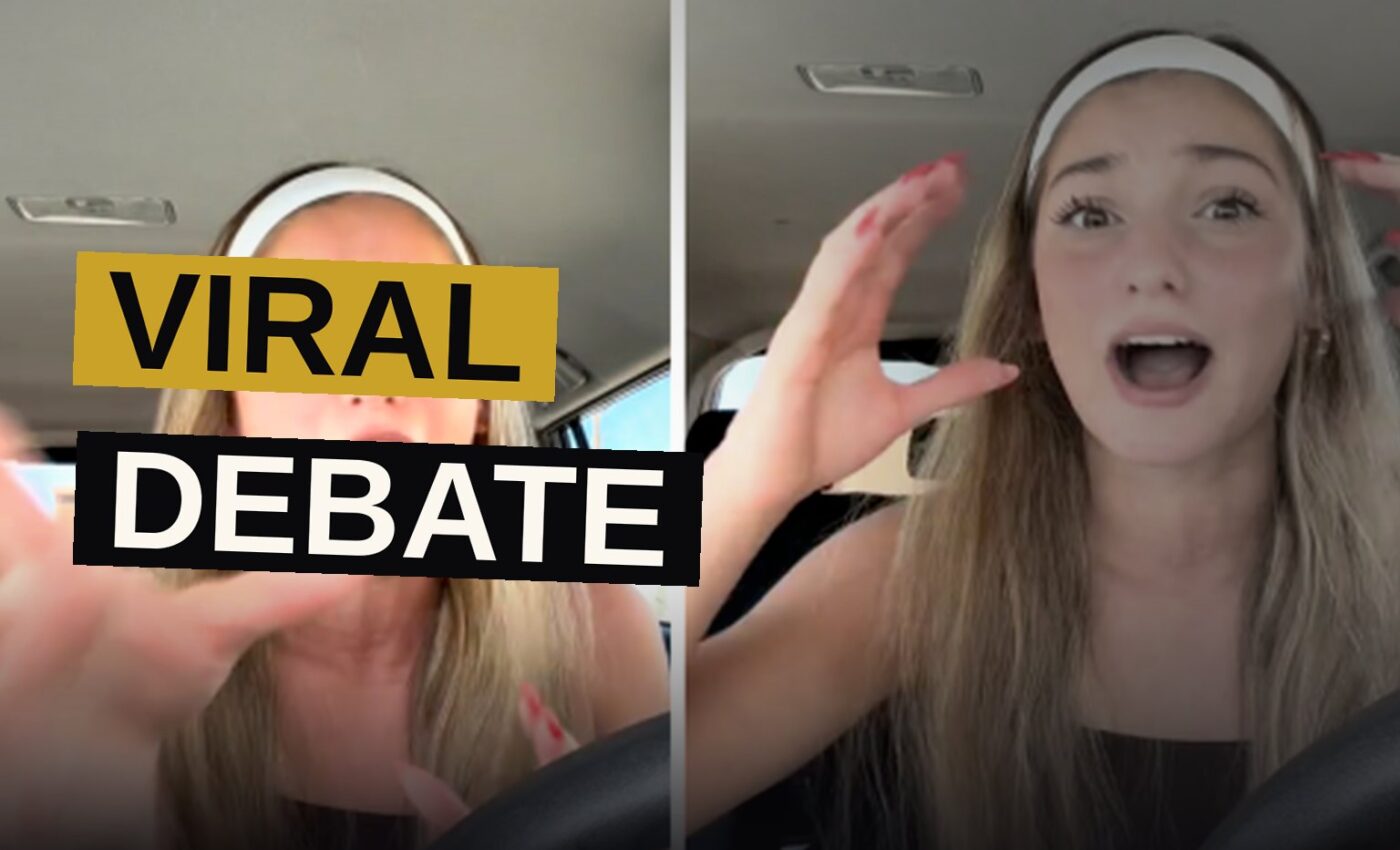
A viral TikTok video is drawing attention to the pressure young girls feel to stay quiet online. User @gemma.moro posted a clip describing an interaction she witnessed between two teenagers on Snapchat, and it has sparked a wide debate about gender, humor, and social media.
The video has received more than 286,000 views and 389 comments.
A Reluctant Post on Snapchat
According to Gemma, she recently saw two girls who appeared to be around 14 or 15 using the app. One of the girls wrote a joke that made both of them laugh. The other girl then suggested posting it to her private story.
The first girl declined.
Gemma said the girl explained, “No, I can’t post that on my story. I don’t really post things with words on my story. People will think I’m weird.”
That single sentence became the core of Gemma’s argument. She does not blame the girls for their caution. Instead, she points to societal expectations that make young women insecure about how they present themselves.
Stigma and the Comedy Gap
Gemma’s main point is that girls are penalized for behavior that boys get away with. She described a stigma that labels girls as “weird” or “less feminine” if they are too funny, too loud, or too much.
“It sucks that we live in a world where girls are too afraid to come off as funny or loud or too much because there’s this stigma that if girls say something a little too out of pocket they’re automatically deemed as weird or less feminine,” she said in the video.
Gemma argued that this stigma is a major reason why comedy remains male-dominated. She said women are frequently criticized for making jokes, while men can make offensive jokes publicly without facing the same level of scrutiny.
She went further, claiming that even successful female comedians face relentless online attacks.
“There isn’t a single famous female comedian in any media space right now that I haven’t seen people online either criticize for her looks or hyper-sexualize,” she said.
Commenters Split on the Meaning
The comment section under Gemma’s video turned into a broader discussion about social media, adolescence, and the rules young people feel they must follow.
One commenter wrote, “That’s crazy. We’re really in the next stage of anti-intellectualism, and it’s taken its full form through misogyny.”
Another commenter supported Gemma’s view, writing, “I hate that people think they can’t do what they want just because someone who’s not you said so. if what you’re doing isn’t directly harmful to anyone else or yourself it shouldn’t matter what you do.”
Not everyone agreed with the initial interpretation. One user offered a different angle, writing, “Ok counter point, what if she thinks people who put words on stories are weird no matter the gender? Like she sees that in other people so are afraid others will see it in herself. Idk just what came to mind.”
Another commenter took a simpler stance, writing, “Out of pocket girls are the best. I don’t care what anyone says.”
An Unverified Account
The story is entirely based on Gemma’s account. The Daily Dot could not independently verify the circumstances she described. The identities and ages of the girls mentioned in the video have not been confirmed.
The interaction is presented solely through Gemma’s retelling on TikTok. The discussion that followed reflects the opinions and experiences of the commenters, not necessarily the reality of what happened between the two girls.
Fear of Being Judged
Insecurities are a common part of adolescence. Social media adds a new layer to that process, because every post is a public performance.
The specific concern here is about self-presentation. The girl in the story was not worried about being mean or offensive. She was worried about being perceived as strange.
She was not afraid of hurting someone. She was afraid of being judged.
Gemma’s argument is that this fear is not natural. It is learned. Girls are taught, through countless small signals, that taking up too much space is a risk. Being funny is a risk. Being loud is a risk.
Men, she argues, do not face the same calculation.
A Claim About Female Comedians
Gemma’s claim about female comedians is a strong one. She said there is no famous female comedian in any media space who has not been criticized for her looks or hyper-sexualized online.
That is a broad statement. It covers stand-up, sketch comedy, film, and television. It covers established stars and rising talents.
The claim is difficult to prove. It remains Gemma’s argument, not an established pattern.
One Anecdote, Wider Questions
This is one anecdote. Gemma saw two girls on Snapchat and heard one of them decline to post a joke. That is the entire factual basis of the video.
The broader claims about comedy, gender, and society are interpretations. They may be correct, but they are not proven by this single interaction.
The response to the video is real. The numbers are real. The video has more than 286,000 views and 389 comments.
Those people are not responding to verified facts. They are responding to a story that feels true to them.
That is the power of the video. It captures a moment that many people recognize from their own lives.
Key Facts
- Platform: TikTok
- Poster: @gemma.moro
- Views: More than 286,000
- Comments: 389
- Subject: Two girls, estimated ages 14-15, on Snapchat
- Verification: The Daily Dot could not independently verify the events described
Discussion Timeline
| Element | Detail |
|---|---|
| Video posted by | @gemma.moro |
| Platform | TikTok |
| Reported interaction | Snapchat, private story |
| Key quote | “People will think I’m weird.” |
| Main argument | Double standard for women and men in comedy |
| Verification status | Not independently confirmed |
The debate is unlikely to end soon. Social media is a permanent part of teenage life, and the pressures that come with it are not going away. Videos like Gemma’s will keep appearing, and commenters will keep arguing about what they mean.
The girl in the video made a choice. Whether that choice was about gender pressure, personal preference, or something else entirely is not something anyone can verify from Gemma’s account alone. But the fact that she felt she had to make it at all is what Gemma is asking people to notice.
Source: dailydot.com
Get the Notebook.
The day's best stories and every fresh verdict, in plain English, in your inbox by seven. One email a day, no more.