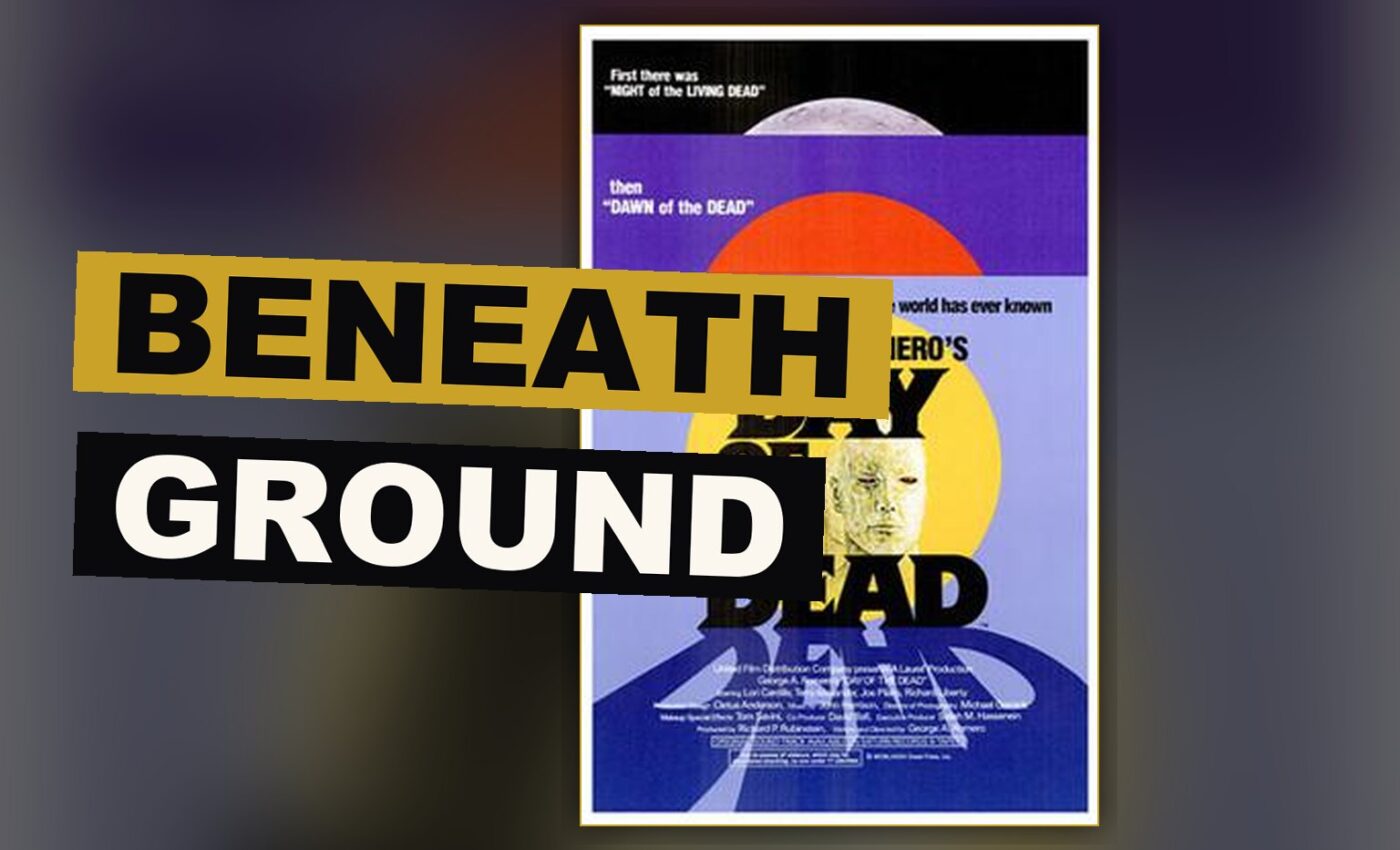
Day of the Dead closed out George A. Romero’s run of films about the dead, a movie set almost entirely beneath the surface, where a shrinking band of people argues over what to do next while the world above falls into ruin. It is the darkest chapter in the series. It offers less relief than the two films that came before it, and it makes that darkness the point.
A Setting Beneath the Surface
Most of Day of the Dead takes place in a facility beneath the surface, where a small group of soldiers and researchers holds out. The setting choice shuts the characters in with each other, and the audience along with them. There is no outside to cut away to, no wider view of the crisis, only halls and rooms and mounting fear between the people confined inside them.
The soldiers want control. The researchers want answers. Neither side gets what it wants, and Romero lets that quarrel turn into something closer to dread than action.
The Question of the Dead
The film’s most striking creation is one of the dead, held and studied by the researchers to test how much of a person might remain after death. He reacts to music, to a blade, to small acts of kindness, and the film asks whether that reaction counts as a mind or just an empty reflection. Romero does not answer the question. He lets it sit next to the human characters, who by comparison often act worse than the dead around them.
The gore effects are extreme even by the standards of the earlier films. Bodies are torn apart on screen in detail that was startling when the film first came out and still carries weight now.
Performances and Pace
The human cast is mixed. Some performances land as intense and desperate; others turn into loud arguing that drags the film down. The military characters in particular are drawn with a heavy hand, more interested in control than in staying alive, and the script relies on that quarrel harder than it needs to.
Pace suffers in the middle portion, where the argument between soldiers and researchers repeats itself without much forward motion. The film picks back up once order inside the facility falls apart completely.
A Rough Filming Schedule
Day of the Dead was made on a reduced budget after an earlier, larger version of the script was cut down. That limit shows in the film’s confined setting, but it also adds to the confined feeling that makes the film work.
| Stage | Focus |
|---|---|
| Writing | Script cut down from an earlier, larger draft |
| Filming | Facility scenes beneath the surface |
| Effects design | Practical gore effects work |
| Editing | Final cut and distribution |
Day of the Dead lacks the surprise of the first film and the satire of the second. What it has instead is despair, delivered without much comic relief. That makes it a harder watch than either of the films before it, and a less immediately satisfying one.
It is still an essential piece of Romero’s work on the dead.
The film’s standing has grown with time, helped by the practical effects and by the figure of the studied dead man, who remains one of the more disturbing characters in the series. Day of the Dead does not equal the second film as a complete work, but it commits fully to its own grim premise, and that devotion is worth respecting.
Day of the Dead is an imperfect but devoted close to Romero’s original run of films about the dead, mixed in its human drama but striking in its setting beneath the surface and its portrait of the studied dead man. Score: 7.1 of 10.