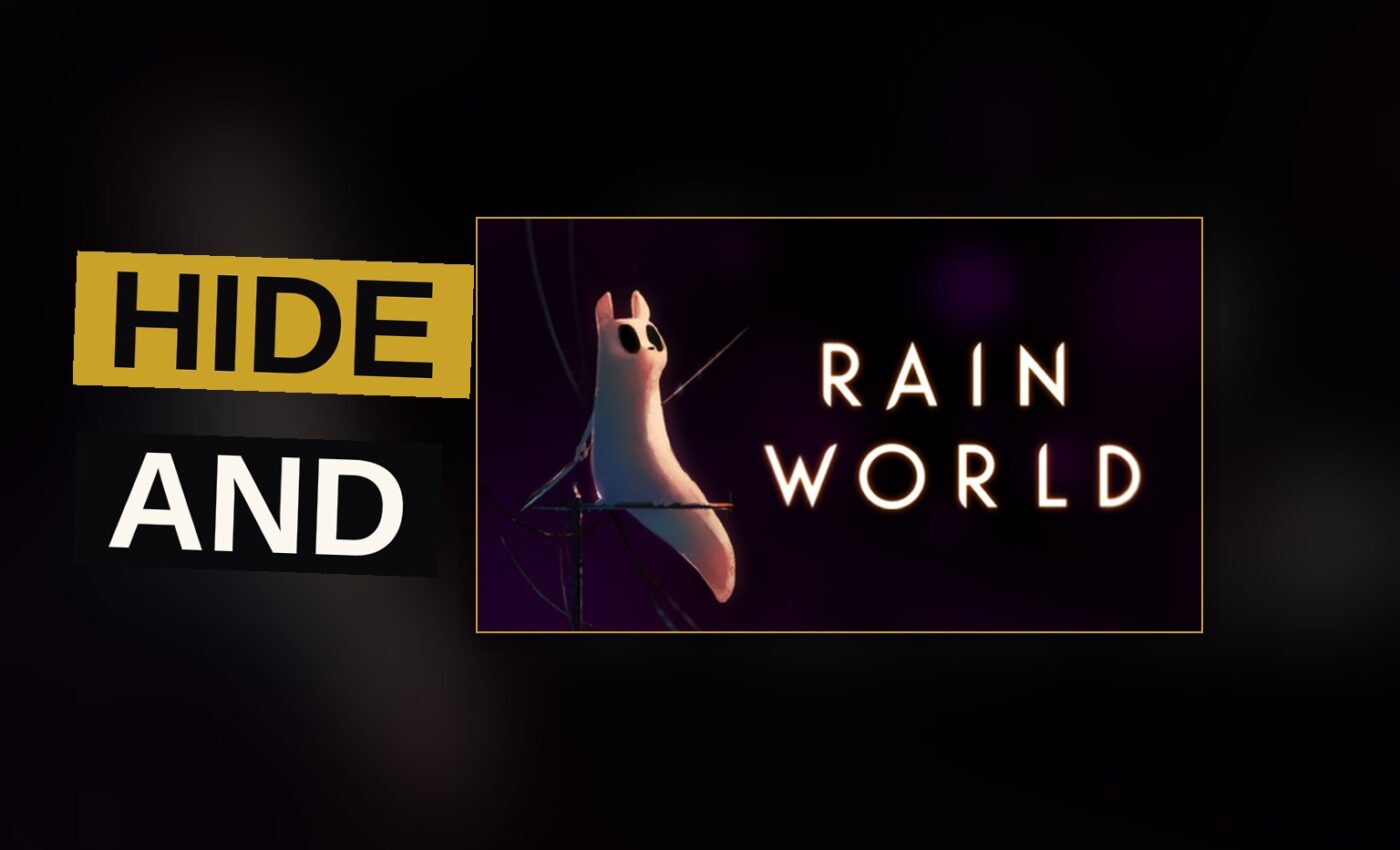
Rain World asks a lot and gives back just enough to keep you moving. Videocult’s 2017 survival-platformer drops a small, agile animal into the ruins of an industrialized civilization and lets the ecosystem do the talking. It is beautiful, strange, and frequently miserable to play. It ends at 6.2 of 10.
The game casts you as a slugcat, a creature that is part cat and part slug, separated from its family when rain strikes. You wake in the remnants of an ancient civilization, hunting food, dodging predators, and looking for a safe room before the next downpour kills you. That is the whole loop, and Rain World commits to it hard.
Trailer, via VIDEOCULT.
A slugcat against the rain
Rain World is a 2D survival-platformer played from a side view. You squeeze through pipes, climb poles, swim, and jump across screens that connect into 12 regions. The slugcat carries spears and debris to fend off creatures that wander each area independently.
Food must be eaten to hibernate. Hibernation rooms are the only checkpoints, and they are scarce. If you do not reach one before the cycle ends, the rain arrives and floods you dead. That timer is the spine of the entire game, and it never stops being the thing you think about.
The rain is not a hazard you outrun with skill alone. It is a schedule, and the schedule does not care how close you are.
Karma, flowers, and locked gates
Death costs one karma level. You gain karma by hibernating, and you can protect it by eating a yellow karma flower, which appears in set spots and replants wherever you die after eating it. Gates between regions demand a specific karma level to pass.
This is where Rain World’s structure starts to fight the player. Karma punishes death in a game built almost entirely around dying, and the gates turn that punishment into a wall. A bad run does not just cost you time. It can lock you out of the direction you were heading.
The game offers little help. A worm-like creature projects holograms that point toward food and story events, but that assistance gets rarer as you go. You can open an in-game map to review where you have been. That is the extent of the guidance.
Five Pebbles and the Void Sea
The story arrives through the environment, through dreams during hibernation, and through those holograms. The slugcat eventually climbs above the clouds into the megastructure of Five Pebbles, a massive, infected, semi-biotic artificial intelligence called an iterator.
Pebbles tells the slugcat that all living things are trapped in a cycle of death and rebirth. The ancient species that built him and the surrounding structures are gone. They built the iterators to find a way to end the cycle. He reads the slugcat as seeking its own end and points it toward the Void Sea, a body of Void Fluid where it can ascend.
A second iterator, Looks to the Moon, fills in the rest. Her structure collapsed and sits partly submerged in the shoreline. Bring her pearls and she reads them, documenting the religion, culture, and history of the vanished civilization. The Hunter’s story runs as a prequel with a 20-cycle limit before the Hunter dies of sickness for good, sent by an iterator named No Significant Harassment to revive a comatose Moon with a green neuron fly.
What the ecosystem actually does
The best idea in Rain World is that creatures do not wait for you. They roam, hunt, and fight on their own. Predators include camouflaged carnivorous plants, large gas-producing vultures, and colored Komodo dragon-like lizards. Some have variations with unique characteristics. Scavengers are agile like the slugcat and carry explosive spears. They are friendly until they are not.
Many enemies kill the slugcat in one hit. Real-time procedural animation gives every creature a fluid, unsettling motion that no hand-animated sprite could match. The art design and that animation are the parts of Rain World that hold up without argument.
The low-fi electronic soundtrack shifts with the situation. Development began in 2011 and included a successful Kickstarter campaign in 2014. The two-man team wanted to simulate a real ecosystem, and the goal shows in every screen where something is hunting something else while you hide in a pipe.
Where the game breaks down
The controls are clumsy, and the game asks you to make precise moves with them. Enemy movement is hard to read. Deaths arrive suddenly and often feel unearned. Checkpoints are infrequent, so failure means repeating rooms you have already solved.
IGN put the problem plainly. Taken alone, the tough elements would be “tough but fair,” it wrote, but together “the odds are stacked so high against the player that it risks toppling the entire structure of the game.” That is the correct read.
Game Informer saw the intent — to make the player feel the slugcat’s suffering in a punishing, mysterious world — and still found the controls, the lack of help, and the unpredictable enemies ruined the result. The intent is real. The execution is not.
Platforms, versions, and what to expect
Rain World launched for PlayStation 4 and Windows in March 2017, with Nintendo Switch following in December 2018. It has since come to Xbox One, Xbox Series X|S, and PlayStation 5. It supports single player, multiplayer, and co-operative play, plus a sandbox mode. Adult Swim Games published the original release, and Akupara Games is credited as well.
| Version | Release window |
|---|---|
| PlayStation 4, Windows | March 2017 |
| Nintendo Switch | December 2018 |
| Xbox One, Xbox Series X|S, PlayStation 5 | Later ports |
The later ports do not change the argument. Rain World is the same demanding, opaque, occasionally brilliant thing on every platform. If you bounce off it on one, you will bounce off it on all of them.
Why 6.2 is the right number
Rain World earns its 6.2. The world-building is extraordinary, and it is done almost entirely without exposition. The iterators, the pearls, the Void Sea, the cycle of death and rebirth — this is a setting with real depth, and it never stops to explain itself. The procedural animation makes the ecosystem feel alive in a way few games manage.
Then you die for the fourth time in a room you already cleared, lose karma, and walk back. The gap between what Rain World is trying to say and what it is like to hold the controller is the whole story of the game. It wants you to feel small and lost in a system you cannot understand, and it succeeds. The problem is that feeling small and lost is only interesting for so long before it becomes a chore.
There is a version of Rain World that keeps the ecosystem, the art, and the mystery, and loosens its grip on the player. This is not that version. The rain is the best thing in the game and the worst thing in the game, because it is both the idea and the punishment.
Play it if you want a world that refuses to explain itself and you can tolerate being killed by things you never saw coming. Skip it if you need the game to meet you halfway. Rain World will not.
Get the Notebook.
The day's best stories and every fresh verdict, in plain English, in your inbox by seven. One email a day, no more.