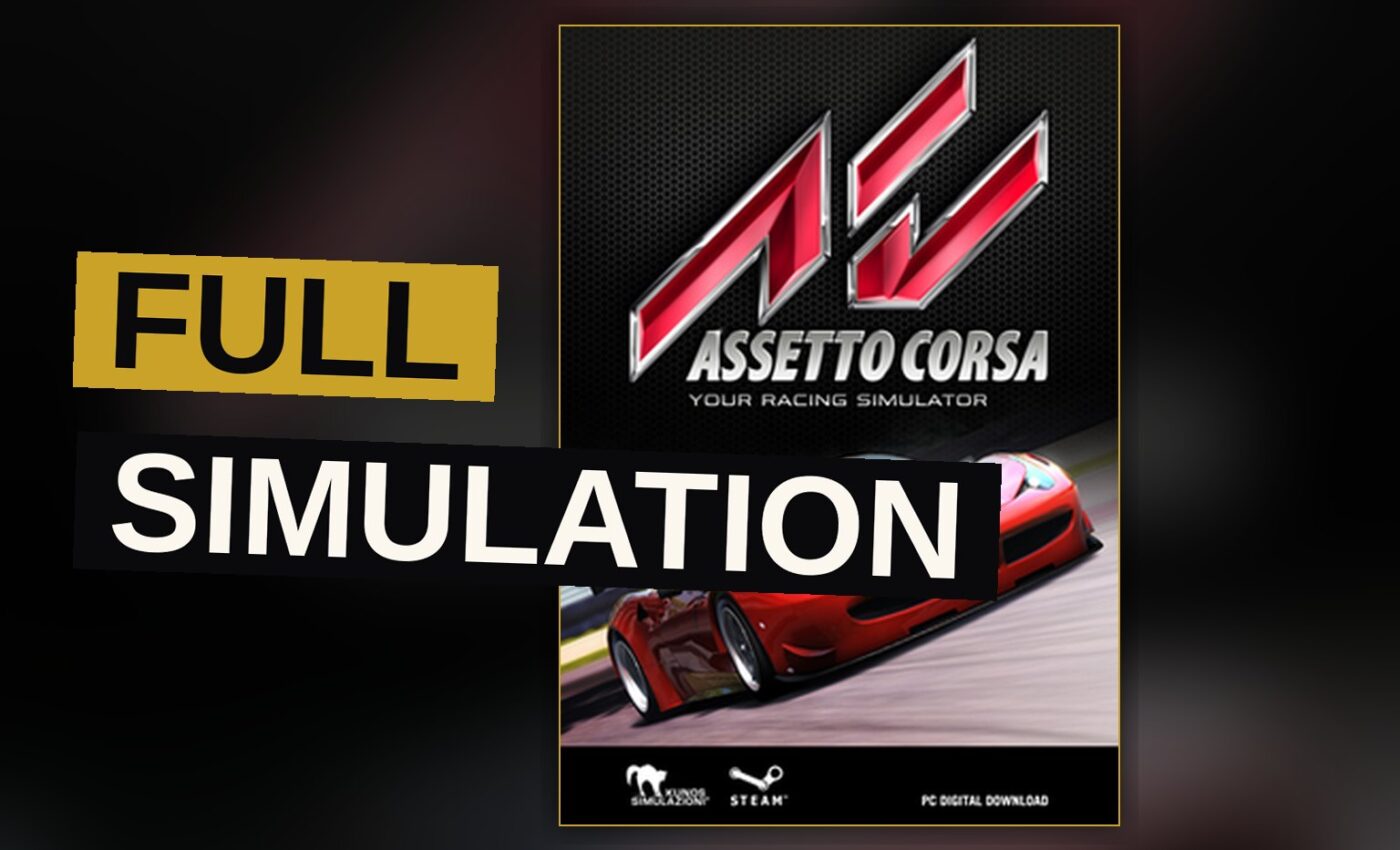
Assetto Corsa arrived on PC in December 2014 as a sim racing project from Italian developer Kunos Simulazioni, and it knows exactly who it is for. It shipped with a DirectX 11 engine, a physics model built around tyre behavior most racing games ignore, and a car list reproduced with manufacturer cooperation. It asks a lot and gives back only to the player willing to meet it. Our score is 6.4 of 10.
Trailer, via PC Games.
Tyre Flat Spots and Heat Cycles
The headline feature of Assetto Corsa is not a car or a track. It is what happens to rubber over time. The physics engine simulates tyre flat spots, heat cycles, graining and blistering — the slow degradation real drivers manage lap after lap. Very few racing simulators model any of this. Assetto Corsa models all of it.
That is the pitch, and it holds up. The aerodynamic simulation includes active movable aero parts controlled in real time by telemetry input channels. Hybrid systems get kinetic energy recovery simulation. This is not decoration on a handling model. It is the handling model.
The physics engine is designed to provide a very realistic driving experience, including features and aspects of real cars. The game allows players to adjust realism settings, from artificial to “factory” or entirely disabled assists, and to change assists on the fly. Players who want to understand why a car behaves the way it does will find the tools to learn.
Laser-Scanned Tracks and Licensed Cars
Kunos rebuilt its race tracks using laser-scanning technology, and the cars are exclusive licensed reproductions made with the official cooperation of the manufacturers. Those two facts do more work than any marketing copy. Laser scanning means the bumps and cambers are real. Manufacturer cooperation means the cars are the cars, not approximations.
The game supports a wide range of peripherals: mouse, keyboard, wheels, gamepads, triple-display setups, TrackIR head tracking, VR head-mounted displays, Nvidia 3D Vision and professional motion systems. That list is unusually broad for a racing sim, and it signals who Kunos was building for — the player with a rig, not the player with a controller.
Modding is supported too. Third-party content can extend the software.
A Setup Screen That Does Not Apologize
When a player joins an offline or online session, they can adjust their car through a setup interface. Depending on the car, that includes gear ratios, tyre compounds, tyre pressures, fuel, anti-roll bars, wheel rates, ride height, packer rates, travel range, bump stops, rebounds, heave dampers, alignment, differential lock and pre-load, hybrid settings, wings, brake bias, brake power and engine limiter.
That is a partial list. It is also the clearest statement of the game’s intent. Assetto Corsa is not interested in hiding its complexity behind a menu of presets, and the range of adjustments on offer may be overwhelming for some.
Assists can be adjusted to taste, from artificial all the way to “factory” or entirely disabled. Traction control, ABS, turbo boost, kinetic energy recovery, engine brake settings and brake bias can be changed on the fly with hot-keys. The game lets you decide how much help you want, then gets out of the way.
The in-game HUD is built from multiple “virtual desktops” that let players place a wide variety of “apps” anywhere on screen. It is a small thing that speaks to the larger design philosophy: nothing is fixed that could be configurable.
Offline Campaigns and Online Servers
Session modes cover offline campaign, special events, custom championships, hotlap, quick race, drift, drag and race weekend. These can be played alone or against AI. A server manager tool lets players create servers for online sessions, and LAN sessions are supported.
The breadth is real, but it is breadth in service of a single activity. There is no story mode and no progression hook. For some players that is the entire appeal. For others it is a wall.
The Console Versions Arrive Late
Assetto Corsa first appeared on Steam’s Early Access program on November 8, 2013, and got its official release on December 19, 2014. The console versions took much longer. Publisher 505 Games and Kunos announced in June 2015 that the game would come to Xbox One and PlayStation 4 in 2016, then set a date of April 22, 2016.
That date slipped. On February 24, 2016, the console release was delayed to June 3. On May 6, 2016, another delay was announced. The game finally reached consoles on August 26 and 30, 2016, in Europe and North America respectively.
Two delays and a two-year gap between the PC launch and the console launch is a lot of ground to give up. Console players got a version arriving into a conversation already in progress.
What the Physics Engine Delivers
| Feature | What Assetto Corsa simulates | Why it matters |
|---|---|---|
| Tyre model | Flat spots, heat cycles, graining, blistering | Degradation changes lap by lap, not just grip level |
| Aerodynamics | Active movable aero parts driven by telemetry | The aero package responds to real-time input |
| Hybrid systems | Kinetic energy recovery | Modern powertrains behave like modern powertrains |
| Track data | Laser-scanning technology | Surface accuracy, not artist approximation |
| Car data | Licensed reproductions with manufacturer cooperation | The car you drive is the car |
The table is the argument. Each row is a system most racing games simplify or skip. Kunos built them all, and built them for players who would notice.
The advanced physics engine is being designed to provide a very realistic driving experience, including features and aspects of real cars, never seen on any other racing simulator
That is the developer’s own framing, and it is the fairest way to describe what Assetto Corsa is. It is a simulator first and a game second.
Where the 6.4 Comes From
Assetto Corsa is excellent at one thing and does not reach far beyond it. The tyre simulation, the laser-scanned tracks, the licensed cars and the setup depth are genuinely ahead of the field. The developer’s own framing is that the physics engine includes features never seen on any other racing simulator.
But a 6.4 is not a knock on the physics. It is a recognition that the game’s design focuses on simulation over broader appeal. The console versions arrived two years after the PC release and after two announced delays. The game has no story mode and no progression hook. The HUD is built from virtual desktops that allow manual placement of apps. The setup screen offers a wide range of adjustments without presets.
None of that is a flaw in the simulation. It is a limit on who will ever see it. Assetto Corsa is built for precision, and it offers tools to learn for players who want to understand how a car behaves. That is a defensible design choice, and it is the reason the game lands at 6.4 rather than higher. The sequel, Assetto Corsa Competizione, followed in May 2019, and Assetto Corsa EVO entered early access in January 2025 — a series that kept building on the same foundation. The original remains the proof of concept: brilliant at the hard part, uninterested in the easy ones.
Get the Notebook.
The day's best stories and every fresh verdict, in plain English, in your inbox by seven. One email a day, no more.