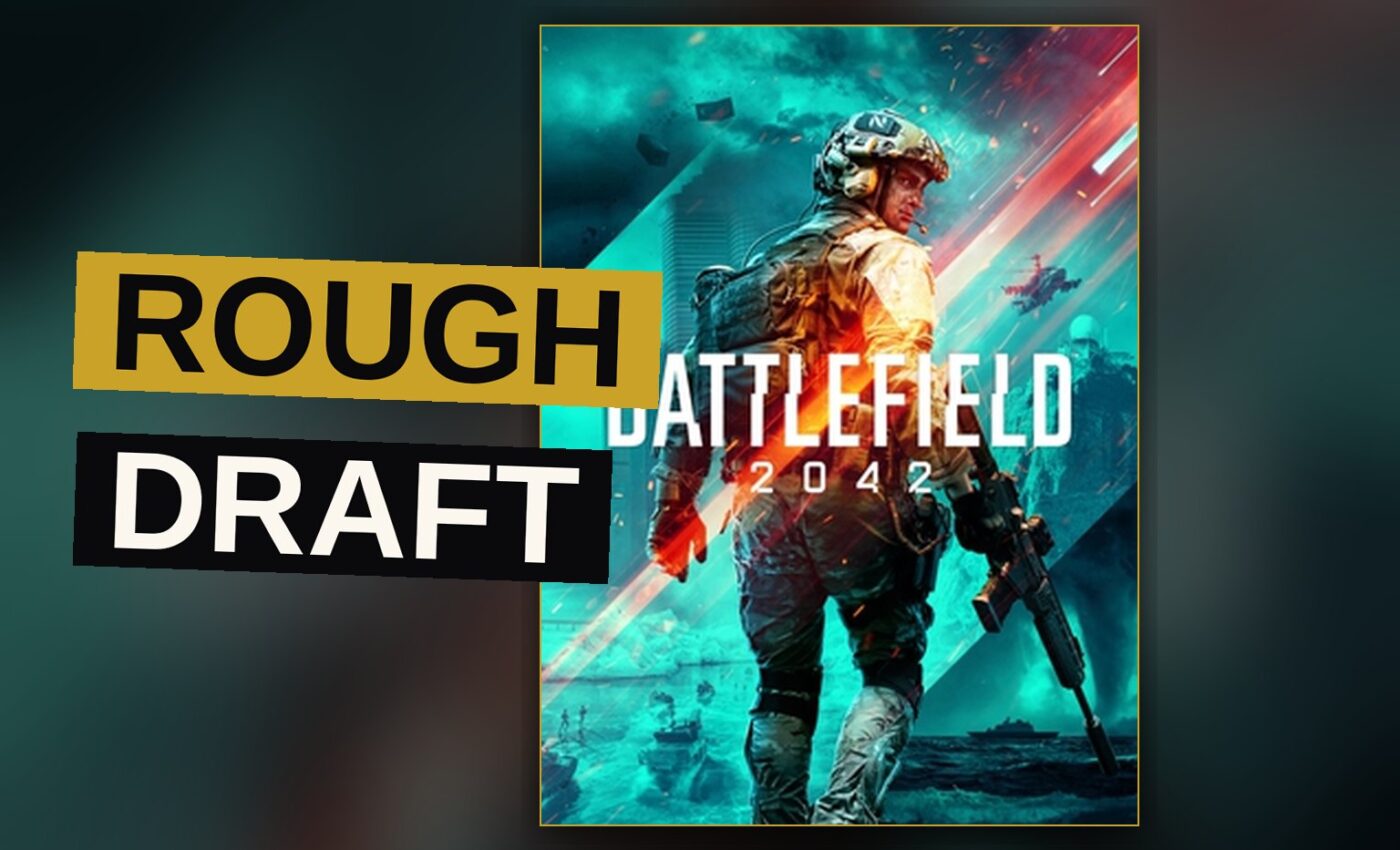
Battlefield 2042 is an online-only shooter with no single-player campaign, and that absence sits at the center of everything wrong with it. DICE built the seventeenth Battlefield around 128-player matches, futuristic gadgets and a class system it tore apart. The pieces are ambitious. The result is a game that too often forgets what made the series work.
Released November 19, 2021, for Microsoft Windows, PlayStation 4, PlayStation 5, Xbox One and Xbox Series X/S, Battlefield 2042 was the final Battlefield game to ship for the PlayStation 4 and Xbox One. It is also the first in the series with cross-platform play. Electronic Arts expected it to sell. It did not sell enough.
Trailer, via XBOX.
A War Told Through Multiplayer Only
Battlefield 2042 takes place 22 years after Battlefield 4. The setting is a world worn down by collapsing economies, rising sea levels and broken alliances. The European Union has collapsed after Germany’s bankruptcy, producing a refugee population called the No-Pats. In 2040, a Kessler syndrome event knocks 70 percent of orbiting satellites out of the sky. The permanent global blackout pushes the United States and Russia toward war, and by 2042 they are fighting.
That is a real premise, and the game tells it almost entirely inside multiplayer matches. A standalone short film, Exodus, premiered August 12, 2021, on Battlefield’s YouTube channel, following events leading to the War of 2042 and bringing back Battlefield 4 character Irish. The rest of the story lives on Electronic Arts’ official website for the game.
A shooter that outsources its narrative to a website and a YouTube short has given up on the campaign it cut. The lore exists. The game rarely lets you feel it.
Ten Specialists, Four Classes Gone
The class system is the biggest change, and the most damaging. Battlefield 2042 removes the four defined classes of earlier games. In their place are specialists, each falling under the traditional roles of Assault, Engineer, Medic and Recon. Any specialist can carry any weapon or gadget a player has unlocked.
Ten specialists shipped. Webster Mackay is a former Canadian soldier with a grappling hook. Maria Falck is a German medic whose pistol fires healing darts. Wikus “Casper” Van Daele is a South African sniper in a ghillie suit. Pyotr “Boris” Guskovsky is a Russian combat engineer who places sentry guns. Kimble “Irish” Graves, another Battlefield 4 veteran, carries a deployable bulletproof shield or an APS. Navin Rao is an Indian hacker who can bring down enemy networks. Santiago “Dozer” Espinoza is a Mexican soldier built to absorb damage. Emma “Sundance” Rosier is a French aerial specialist with a wingsuit.
The freedom sounds generous. In practice it erases the trade-offs that made squad play legible. When anyone can do anything, no one has a reason to depend on anyone.
Tornadoes, Sandstorms and Seven Maps
DICE did not skimp on spectacle. Matches feature extreme weather, including tornadoes and sandstorms that change how a battle plays out. Players can call in a vehicle air-drop to almost any location. A “Plus” system lets them customize weapons on the spot. The arsenal is futuristic, with deployable turrets and drones alongside controllable vehicles.
There were seven maps at launch, including Breakaway, the largest map in Battlefield history. Scale is the pitch. Scale is also the problem when the space between fights grows and the fights themselves thin out.
Conquest, Breakthrough and Hazard Zone
Three modes carry the game. All-Out Warfare covers Breakthrough and Conquest, the two staples of the series. In Conquest, two teams fight to capture control points, and taking every point in a sector gives that team the sector. In Breakthrough, one team attacks and the other defends. Both can be played with and against AI-controlled players.
The PlayStation 5, Windows and Xbox Series X/S versions support up to 128 players. The PlayStation 4 and Xbox One versions do not.
Hazard Zone, the all-new mode, was meant to be the fresh idea. It is not enough of one to justify the price of entry, and it does not fix the core modes underneath it.
What Went Wrong
Battlefield 2042 received mixed reviews from critics and a negative reception from players. The complaints were technical issues, missing features and gameplay changes. The game failed to meet Electronic Arts’ sales expectations.
Those three complaints are not equal, and the ordering matters. Technical problems can be patched. Missing features can be added. The gameplay changes are a design decision, and they are the reason the game feels less like Battlefield than any entry before it.
Unlike previous games in the series, Battlefield 2042 is solely multiplayer and does not have a single-player campaign.
That sentence from the game’s own description is the whole story. DICE traded a campaign for 128 players and specialists, and got neither the focus nor the payoff.
The Series Moved On
A new installment, Battlefield 6, was developed by Battlefield Studios — DICE, Motive Studios, Ripple Effect Studios and Criterion Games — and released October 10, 2025. The series did not stay where Battlefield 2042 left it.
That is the clearest verdict available. Electronic Arts and DICE treated Battlefield 2042 as a direction, then abandoned it. The specialists, the stripped classes, the narrative pushed off the disc and onto a website: none of it survived as the foundation for what came next.
What remains is a game with genuine scale and a genuine identity crisis. The tornadoes are impressive. The wingsuit is fun for an afternoon. The 128-player matches can produce moments no smaller shooter can. None of that coheres into a reason to keep playing once the novelty drains.
Should You Play It
If you want the classic Battlefield squad dynamic, this is not it. The specialists break the interdependence that made Conquest and Breakthrough work, and no amount of map size repairs that. If you want spectacle and you can tolerate the technical rough edges, the price has likely fallen far enough to match what you get.
The honest read is that Battlefield 2042 is a transitional game that its own publisher treated as a dead end. It is worth a look for series completists and for anyone curious how a franchise loses its footing. It is not worth defending as a high point.
Get the Notebook.
The day's best stories and every fresh verdict, in plain English, in your inbox by seven. One email a day, no more.