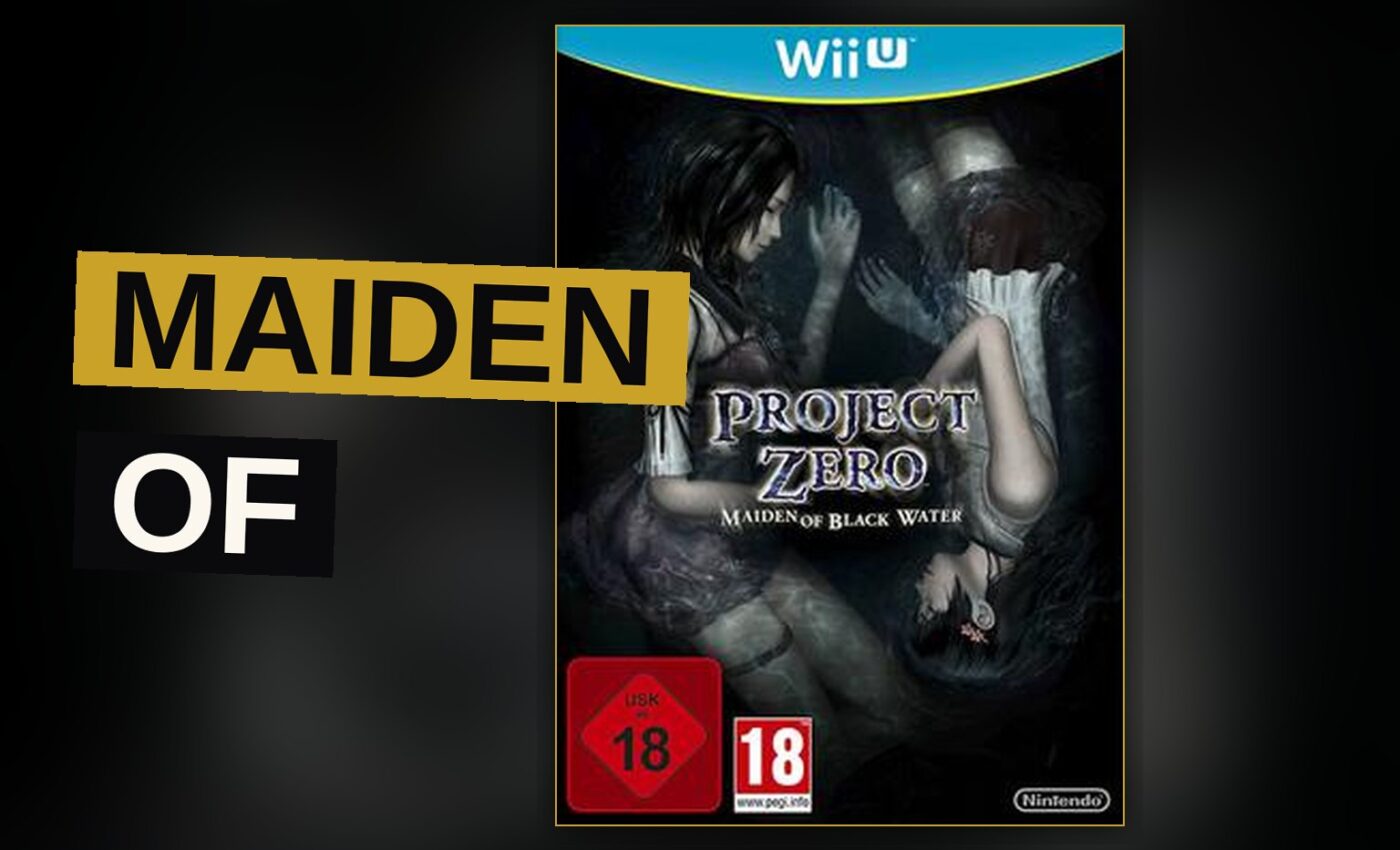
Fatal Frame: Maiden of Black Water arrived on the Wii U with a camera in the player’s hands and a mountain full of the dead. Koei Tecmo developed it and Nintendo published it. The fifth main entry in the Fatal Frame series came out in Japan in September 2014 and worldwide in October 2015. It is a survival horror game, and it is a strange, uneven one.
Trailer, via Nintendo of America.
The Camera Obscura and the Wii U GamePad
The core idea is the best thing here. Players fight ghosts by photographing them with the Camera Obscura, an antique camera. In the original version, the camera is controlled with the Wii U GamePad, and that decision is what the game was built around. Series co-creator Keisuke Kikuchi proposed the project when he saw that the GamePad could be used as the Camera Obscura. You hold the screen up, you frame the shot, you fire. It is the rare Wii U game whose central mechanic could not exist anywhere else.
Combat runs from a first-person view through the lens, while exploration happens in third person. Shot proximity and angle change how much damage a ghost takes. The biggest hit is a “fatal frame,” which lands on a ghost’s weak spot. After a shot, fragments of the ghost appear around it. It works. It is also thin.
Three Characters, One Wetness Meter
You control three different characters across Hikami Mountain, moving through ruined buildings and dark forests. An interactive map handles navigation, and characters can walk or sprint. Ghosts attack by touch and damage you. If one grabs you, you dodge or break free. The Camera Obscura is your only defense and your only attack.
Then there is the wetness meter. It tracks how damp a character gets while moving through the environment, and it cuts both ways. Being wet increases the damage your camera does. It also increases the number of ghosts in an area and makes their attacks hurt more. That is a real risk-reward system, and it is the most interesting thing the game does after the camera itself.
Yuri Kozukata and the Call of Hikami Mountain
The story puts Yuri Kozukata at the center. She works at an antique shop and can see the “shadow” of objects she touches, and she can bring people back from the “shadow world.” Her gift is why she keeps other people at a distance. She also uses it to find lost items and missing people for anyone who asks.
One day a girl named Fuyuhi Himino comes to the shop. She wants Hisoka Kurosawa to find her friend Haruka Momose, who has gone missing around Mt. Hikami. Hisoka is not there, so Yuri takes the request herself. The mountain has a reputation for suicides and for spiritual events tied to local bodies of water. People go into the forest during the witching hour, when the line between the living world and the hidden world of shadows blurs. The belief is that someone ending their own life there dies a clean, “proper” death instead of becoming trapped as a ghost.
The larger plot concerns an ancient ritual to seal away the Black Water, a malevolent force corrupting the surrounding spirits, tied to the fate of the shrine maiden Ose Kurosawa. A post-endgame story featuring Ayane from Dead or Alive is also available, with altered gameplay mechanics.
What the Game Gets Wrong
Here is where Maiden of Black Water loses its grip. The pacing drags. The controls beyond the camera are clumsy. The story, which should be the spine of a game like this, is the weakest part — the mixed response to it at release was earned, not a misunderstanding. The portrayal of the game’s female characters is a fair target too, and the wetness meter sits right at the center of that problem. A mechanic that rewards you for soaking your characters while the camera lingers is not subtle, and the game never finds a reason for it beyond the numbers.
It is worth ranking what actually holds up, because the game’s reputation tends to blur it all together:
- The Camera Obscura and the GamePad integration — genuinely inventive, and the reason to play.
- The wetness meter as a risk-reward system — clever, even if the framing around it is not.
- The atmosphere and the mountain setting — effective, and the part critics agreed on.
- The story and its three protagonists — muddled, and the biggest drag on the whole thing.
- The pacing and controls — the parts that make the good ideas harder to reach than they should be.
A Remaster Does Not Fix the Middle
A remaster for eighth and ninth generation consoles and Windows, published this time by Koei Tecmo, arrived worldwide in October 2021, with the camera controls adjusted for other hardware. That version solves the availability problem. It does not solve the pacing, the story, or the controls. It also strips out the one thing that made the original worth defending: the GamePad. On a modern console, Maiden of Black Water is a decent horror game with a good camera and a bad middle.
So where does that leave it? The Wii U version is a game with one great idea and a lot of dead weight around it. The camera is the reason it exists, and the camera is the reason to remember it. Everything else — the three leads, the ritual, the shrine maiden, the wetness — is noise next to that. Play it for the shot. Do not play it for the story.
Get the Notebook.
The day's best stories and every fresh verdict, in plain English, in your inbox by seven. One email a day, no more.