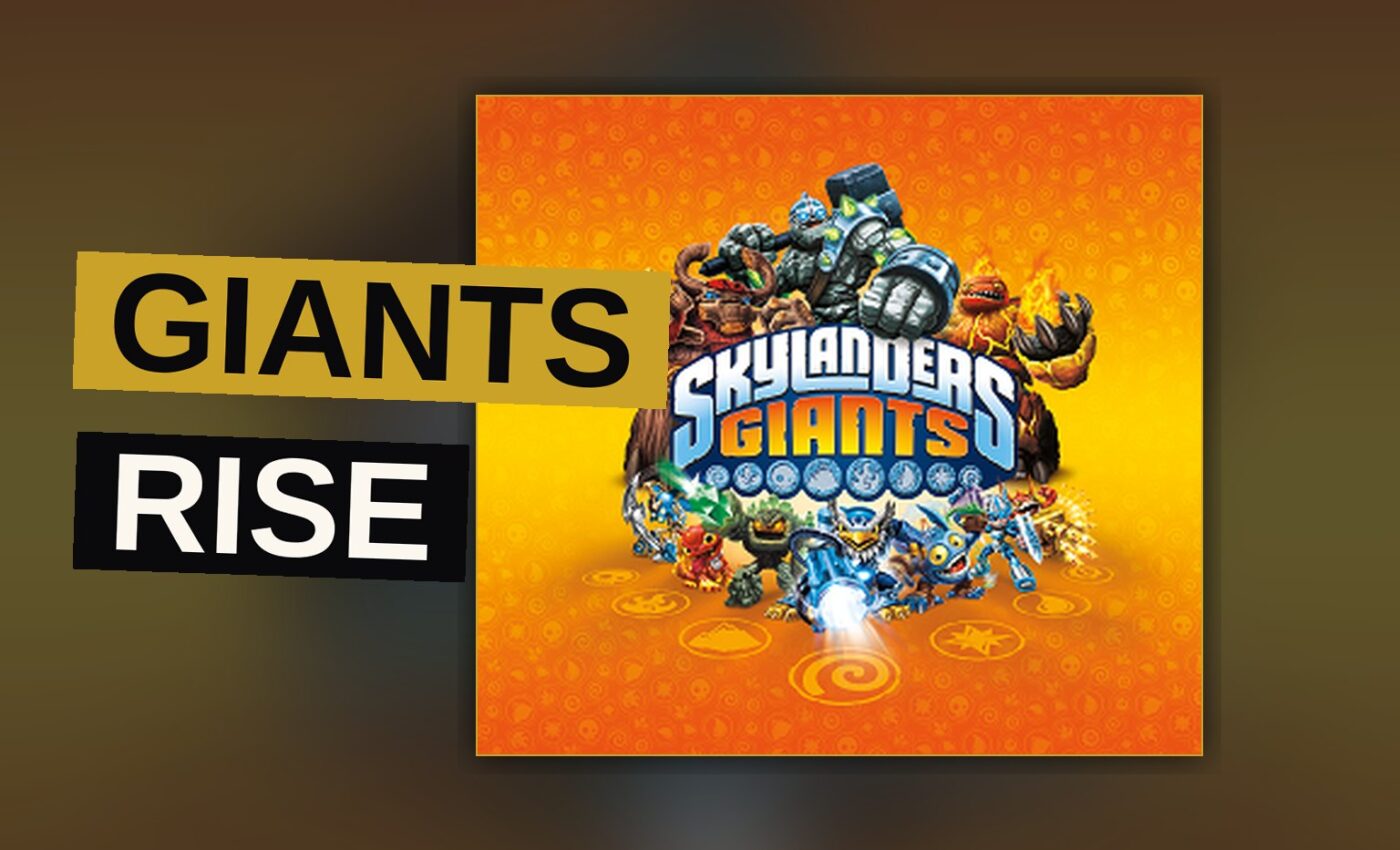
Skylanders: Giants arrived in October 2012 carrying a strange burden. It was a direct sequel to Skylanders: Spyro’s Adventure, the 2011 game that had turned plastic toys and a glowing portal into a working business. It was also the last Skylanders game owned by Vivendi before Activision became an independent company in 2013. And it had to sell bigger toys.
Trailer, via IGN.
Toys for Bob Builds on Spyro’s Adventure
Toys for Bob developed Skylanders: Giants, and Activision published it. The game came to PlayStation 3, Wii, Xbox 360 and Nintendo 3DS in October 2012, and it landed on the Wii U as a launch title in North America, Europe and Australia. That spread matters. Giants was not a niche release. It was a machine built to sit under a television in every kind of household, on every console a family might own.
The core mechanic did not change. You connect a physical toy to the console through a Portal of Power, and whichever toy you set down becomes that character in the game. That is the whole trick, and it is a good one. The toy is not a download code or a cheap plastic key. It is the character, and the character carries its own history.
Giants builds on the fundamentals of Spyro’s Adventure rather than replacing them. The first game’s figures are forward compatible, so a collection does not become waste. There are also new versions called Series 2, which carry more powerful attributes than the originals. Use a Series 2 figure in the first game and it acts as its own Series 1 counterpart. That is a small piece of design, and it is the right one.
Eight Giants, Forty New Figures
The headline number is over 40 new toy figures. Some of them are more than twice the size of the original Skylanders cast, in both physical and virtual form. Sixteen new Skylanders were introduced, including eight Giants: Bouncer, Crusher, Eye-Brawl, Hot Head, Ninjini, Swarm, Thumpback and Tree Rex.
That is the pitch, and it is honest about itself. The game is called Giants. The Giants are large.
A new line called LightCore also arrived. These figures glow when placed on the Portal of Power and have a flash bomb attack in the game. It is a gimmick, but it is a gimmick with a visible payoff. A child can see the thing light up. That is not nothing.
Battle Mode returns with more areas and gameplay options, plus a new variety of alter ego Skylanders for head-to-head play. Single player, multiplayer and co-operative modes are all here. The game supports a bird’s-eye, isometric view across its role-playing, hack-and-slash and adventure bones.
The Iron Fist of Arkus
The plot reaches back 10,000 years. The Arkeyan Empire, a civilization of robots, enslaved Skylands. The Giants were the first Skylanders, larger than the normal ones, and they rebelled. They defeated the robot king who held the source of Arkeyan power, the Iron Fist of Arkus.
The victory powered down every robot. But the Fist then transported the Giants to Earth, where they froze into toys because there was no magic. Over time they were regarded as myths, which is a neat piece of writing. The toys you bought were always the heroes. The fiction just caught up.
In the present day, after the events of the first game, Kaos returns. He had been shrunk and put on display in a toy store on Earth, and he finds a Portal of Power. The Skylanders set out on Captain Flynn’s ship, the Dread-Yacht, after learning something big is happening in Skylands.
They meet Ermit the hermit, who reveals Kaos is back and has accidentally awakened an ancient Arkeyan Conquertron, a giant robot. The Conquertron recruits Kaos as its new leader. Both sides are hunting the Lost City of Arkus, where the Iron Fist sits. Ermit mentions he has a giant robot of his own.
The crew encounters a “machine ghost,” which turns out to be the soul of Ermit’s robot, and they reactivate it. Kaos still reaches the Iron Fist first and transforms into a large Arkeyan robot, ready to conquer Skylands with the reactivated Arkeyans. The Skylanders learn he cannot be stopped unless the Fist is removed from him. With help from Ermit and the Machine Ghost, they pull the Fist of Arkus free, defeat Kaos and return him to normal.
Kevin Sorbo and Bobcat Goldthwait in the Cast
The cast is deep for a toys-to-life game. Kevin Michael Richardson, Greg Ellis, Peter Lurie, Steve Blum, Dave Wittenberg, Carlos Alazraqui, Kevin Sorbo, Bobcat Goldthwait, Patrick Seitz and Julie Nathanson all appear. That is a real bench. Sorbo and Goldthwait in particular are the kind of names that signal someone at Toys for Bob wanted the performances to land, not just fill space.
Giants sits between Spyro’s Adventure and Skylanders: Swap Force in the series order. It is a bridge game, and it behaves like one.
A Sequel That Sells the Same Toy Twice
Here is the problem. Giants is a solid game built on a foundation that already worked, and it does very little to move that foundation. The Giants are bigger. The figures are more numerous. LightCore glows. Battle Mode has more areas. None of that changes what the game is.
The forward compatibility is genuinely generous, and it deserves credit. But the Series 2 figures carry more powerful attributes than the originals, and the game is candid about that. It is a business decision dressed as a gameplay one.
What the 6.9 Says About the Series
The published critical score is 6.9 out of 10, drawn from an aggregate of nine outlets. That number is fair, and it is not a knock on the craft. Giants does what a sequel is supposed to do. It adds characters, it adds modes, it keeps the portal working, and it tells a story with actual stakes. The Arkeyan Empire and the Iron Fist of Arkus give the game a mythology rather than a premise.
But a 6.9 is the score of a game that is good without being necessary. Spyro’s Adventure was the idea. Giants mostly holds the line.
Release Schedule
| Platform | Release window |
|---|---|
| Nintendo 3DS | October 2012 |
| PlayStation 3 | October 2012 |
| Wii | October 2012 |
| Xbox 360 | October 2012 |
| Wii U | Launch title, North America, Europe and Australia |
It features larger Skylanders known as “Giants”, along with other new gameplay mechanics.
That line is the whole game in one sentence. The larger Skylanders are the hook, and the other mechanics are the supporting cast.
The Dread-Yacht and the Machine Ghost
Skylanders: Giants is a competent, generous sequel that respects the collection it inherited. Forward compatibility is the best thing in it. The eight Giants are the most visible thing in it. The plot, with its robot empire and its 10,000-year gap, is more ambitious than a toy game needs to be.
What holds it at 6.9 is the sense that Toys for Bob played it safe. The game adds size and volume where it could have added invention. Battle Mode and LightCore are welcome, but they are additions, not advances.
Buy it if you already own the portal. Buy it if the Giants are on the shelf and the child in your house has been waiting. Do not expect it to justify the collection on its own. It is the middle chapter, and it reads like one.
Get the Notebook.
The day's best stories and every fresh verdict, in plain English, in your inbox by seven. One email a day, no more.