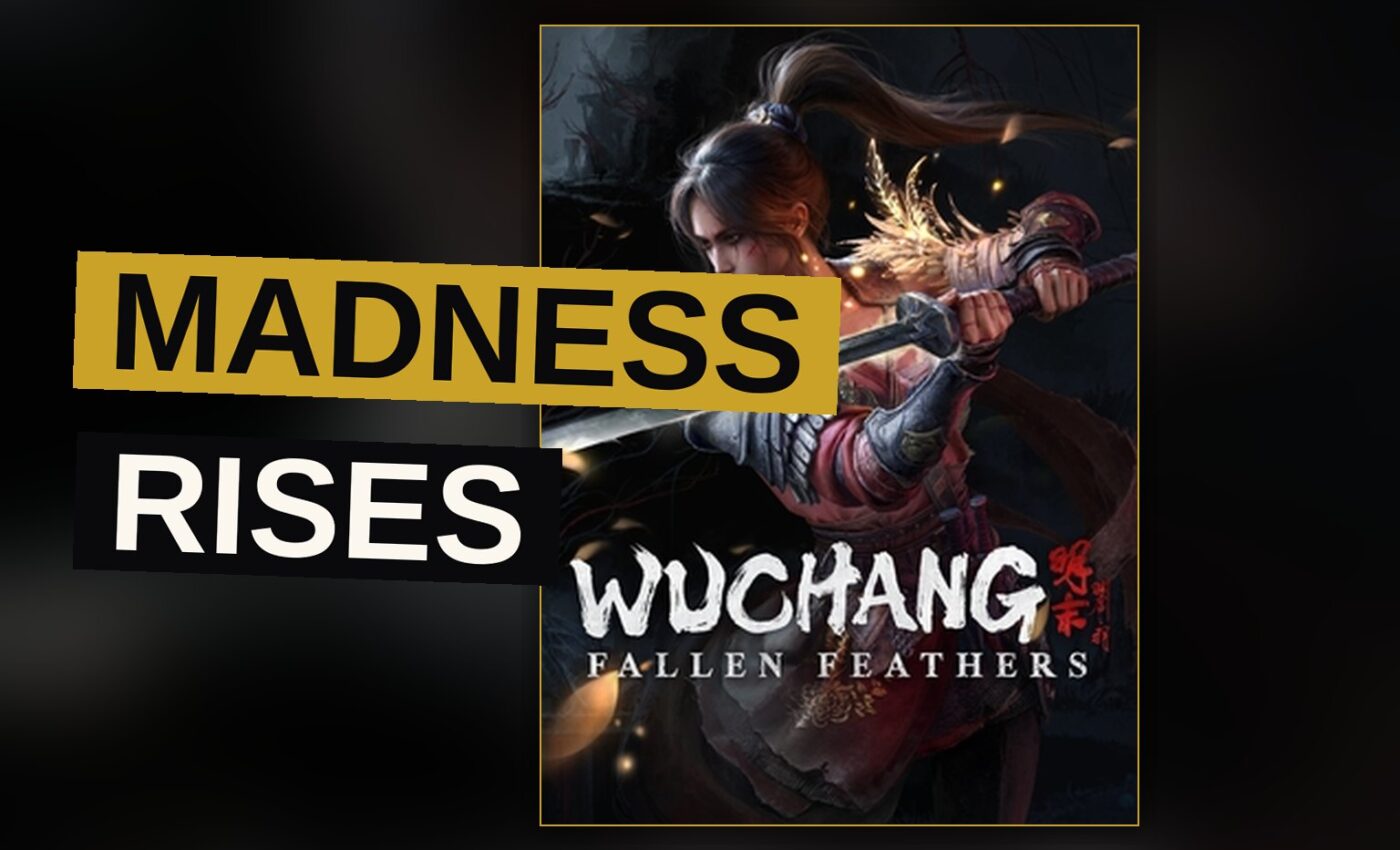
Wuchang: Fallen Feathers is a Soulslike that asks you to fight a plague, and to lose your memory while doing it. Leenzee Games developed it, 505 Games published it, and it arrived on PlayStation 5, Windows and Xbox Series X/S on 24 July 2025. You play Bai Wuchang, a female pirate who comes home to Shu chasing an artifact that can bring her younger sister back from the dead.
That is a strong premise. What the game does with it is uneven, and the unevenness is worth naming plainly, because the parts that work are not the parts most Soulslikes lean on.
Trailer, via 505 Games.
Bai Wuchang and the Feathering
The setup is specific and grim. Late Ming dynasty, the region of Shu, warring factions, and a disease called the Feathering that erodes memory, drives victims mad and twists them into monsters. Wuchang carries one remnant of the artifact, the Ancient Chisel. After a feathered monstrosity rampages in Worship’s Rise, she catches the Feathering herself and loses her memory. A Taoist named Xuanyangzi finds her unconscious and takes her to a cave near the Reverent Temple.
From there she heads for the Shu Sanctum, rumored to hold what is needed to treat the disease, and finds it neglected instead. She reunites with He Youzai, her crewmate and companion in the quest to revive Bai Yu. The two of them push through a land coming apart.
The Feathering is not just plot. It is the game’s best idea, because it doubles as a combat system. Kill humanoids or die, and Wuchang’s madness climbs. Kill feathered beings, and it falls. Her eyes turn red. Demonic markings show on her body. Some skill tree upgrades get stronger once her madness reaches certain heights. At 90 percent she deals more damage and takes more damage.
That is a clean risk-reward loop, and it is tied to the fiction rather than bolted on. It also means the game’s ugliest choices — who you kill, how often you die — feed a meter you can see on her skin.
Weapons, disciplines and skyborn might
Combat runs on two resources. The first is skyborn might, which pays for weapon skills, disciplines and spells, and also enables swift draws, weapon swaps that instantly fire a weapon skill. You build it by landing shimmers, well-timed dodges, plus methods tied to each weapon type. It shows up as colored feathers on Wuchang’s arm.
The second is madness, described above. Together they give fights a rhythm beyond stamina management, and the arm feathers are a smart readout — you can check your resource without leaving the action.
The weapon spread is wide: longswords, one-handed swords, dual blades, axes and spears, each equipped as primary or secondary. Weapon skills belong to individual weapons. Disciplines belong to weapon types, unlocked through the skill tree and assignable to any weapon of that type. Blocks and deflects depend on which disciplines a type has available. Wuchang starts with Cloudfrost’s Edge, a longsword based on the Chinese changdao.
Here is the problem. That is a lot of systems, and the game does not always make the case that all of them matter. Breadth is not the same as depth, and a skill tree that hands you five weapon classes can still leave you using two.
A Shu that history did not write
The setting is an alternate history of Shu, and Leenzee is upfront about the seam. According to Xia Siyuan, the portrayal of historical events aligns with mainstream historiography, but the world diverges because supernatural forces reshaped history millennia ago. The worldbuilding traces back to the era of King Duyu of Shu.
That is the right way to handle this material. You get the texture of the late Ming — factions, collapse, a society failing under plague — and you get permission for the monsters. The Feathering does the thematic work: a disease that eats memory is a disease that eats identity, and Wuchang is already a woman who lost hers.
The plot keeps moving. Wuchang reaches the Tang Emperor’s Palace and finds the Jade Ancient Chisel, then loses it to Honglan, Commander of the Imperial Guard. She pursues her to Cloudspire, where Ming and rebel forces are already fighting. She kills Huang Yan, Madam of Snowfall Palace, and finds Honglan imprisoned.
The Madam had used the chisel to revive Fang Ling, tortured to death, and turn her into a perfect bride — an act that made her a monstrosity instead. Wuchang kills Ling, takes the chisel back. Fang Yao mourns her elder sister, and may leave with He Youzai for other locations. At Mount Zhenwu, a rebel army seizes control and slaughters locals, and in the Zhenwu Temple the rebels use the Aurum Ancient Chisel.
That is a lot of proper nouns arriving fast, and the back half of the story sometimes feels like a list of places rather than a descent. The best material — the Madam, the bride, the thing that came back wrong — is the material the game spends least time on.
Where Wuchang: Fallen Feathers lands
Ranked by what actually holds up:
- The madness system. It ties violence, death and identity into one readable meter, and it is the reason to play this over a dozen other Soulslikes.
- Skyborn might and swift draws. Weapon swapping that fires a skill is a genuinely good combat hook.
- The Shu setting. Alternate history with a supernatural seam is more interesting than straight historical dressing.
- The weapon spread. Five classes and a discipline system is generous, but generosity is not the same as necessity.
- The plot’s back half. Too many names, too little time with the ones that land.
Wuchang: Fallen Feathers sold over 1 million units as of March 2026 and reached 5 million players by July 2026, and a sequel is coming from Indolphinity with 505 Games publishing. That is a real audience for a first outing, and it is deserved in part.
The parts worth keeping are the parts that make the disease mechanical. When the game lets the Feathering sit inside the combat loop, it is doing something most Soulslikes do not bother with. When it hands you another named location and another faction, it is doing what all of them do.
This is a strong foundation with an overstuffed middle. The sequel has an obvious place to start: fewer chisels, more madness.
Get the Notebook.
The day's best stories and every fresh verdict, in plain English, in your inbox by seven. One email a day, no more.