
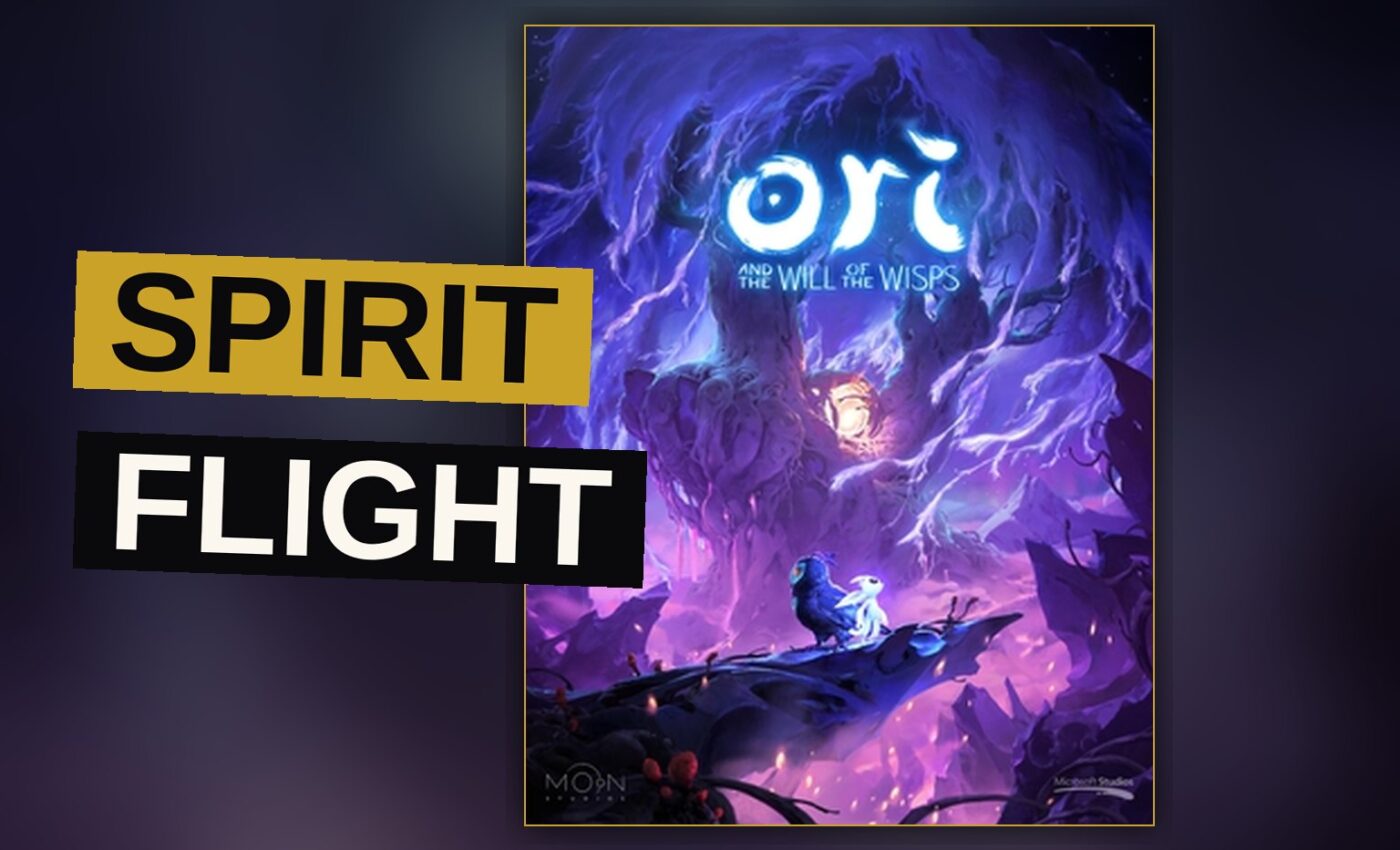
Ori and the Will of the Wisps arrived in March 2020 for Windows and Xbox One, a direct sequel to 2015’s Ori and the Blind Forest and the work of Moon Studios, the Vienna-based team with contributors scattered worldwide. A Nintendo Switch version followed in September 2020, published by Iam8bit. A version optimized for Xbox Series X/S shipped as that console’s launch title in November 2020.
It is a Metroidvania in the plainest sense: a 2D platform game built on exploration, item collection and backtracking into rooms that were locked to you an hour ago. It is also, at its best, one of the most beautiful things the genre has produced.
Trailer, via XBOX.
Niwen, and a Wing That Would Not Fly
The story picks up immediately after Blind Forest, narrated by the Spirit Tree. Kuro’s last egg hatches, and Ori, Naru and Gumo raise the owlet Ku as family. Ku is born with a damaged wing and cannot fly until Gumo affixes Kuro’s feather to it. A flight goes wrong, the pair are carried out of Nibel and into Niwen, and a storm separates them.
That separation is the engine of the whole game. Ori’s search leads to Kwolok, a toad who watches over the Inkwater Marsh and the Moki who live there. Kwolok says Ku is in the Silent Woods, the Moki’s old home, now a graveyard of owls. To reach them, Ori must set the wheels of The Wellspring turning again and clean Niwen’s water.
The reunion happens. It does not go well. Shriek, a deformed and vicious owl orphaned at birth and rejected by her own kind, rules the Silent Woods and attacks the pair, putting Ku in a coma. The Voice of the Forest, the wisp Kwolok gave Ori, is not strong enough to bring her back. The Spirit Willow’s light shattered into five wisps, and Ori has to find them.
Shards, Not Soul Links
The mechanical break from Blind Forest is real and it matters. The old sequential upgrade system is gone, replaced by shards — bought or found across the map, used to modify Ori’s stats and attacks — a system the studio modeled on Final Fantasy’s materia. Attacks run through a radial menu. Health and energy orbs sit scattered through the world.
Autosaving replaces the manually placed soul links of the first game, which removes a layer of busywork and a layer of tension with it. Sein, Ori’s companion in Blind Forest, is gone. Spirit Trials, shown at Gamescom 2018, turn traversal into a race against other players’ best times and routes, and you can see the routes they took. Side quests from NPCs pay out in collectibles like Gorlek Ores, which expand the hub.
A Three-Dimensional Overhaul
The visual change is the headline. Blind Forest’s two-dimensional artwork gives way to three-dimensional models played against multilayered backgrounds, and the result holds up in motion — detailed animation, cohesive sound and image, an orchestral score doing steady work underneath.
The game drew critical acclaim on release, with praise for its story, characters, visuals, combat, exploration, environments, chase sequences and soundtrack. It is considered an example of art forms in the video game medium.
That acclaim was not unqualified. Frame rate issues and visual bugs drew criticism at launch, and a day-one patch largely resolved them. “Largely” is doing honest work in that sentence.
Ori and the Will of the Wisps received critical acclaim.
Niwen’s Real Villain
Shriek is the piece of this game that stays. She is not a monster with a motive bolted on. She was an orphan at birth, rejected by her kind, and the corruption that killed the Willow’s guardian spirits — and her parents, before she was born — made her what she is. The game gives her a history and then makes you fight her anyway.
Kwolok carries the middle act with less to work with, a toad handing out tasks and a wisp. The Moki, the Silent Woods, the Inkwater Marsh: Niwen is a region with a past, and the game treats its decay as something that happened to people, not as set dressing.
What the Shards Cost
Here is the trade. Dropping the sequential upgrade path for shards buys freedom and costs you the sense that Ori is becoming something specific. In Final Fantasy, materia worked because the party was fixed and the builds were the point — that is this paper’s comparison, not the studio’s. Here, the shards are a menu, and a menu is a weaker story than a spine.
Spirit Trials are a good addition and a small one. Racing other players’ ghosts is a fine use of a movement system this good, and it is also the most disposable thing in the package. The chase sequences and the exploration are where the game earns its reputation, and both are excellent.
The technical trouble at launch is worth naming plainly because it is the only thing that ever argued against this game. A day-one patch fixed most of it. Most is not all, and a game this dependent on precise timing feels every dropped frame.
What Moon Studios built here is a sequel that understands its predecessor and refuses to repeat it. The shift to 3D models in multilayered backgrounds, the shards, the autosave, the new melee combat — these are not tweaks. They are a studio deciding the first game’s answers were not the only ones. Some of those decisions land harder than others. The shard system is the weakest of them, and it is still more interesting than a safe sequel would have been.
Ori and the Will of the Wisps is considered an example of art forms in the video game medium, and that reputation is earned by the animation, the score and the environments more than by the combat. It is a game about a small spirit looking for family in a land that has already lost its own. That it makes you feel the loss while you are busy jumping between platforms is the whole trick, and it works.
Get the Notebook.
The day's best stories and every fresh verdict, in plain English, in your inbox by seven. One email a day, no more.


