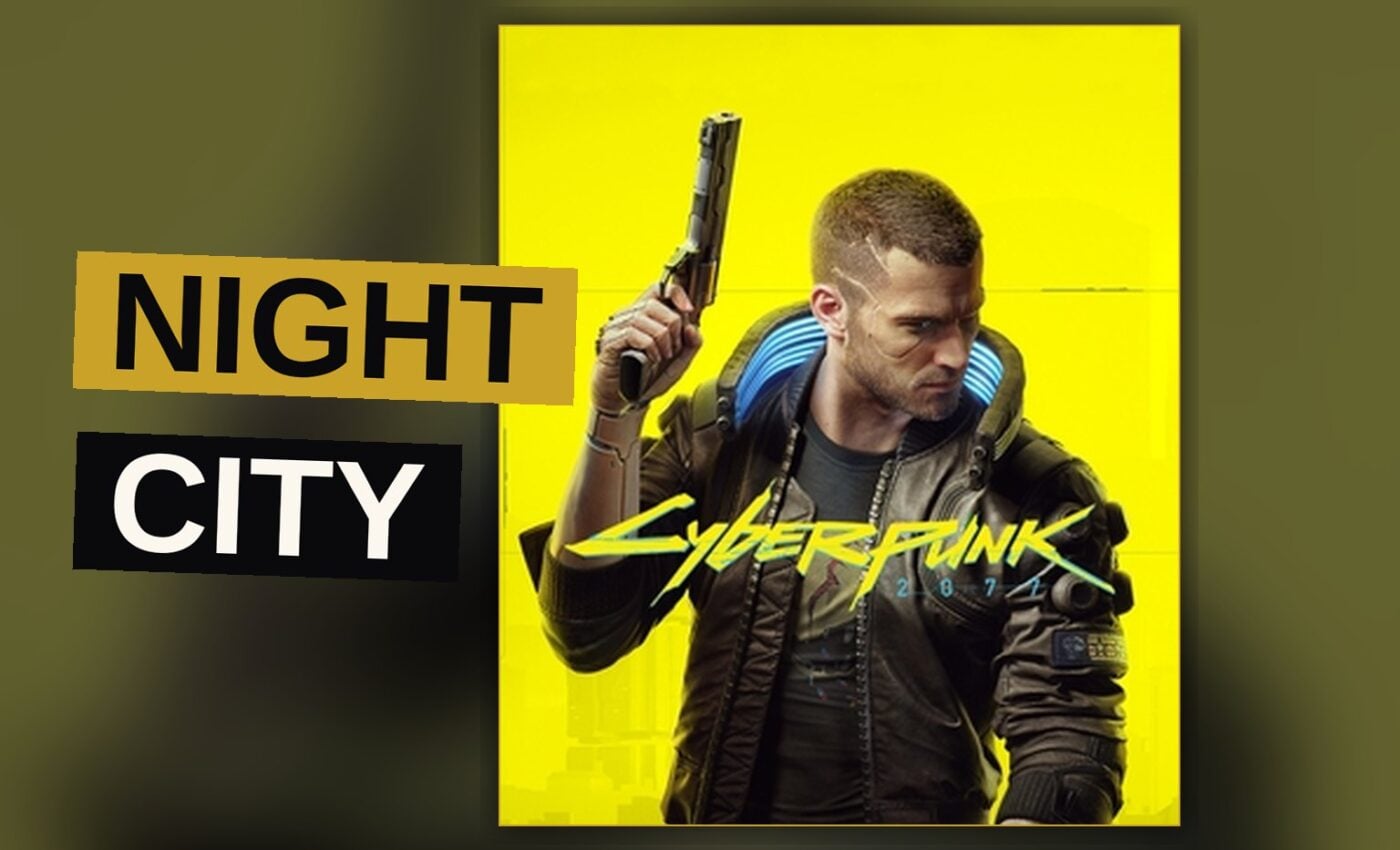
Cyberpunk 2077 is a game about a city that eats people, and about the one mercenary who refuses to be swallowed. CD Projekt Red released it in December 2020 for PlayStation 4, Stadia, Windows, and Xbox One, with PlayStation 5 and Xbox Series X/S versions following in February 2022. It runs on REDengine 4, was built by a team of around 500 people, and is based on Mike Pondsmith’s Cyberpunk tabletop game series. Pondsmith served as a consultant. The score lands at 8.6 out of 10.
Trailer, via Cyberpunk 2077.
Night City, California
The setting does the heavy lifting. Night City is an independent megacity and city-state between the Free States of North California and South California, a corporatocracy unaffected by federal or state legislation. It was founded in the mid-2040s and has been progressing ever since.
What that progress looks like: rampant gang violence, corporate warfare, an ineffectual and corrupt municipal government, and a police force to match. Homelessness and poverty are widespread. Cybernetic modification is widespread too, even among the underclasses, which means cosmetic addiction and high levels of violence sit alongside everything else.
The city’s architecture and fashion come from four aesthetic eras it passed through: Entropism, Kitsch, Neo-Militarism, and Neo-Kitsch. That detail matters more than it sounds. It gives Night City a history instead of a mood board.
V, Johnny Silverhand, and the Relic
You play as V, voiced by Gavin Drea or Cherami Leigh depending on the player character’s gender. V is a mercenary who gets reluctantly imbued with a cybernetic “biochip” containing an engram of legendary rockstar and terrorist Johnny Silverhand, portrayed by Keanu Reeves. Johnny’s consciousness begins overwriting V’s own. The two must work together to separate and save V’s life by confronting the Arasaka Corporation, the megacorporation acting as the de facto ruler of the city.
The plot opens with one of three lifepaths — Nomad, Streetkid, or Corpo — each leading to a partnership with street thug Jackie Welles and netrunner T-Bug. Fixer Dex DeShawn hires the crew to steal the Relic from Arasaka. The heist goes awry.
That structure is the smartest thing the game does. The lifepath choice sets V’s background, starting location, prologue mission, and initial clothing. It does not grant advantages in perks, attributes, or levelling. What it unlocks is dialogue options tied to V’s history, and that is the right call. A Street Kid V starts in Heywood with extensive knowledge of the city’s streets and gangs. A Corpo V begins in the City Center with the expertise to handle the upper echelon of the corporate world. A Nomad V starts in the Badlands, an outsider with specific knowledge about acquiring and transporting corporate goods.
Netrunner or Solo
The two primary play styles are Netrunner, which is hacking, and Solo, which is combat. V can sprint, take cover, double-jump, and slide to reposition, and many of those abilities unlock or upgrade through cyberware implants installed by a “ripperdoc.”
Weapon use increases accuracy and reloading speed, reflected in character animations. Equipment is governed by a colored tier system and splits into melee and ranged options. Five attributes — Body, Intelligence, Reflexes, Technical Ability, and Cool — shape the build. A sixth, Relic, arrived with the Phantom Liberty expansion.
| System | What it governs | Player control |
|---|---|---|
| Attributes | Body, Intelligence, Reflexes, Technical Ability, Cool | Full customization |
| Life paths | Background, start location, prologue, dialogue | One of three |
| Cyberware | Maneuvers and abilities via ripperdoc | Unlock or upgrade |
| Equipment | Weapons and armour, melee and ranged | Colored tier system |
The Cast and the Score
Reeves as Johnny Silverhand is the anchor. Johnny is a digitised engram, playable during some segments, and the arrangement gives the story two voices instead of one. The original score was composed by Marcin Przybyłowicz with contributions from several licensed artists.
V’s customization covers voice, face, hairstyle, body type, modifications, background, and clothing. That is a lot of surface. The game’s real subject is underneath it: a world where decadence, sex, and pop culture mix with violent crime, extreme poverty, and the unattainable promise of the American Dream.
Night City runs on robotic technology for waste management, building and infrastructure maintenance, and public transportation. Open carry is permitted for all residents because of the constant threat of physical harm. Privatized health corporations like Trauma Team use paramilitary doctors for rapid medical services. Those whose addictions and heavy modifications have rendered them mentally unstable, known as cyberpsychos, are handled by the police tactical unit MaxTac.
None of that is decoration. It is the argument.
What Holds Up and What Doesn’t
The lifepath system promises more than it delivers. Backgrounds change dialogue and a prologue, not the mechanics of play. Players who picked Corpo expecting a corporate-infiltration game got a different set of lines. That gap between promise and delivery is the central tension of Cyberpunk 2077, and it is worth naming plainly.
The platform history is the other thing to weigh. A 2020 release across PlayStation 4, Stadia, Windows, and Xbox One, then PlayStation 5 and Xbox Series X/S in February 2022. The game’s reputation was built on that first wave, and the version most people can play now is not the version most people first met.
- Night City as a setting — the four aesthetic eras, the corporatocracy, the robotic infrastructure. This is the strongest element and it carries the whole game.
- Johnny Silverhand and the Relic premise — two consciousnesses in one body, played for both conflict and comedy.
- The lifepath system — meaningful for roleplay, thinner than advertised for mechanics.
- Netrunner versus Solo — two genuinely different ways to solve most problems.
- The platform rollout — a 2020 launch that shaped the conversation more than the game’s actual content did.
The writing around Night City’s underclasses is where Cyberpunk 2077 earns its score. Cybernetic modification does not preclude poverty here; it coexists with it, producing cosmetic addiction and violence in the same breath. MaxTac exists because the city’s own enhancements broke people. Trauma Team sells paramilitary rescue. Open carry is the baseline. That is a coherent vision of a corporatocracy, and it is more interesting than any single mission in the game.
The weakness is that the game keeps gesturing at choice without always paying it off. Attributes and cyberware give real build variety. Life paths give flavor. The distance between those two things is where the disappointment lives, and it is a real one.
Cyberpunk 2077 is not a game about saving Night City. It is a game about surviving it long enough to get your own body back. On those terms, it works.
Get the Notebook.
The day's best stories and every fresh verdict, in plain English, in your inbox by seven. One email a day, no more.