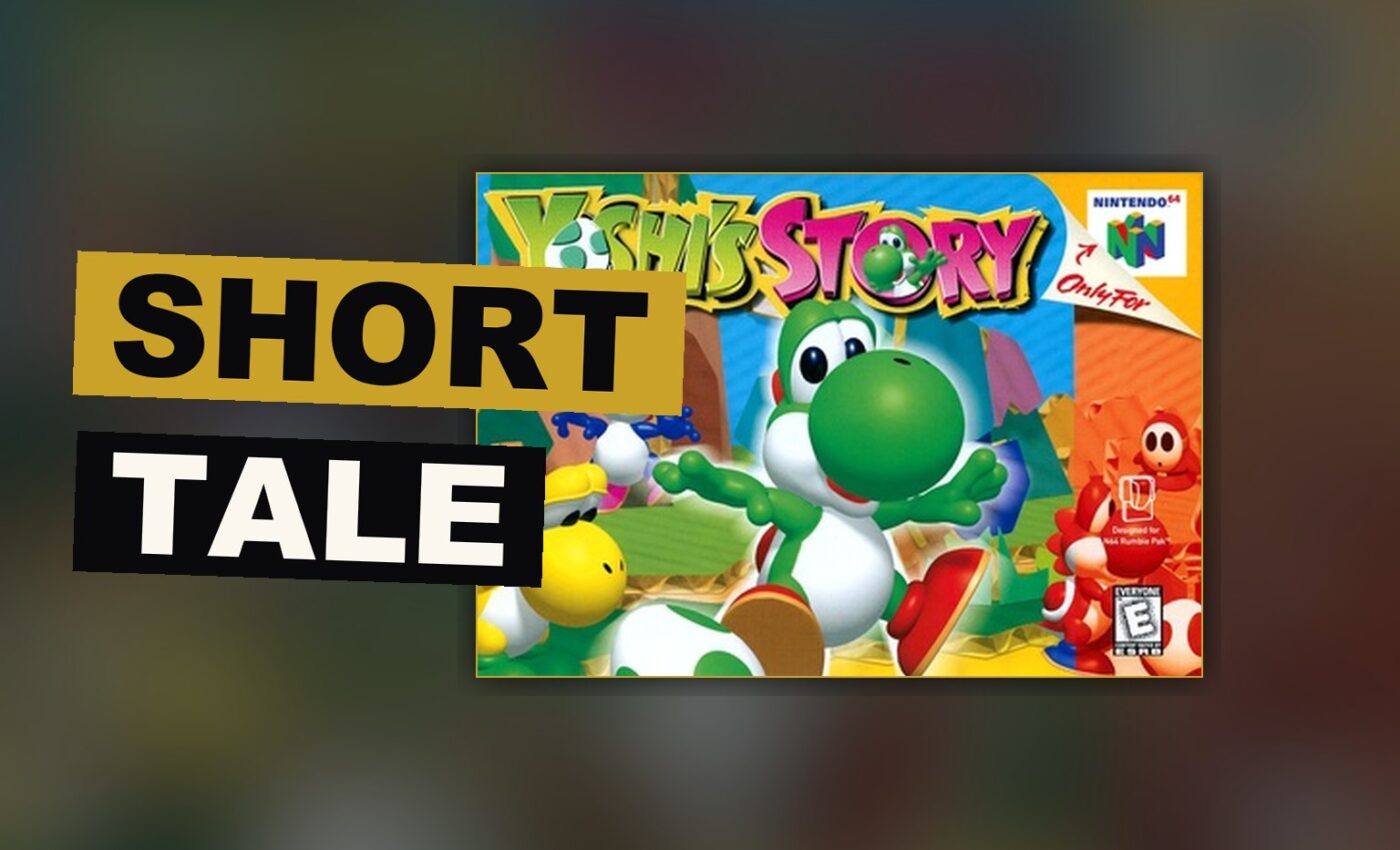
Yoshi’s Story arrives on Nintendo 64 as a bright, musical break from the platformers around it. It trades wide, open worlds for small, packed pages that read like a picture book. That choice explains everything good and frustrating about the game.
The Setup
Six heroes, each a different color, set out to save the Super Happy Tree after a young foe takes it away. Each level is a page turned in a painted book, framed with painted borders and soft, rounded scenery. The look holds up as one of the console’s most distinct styles.
Controls are simple. The hero bounds with a light spring, flaps to drift slowly to the ground, and eats fruit and enemies with a long tongue. Eating enough fruit fills the frame and closes out the level, and eating a hero’s preferred color adds an extra gain on top. The goal is not reaching a finish line. It is eating well and staying alive.
What Works
The presentation carries the game. Character animation is smooth and full of life, and the music changes along with the hero’s condition during play, a small touch that fits the mood without calling attention to itself. Fights against bosses are clever, built around watching enemy moves rather than fast timing, and they suit the gentle tone of the game.
A short list of strengths stands out clearly:
- A distinct, painted style unlike anything else on Nintendo 64
- Music that changes with how the hero is doing in the moment
- Boss fights with clear, readable moves to learn
- Simple controls suited to younger or newer players
What Holds It Back
Length is the game’s biggest problem. Yoshi’s Story offers only six pages out of a larger set in a full run, and skilled players can clear them fast. There is little push to look around beyond eating fruit, since levels do not scroll back and secrets are few and rarely found.
Difficulty rises and falls without much middle ground. Bosses can test the player, but the levels leading up to them are gentle enough that little pressure builds along the way. The game feels built for short sessions rather than long, steady play, and that keeps it from matching the depth found in other platformers of its time.
A full run, start to finish, comes in well under an hour. The rough order of a single playthrough looks like this:
| Page | Order in the Run | Note |
|---|---|---|
| 1 | Opening | Introduces plain controls |
| 2 | Early | Fruit gathering builds toward filling the frame |
| 3 | Middle | Difficulty stays gentle |
| 4 | Middle | Path may change based on fruit collected |
| 5 | Late | Leads into the final part |
| 6 | Closing | Boss fight ends the run |
That order repeats no matter which six of the game’s pages a player happens to see, since the choice of path changes the scenery but not the shape of the run.
The Pages and Final Word
The design of the game means every playthrough only shows part of the full set of pages, chosen by which fruit the player gathers along the way. That variety gives the short game a bit of replay value, since two runs rarely look exactly alike.
The reward for finishing is mostly for show. Players open new page paths tied to fruit choices, along with a scoring system that ranks how well each level was played. That scoring adds a light reason to try again for those chasing a perfect score, but it does not conceal how quickly the main content runs short. Yoshi’s Story is built entirely around one player working through the pages alone, with no mode for a second person to join in.
Yoshi’s Story succeeds as a display of style. Its music, animation and painted look remain worth remembering, and its simple controls make it a fine start for younger players. But its short length and changing difficulty keep it from standing beside the best of its console’s other platformers. It is a pleasant, polished treat of a game rather than something larger.