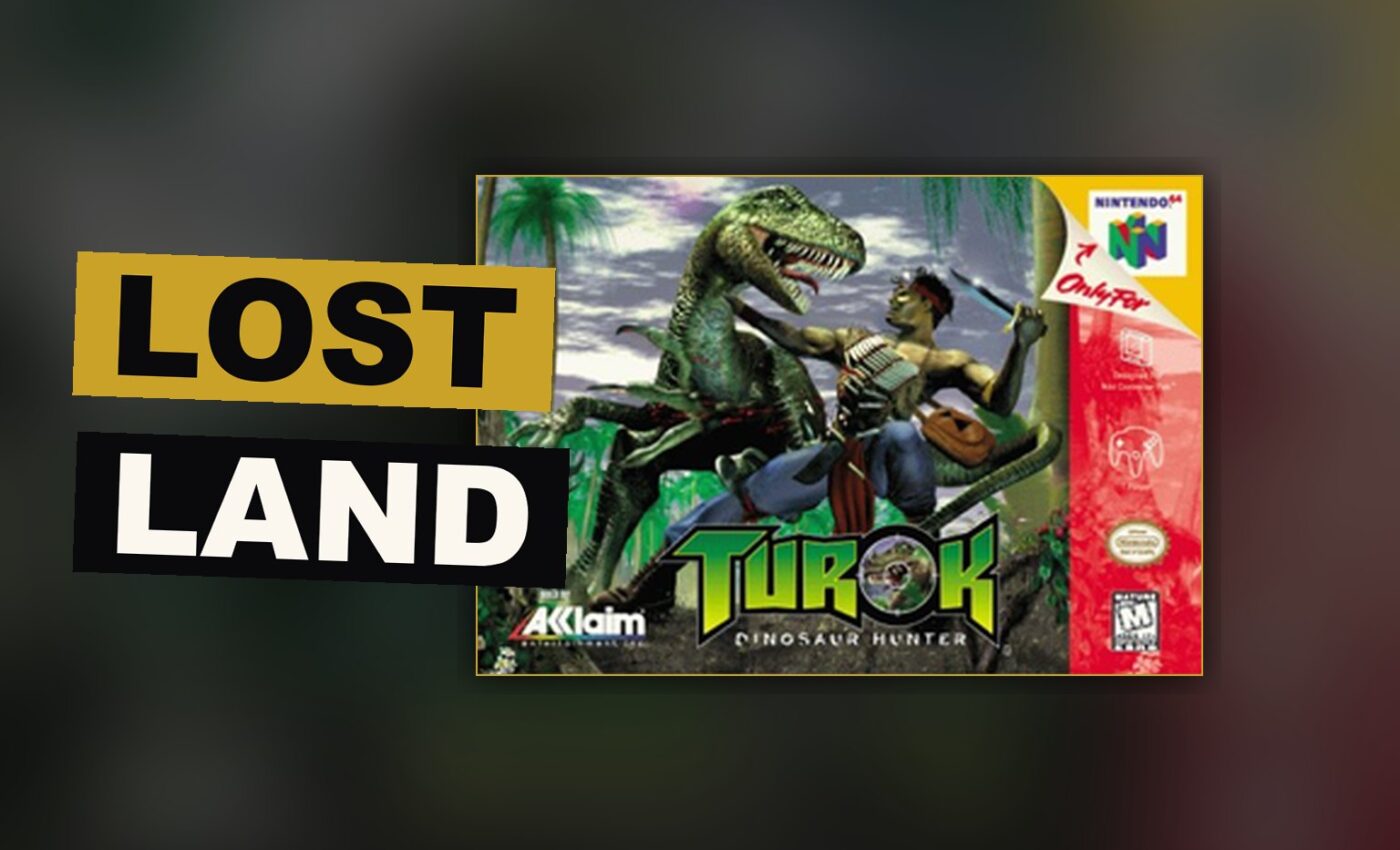
Turok: Dinosaur Hunter arrived on the Nintendo 64 in January 1997 with a mandate heavier than most launch-window games carry. Acclaim needed it to work. The publisher had bought Valiant Comics in 1994, renamed it Acclaim Comics, and built a strategy around developing games in-house and licensing the merchandise that came with them. Cash flow was tight and sales were falling. Turok was its best hope for a financial turnaround.
It paid.
Iguana’s cartridge squeeze
Iguana Entertainment developed the game, and the studio pushed the Nintendo 64’s graphics to their limit. The cost was visible in the cartridge: 8 megabytes, which forced the team to compress or cut elements to fit. Bugs pushed the release from September 1996 to January 1997.
The result is a first-person shooter that borrows Doom’s run-and-gun energy and Tomb Raider’s exploration, then sets both loose in jungle. Players start in a hub level with portals to seven other stages. Keys are scattered across those stages. Feed enough keys into a portal’s lock mechanism and the level opens.
The Chronoscepter and the Campaigner
The player controls Tal’Set, a Native American time-traveling warrior who holds the mantle of Turok. The title passes every generation to the eldest male, and each Turok guards the barrier between Earth and the Lost Land — a primitive world where time has no meaning and where dinosaurs and aliens share ground.
The Campaigner, an evil overlord, wants the Chronoscepter. The weapon was broken into pieces precisely so it could not fall into the wrong hands. He plans to magnify it with a focusing array, tear down the barriers between the ages of time, and rule the universe. Turok vows to find all eight pieces first.
Thirteen weapons and a health number
Turok carries 13 weapons plus the Chronoscepter, from a knife and bow up to high tech gear. Everything but the knife needs ammunition, dropped by dead enemies or found in levels. Enemies and bosses have multiple death animations depending on which body region the player hits. Because dropped items vanish fast, fights happen at close range.
Health is a number at the bottom of the screen. Full health reads 100. Hitting 0 costs a life; losing the last one ends the game. Life force points scattered through levels add a life per 100 accumulated. Powerups restore health and can push it above full. Shooting deer or other non-threatening wildlife also adds health points.
Turok: Dinosaur Hunter is a first-person shooter video game developed by Iguana Entertainment and published by Acclaim Entertainment.
That plain description undersells what the game does with movement. Players jump, swim, climb, crawl and run through large levels, and the traversal is as much the point as the shooting.
Where the slowdown bites
The complaints are real and they have not aged away. Multiple enemies onscreen cause graphical slowdowns. The controls are occasionally awkward, and in a game that asks for close-range engagement against disappearing drops, awkward controls cost lives.
The slowdown is the harder problem. Iguana spent its 8-megabyte budget on ambition, and when the screen fills with dinosaurs and gunmen, the frame rate suffers. It is a trade the studio chose, and it is visible.
Why Turok still holds
Turok became one of the most popular games for the console on release and sold 1.5 million copies. It boosted Nintendo 64 sales. It won praise for its graphics and for evolving the genre, and it spawned a franchise that includes a direct sequel.
The praise was earned. Turok took the first-person shooter out of corridors and gave it space to explore, then filled that space with poachers, gunmen, indigenous warriors, dinosaurs, demons and insects. The hub-and-portal structure gives the seven stages a shape instead of a list. The Chronoscepter pieces give every level a reason to be searched rather than cleared.
The health-as-a-number choice is smarter than it looks. A meter tells you roughly how you are doing. A number tells you exactly, and it makes every hit a subtraction you can calculate. The life force system turns exploration into a slow accumulation of extra chances, and the wildlife health trick rewards players who pay attention to what the levels actually contain.
What Acclaim’s bet bought
Turok: Dinosaur Hunter is a launch-era Nintendo 64 game that pushed the console’s graphics to their limit and mostly got there. The slowdown and the controls are genuine faults, not nostalgia-filtered ones. But the scale of the levels, the weapon variety, the boss death animations and the hub structure make it more than a Doom clone in jungle paint.
Acclaim handed its best hope for a turnaround to a studio that pushed a console to its limits and shipped something people wanted to play. The franchise that followed is the proof.
Get the Notebook.
The day's best stories and every fresh verdict, in plain English, in your inbox by seven. One email a day, no more.