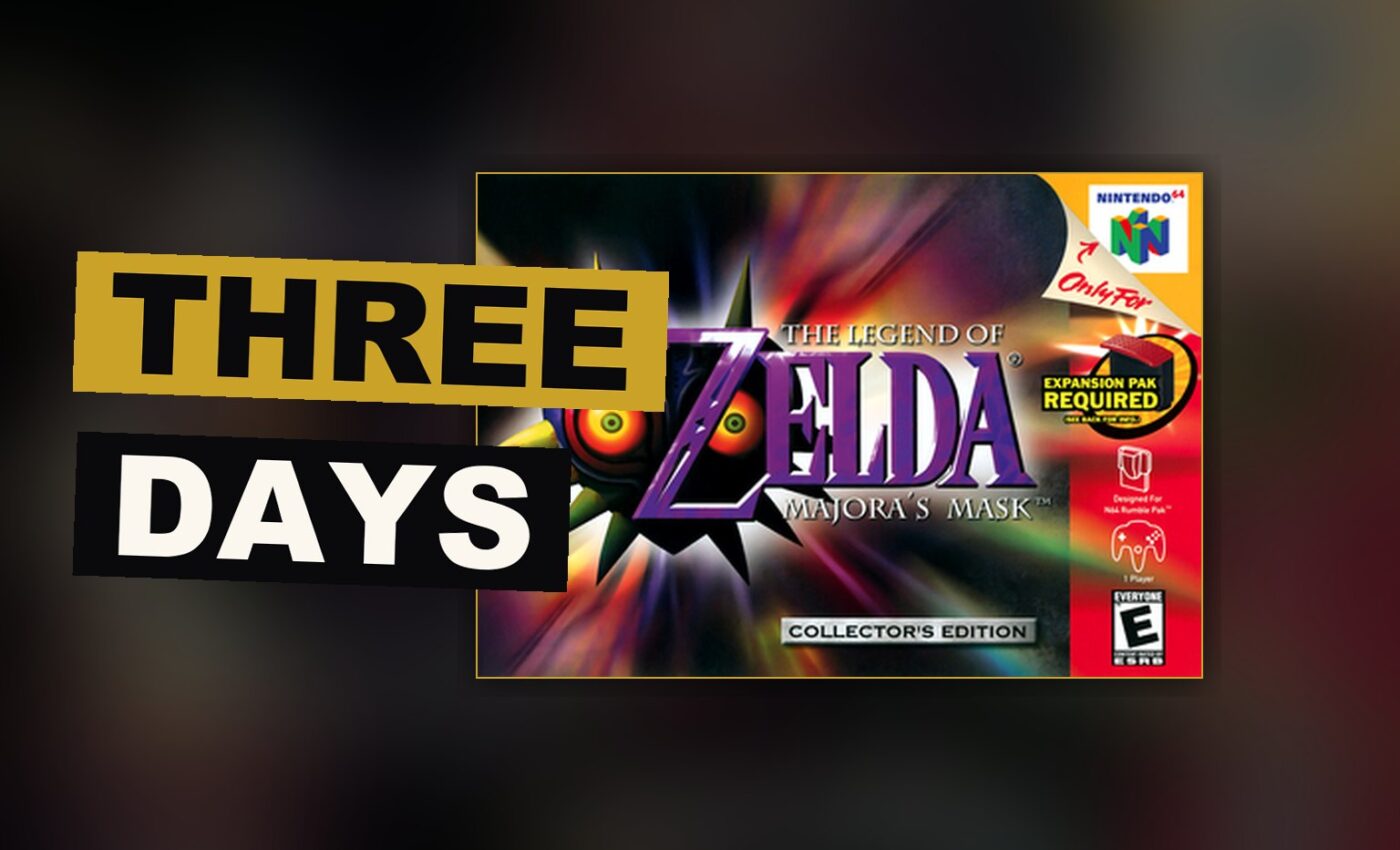
The moon falls in three days in The Legend of Zelda: Majora’s Mask, and that single fact makes this one of the boldest games Nintendo ever put on a cartridge.
The Moon and the Mask
The moon falls at the end of a set span of time. Link cannot stop it forever, only push against it, again and again, using the Song of Time to turn the world back and try once more. That plan could have felt cruel. Instead it makes every choice weigh more.
The masks give the game its shape. Wearing one mask lets Link move as a small forest child, another lets him take the form of a stout mountain fighter, and a third lets him swim as a creature of the sea, changing what Link can do and where he can go. The people of the town do not exist to fill space. Each one follows a private path tied to the falling moon, and watching those paths cross and meet across the three days is where the game finds its heart.
Small Cast, Big Weight
- A father searching for his missing son
- A couple whose wedding may never happen
- A worker guarding against robbers at night
- A musician carrying grief no one else understands
None of them can be saved for good in a single pass through the three days. Link can only ease their night, then turn back time and lose the moment. That habit builds a strange, sad bond of feeling rare in any game of this kind.
Comparing the Two Worlds
| Element | The Game Before It | The Legend of Zelda: Majora’s Mask |
|---|---|---|
| Shape | Long, straight quest | Repeating span of three days |
| World | Wide and open | Tight and full |
| Mood | Bright, hopeful | Heavy, sad |
| Core instrument | Songs played on a small wind instrument | The Song of Time and masks that change Link’s form |
The comparison matters because The Legend of Zelda: Majora’s Mask uses the same engine and the same character model as the game before it, yet bends both toward something far stranger. It is a sequel that refuses to repeat itself.
There are fewer dungeons here than in past Zelda games, but each one is built closely around its own mask and its own trick, rewarding care over force. The final part, working through a great stone temple and preparing to face Majora’s Mask itself, asks players to hold several forms and timing tricks in mind at once. It asks a lot. It also feels deeply satisfying when it comes together.
Some players will find the falling moon hard to sit with, and the game does not ease that pressure. That weight is the point, not a fault to smooth over.
The Legend of Zelda: Majora’s Mask takes real risks with its own design and lands nearly all of them, giving players a strange, sad, lasting few days in a town under a falling moon.