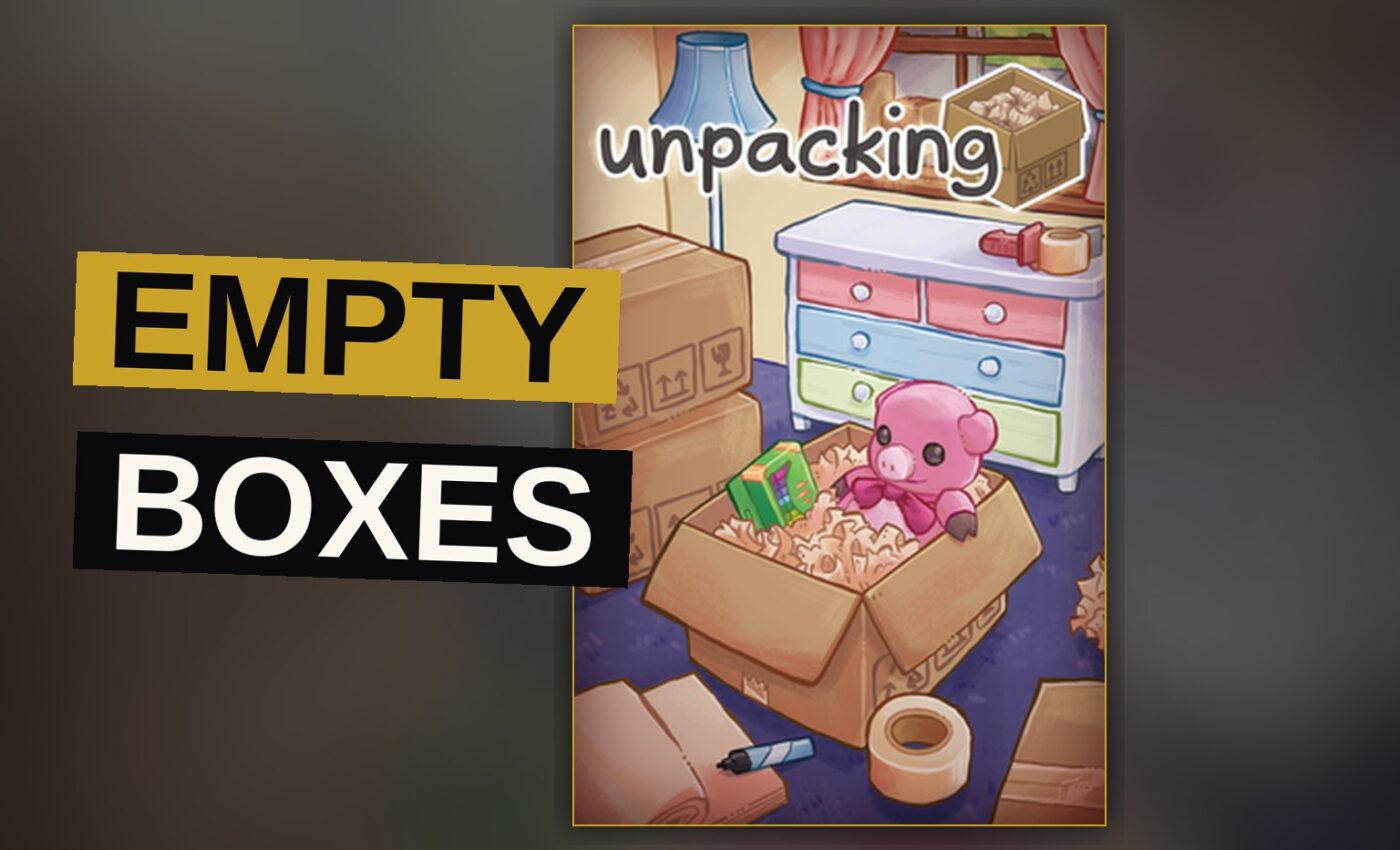
Unpacking asks you to do something most games spend their whole running time avoiding: put things away. Witch Beam’s 2021 puzzle game is built on the mundane act of pulling possessions from boxes and fitting them into a new home, and it turns that chore into one of the most quietly affecting releases of its year.
It is part block-fitting puzzle, part home decoration. You create a satisfying living space, and along the way you learn clues about the life you are unpacking. That is the whole pitch, and it is enough.
Trailer, via Witch Beam.
Eight Moves, Eight Years
Unpacking is divided into stages named by the years in which they take place: 1997, 2004, 2007, 2010, 2012, 2013, 2015, and 2018. In each stage you unpack a female character’s possessions from boxes into a new dwelling.
The structure is the story. Across eight house moves you build a sense of intimacy with a character you never see and a story you’re never told. You discover her life through the items that come with her to each new home — and through the items that get left behind. There are 35 rooms across all the dwellings.
Some items have designated places they must go in order to complete a stage. That constraint is the puzzle. Everything else is yours to decide.
| Year | Move |
|---|---|
| 1997 | First stage |
| 2004 | Second stage |
| 2007 | Third stage |
| 2010 | Fourth stage |
| 2012 | Fifth stage |
| 2013 | Sixth stage |
| 2015 | Seventh stage |
| 2018 | Eighth stage |
The Boxes Do the Talking
Here is the smartest thing Unpacking does. It never shows you the woman whose life you are handling. It never names her. It hands you her belongings and lets you read.
The game gives you her possessions and the places she lives, and asks you to work out the rest. When something does not come along to the next address, you notice. When something new appears, you notice that too. Witch Beam trusts the player to do the noticing, and that trust is the reason the game lands.
The designated-slot rule could have flattened all of this into a chore. It doesn’t, because the game withholds judgment about most of what you place. You are not being graded on taste. You are being asked to make a home for someone, and the small decisions are the only language the game gives you.
A Zen Puzzle That Earns Its Calm
Unpacking is filed as point-and-click, puzzle, simulator and indie, with a drama theme, a single-player mode and a bird’s-eye isometric view. Those labels undersell how deliberate the thing is. The camera stays above the room. The pace stays slow. Nothing chases you.
That restraint is a choice, and it mostly pays off. The game is short enough that the loop never curdles into busywork, and the eight-stage span gives the repetition a shape.
Where it stumbles is in the friction between freedom and rule. The items that must go in specific spots can interrupt the decorating you were enjoying. It is a small complaint against a game that otherwise knows precisely what it is.
Awards and the Case for 8.3
Unpacking received positive reviews and won several awards, including two BAFTA Games Awards, a D.I.C.E. Award for Outstanding Achievement for an Independent Game, and Game of the Year from Eurogamer. It is available on PC, Mac, Linux, iOS, Android, Nintendo Switch, Xbox One, PlayStation 4 and PlayStation 5.
That is a lot of hardware for a game about cardboard. It also makes sense, given how small the interaction is and how many screens it has landed on.
The awards tell you the industry noticed. What they do not tell you is why the game holds up after the novelty of the first few rooms wears off. The answer is that Unpacking is not really about tidiness. It is about the accumulation of a life and the way a home records it, and it makes that argument without a single line of dialogue.
The 8.3 is the right number. Unpacking is not a game that overwhelms you with systems or length, and it does not try to. It is a small, exact piece of design that does one thing with unusual care, and the designated-slot friction keeps it from being flawless. What it gets right — the patience, the withholding, the way a left-behind object carries more weight than any cutscene could — is the part worth remembering.
Unpacking earns its calm. It asks you to put a stranger’s life in order and then lets you feel the weight of it, one box at a time.
Get the Notebook.
The day's best stories and every fresh verdict, in plain English, in your inbox by seven. One email a day, no more.