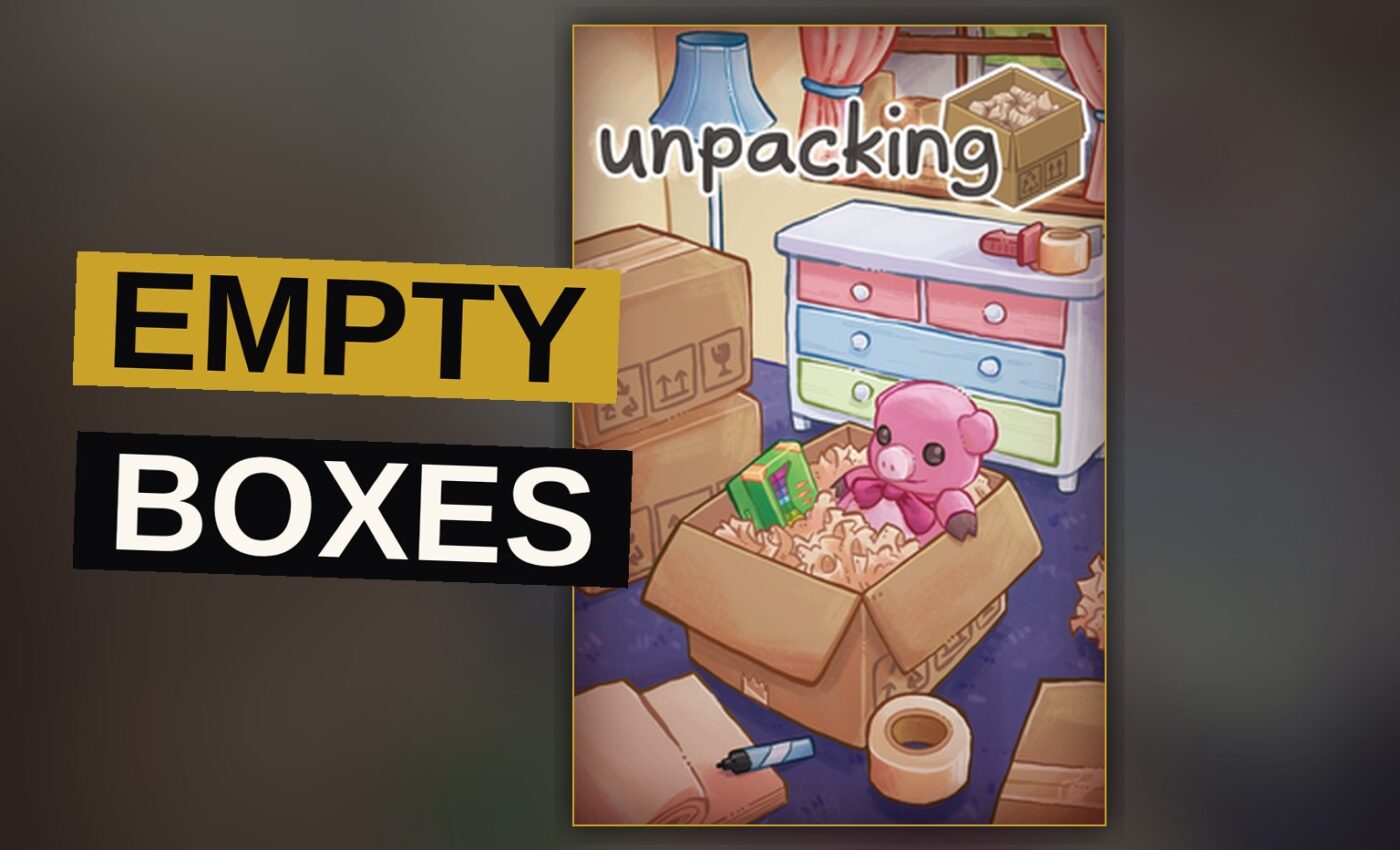
Unpacking asks players to do one thing: take objects out of boxes and find a place for them. That simple act carries an entire life story, told without a single line of speech. The game, released in 2021 for PC, Switch, Xbox One and Xbox Series X/S, earned a critical score of 8.3 out of 10, and it holds up as one of the most quiet and effective narrative games of its year.
Trailer, via Witch Beam.
Empty Rooms and Full Boxes
Each level drops players into a bare room and a pile of boxes. The task is always the same: empty every box and put each item somewhere sensible. There’s no clock counting down, no failure state, no score for speed.
The game trusts players to read the story through where things end up, not through anything said aloud. A diploma from finishing school goes on a wall. A toy from childhood ends up in a box marked “keep,” carried from one home to the next across the years. Nothing is spelled out. Everything is left for the player to notice.
Because the game never explains itself, the small choices players make start to feel like their own. Put a book on a shelf in the wrong room, and nothing bad happens, but it feels wrong still, and that feeling is the whole point.
Eight Moves Across the Years
The woman at the center of Unpacking, who is never named, moves eight times across the years the game covers, from a child’s bedroom to a shared apartment to a house that finally feels like her own. Each move marks a milestone: finishing school, a first job, a parting from someone she loved, a marriage that later comes apart.
The game never states any of this directly. Players work it out from what shows up in the boxes and what has gone missing since the last level. A shared bookshelf in one level is split awkwardly across two smaller shelves in the next, a small but clear sign that a shared life has ended.
The chapters are marked by years, not by the ages of the protagonist. The game’s own framing lists each move by the year it happens, and players track the passage of time through that calendar rather than through any stated birthday. This makes the story feel less like a biography and more like a record of a life as it actually unfolds — one year at a time, one box at a time.
| Move | Year | Setting |
|---|---|---|
| 1 | 1997 | Childhood bedroom |
| 2 | 2004 | Shared bedroom, first move |
| 3 | 2007 | First apartment |
| 4 | 2010 | Shared apartment with partner |
| 5 | 2012 | Small house |
| 6 | 2013 | Larger shared house |
| 7 | 2015 | Studio apartment, alone |
| 8 | 2018 | Final house |
A Diploma Under the Bed
Small objects carry great weight in this game. A diploma that gets placed in one level and proudly hung on a wall in another tells players more about confidence and circumstance than any spoken scene could. The detail of where it sits changes from one home to the next, and that change is the story.
A well-known beat involves the diploma being put under a bed in a later level, a small but pointed statement about how the protagonist’s feelings about that achievement have shifted. The game doesn’t say anything about it. It doesn’t need to.
The same is true of a sewing machine that keeps showing up across the years, on a desk, inside a closet, and finally given a whole room of its own. It’s a quiet thread about a creative life that continues even as everything around it changes.
The Controls Struggle
Unpacking’s controls are simple by design, but simple doesn’t always mean smooth. Turning and setting down objects with a controller can be awkward, especially with oddly shaped items that need to fit into narrow spaces.
On PC, the mouse makes this easier.
On Switch and Xbox, the process sometimes slows the pace of what should be a calm, unhurried experience. A few levels ask players to fit a dozen small items into a single crowded drawer, and getting each one to sit right can take longer than it should.
Logic in the Kitchen
The most satisfying levels are the ones with real thinking to do about where things belong. Kitchens, in particular, ask players to think about use: where do knives go, where do plates pile up, what fits under a counter and what doesn’t.
The game does allow some freedom. Items can go in more than one “correct” spot, and the story doesn’t punish choices made in good faith. But there are wrong answers too. Placing a brush for teeth in a kitchen drawer will get flagged the next morning, when the game gently shows that something is out of place.
The Ring That Vanishes
The game’s most striking moment of telling its story without words involves an engagement ring. It appears in one level’s boxes and finds a place on the table beside the bed. In the following level, it’s simply gone.
No text confirms what happened between the two levels.
No characters discuss it aloud.
The absence is the entire story, and it lands harder than any spoken explanation would have. The ring is not hidden or buried; it is simply not there, and the player is left to draw the only conclusion that makes sense.
The Final House
The final level offers a kind of resolution, a home that finally feels complete, shared with someone whose belongings mix easily with hers rather than crowding her out. The difference between this room and the earlier, more cramped, more compromised living spaces is clear the moment players start setting things down.
It’s a satisfying close to a story told entirely through what ends up on the floor, on the shelves, and on the walls.
Unpacking doesn’t stay too long in any one place. A full playthrough covers eight moves and takes a few hours, and the pace never drags because each level feels truly different from the last, both in the objects it hands players and in the life stage it represents.
The lack of speech is a strength, not a limitation. Players fill in the blanks themselves, guided by where things are put rather than by explanation, and that trust in the audience gives the game a rare kind of closeness to its subject. Few games manage to say this much about a person’s life while saying nothing at all.
Unpacking earns its reputation as a small, thoughtful game that does a great deal with very little. It scores 8.3 out of 10.