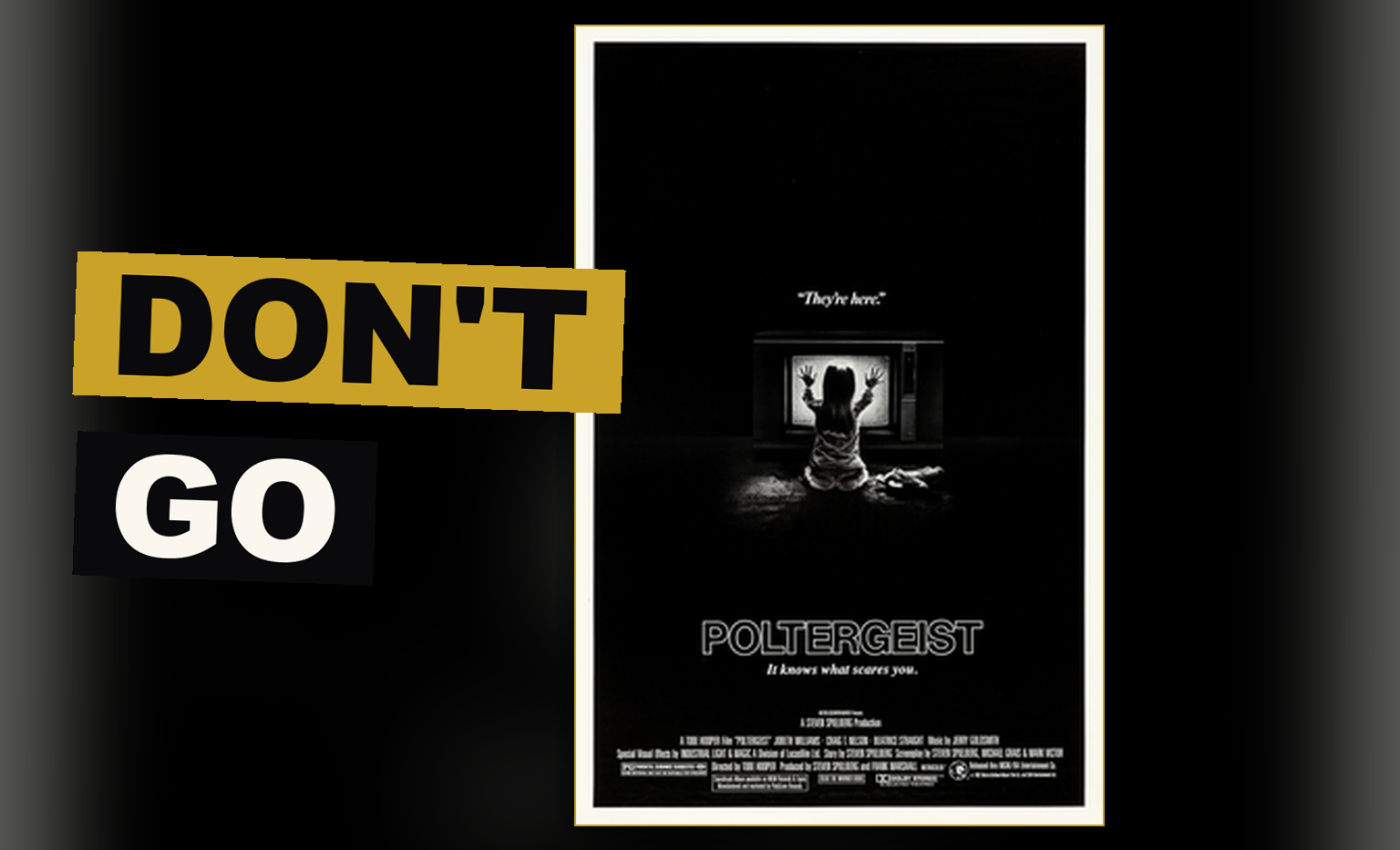
Tobe Hooper’s Poltergeist opens on a television playing static, and that image never leaves. A five-year-old girl talks to the screen. A ghostly hand pushes through the glass. The house shakes. The family wakes to a child’s voice saying the line everyone remembers.
“They’re here.”
That is the whole movie in one night. Poltergeist is a haunted-house film built on a simple, cruel idea: the thing that takes your child is already inside your home, and it came in through the appliance you leave on.
The Freelings of Cuesta Verde
Steve Freeling (Craig T. Nelson) sells houses in the planned California community of Cuesta Verde. Diane (JoBeth Williams) raises their three children: Dana, sixteen; Robbie, eight; and Carol Anne, five. Their life is ordinary, suburban, and a little smug.
Then the static starts. A glass of milk breaks by itself. Silverware bends. Furniture slides across the floor. Hooper stages these early events as mischief, almost jokes, before the film turns.
The turn is brutal. During a thunderstorm, the backyard tree comes alive. A branch smashes through the children’s bedroom window and drags Robbie outside into the rain. While the family runs to save him, Carol Anne is pulled into a portal inside her closet.
A Portal in the Bedroom Closet
The film does not explain the portal. It does not need to. Carol Anne’s voice comes out of the television, and that is enough to tell the Freelings she is alive somewhere.
Parapsychologist Martha Lesh (Beatrice Straight) arrives with Ryan and Marty. They find a poltergeist intrusion — multiple ghosts, not one. Steve learns from his boss Lewis Teague that Cuesta Verde was built over a cemetery, and the graves were moved somewhere else.
That detail lands harder than any ghost. The horror has a paper trail.
Zelda Rubinstein Walks In
Zelda Rubinstein plays Tangina Barrons, the medium Dr. Lesh calls in. She tours the house and explains that Carol Anne is on another plane of existence. Rubinstein is small, calm, and completely certain, and she owns every scene she is in.
The film’s best stretch is Tangina’s. The séance, the closet, the rescue — Hooper keeps it tight and physical.
Spielberg Wrote It, Hooper Directed It
Steven Spielberg wrote Poltergeist with Michael Grais and Mark Victor, from his own story, and produced it with Frank Marshall. He could not direct it himself while making E.T. the Extra-Terrestrial, so Hooper was hired on the strength of The Texas Chain Saw Massacre and The Funhouse.
Accounts differ on how much Spielberg actually controlled. He was on set often and had real creative authority. Some have argued he should count as co-director or even the main director. Both men have disputed that.
You can feel both hands. The suburban warmth is Spielberg’s. The mean streak, the tree, the house turning on its family — that is Hooper.
What Holds Up and What Doesn’t
The effects mostly hold. The tree is a puppet and looks like one, but the intent reads. The closet portal is a trick of light and sound, and it still works. The film’s real weapon is the house itself, a normal place made hostile.
What does not hold is the ending’s noise. After the rescue, Poltergeist throws everything at the screen, and the precision of the first hour goes slack.
The performances carry it. Williams plays Diane as a mother who refuses to grieve, and Nelson plays Steve as a man whose job built the problem. Heather O’Rourke, as Carol Anne, has almost no dialogue and is still the center of the film.
The House Was Built on Moved Graves
Poltergeist was released by MGM/UA on June 4, 1982. It was a critical and commercial hit, the eighth-highest-grossing film of that year, and it earned three Academy Award nominations. It has since been called a horror classic, and that label is fair.
The reason is not the ghosts. It is the graves under the development. A real-estate agent sells families a home built on moved bodies, and the dead come back for the children. Poltergeist is a haunted-house movie that is also about what a salesman will not tell you.
Hooper and Spielberg made a film about a family that cannot leave, because leaving means admitting what their home was built on. That is why the static still works.
7.3 of 10.
Get the Notebook.
The day's best stories and every fresh verdict, in plain English, in your inbox by seven. One email a day, no more.