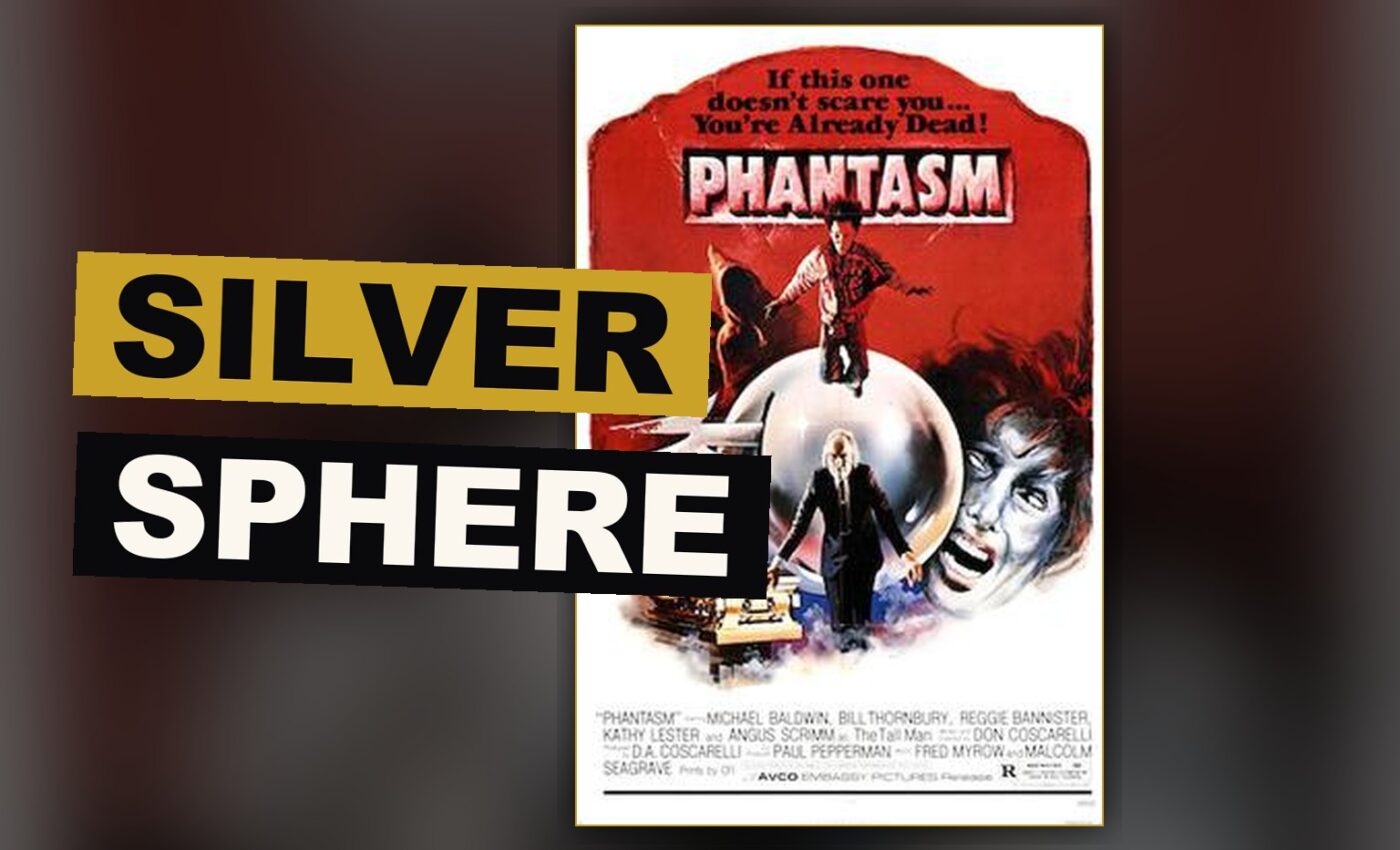
A man in a dark coat guards a small graveyard, and once you have seen him, you do not forget him. That is the promise and the proof of “Phantasm,” Don Coscarelli’s 1979 horror film, a work this paper holds in especially high esteem.
The Man in the Dark Coat
The story follows a boy who watches a burial parlor run by a figure known only by his height and his silence. The boy sees things he should not see: caskets that hold more than bodies, a strange silver sphere that moves through the air on its own, and doors that open into places far from the town where the story starts. Coscarelli, who made the film on a small budget and a few settings, builds a world where the strain never shows as a weakness. It shows as invention.
The film does not explain itself in a hurry. It lets images sit: a long dark car moving down an empty road, a hand reaching from a coffin, a chase through halls that seem to fold back on themselves. Some of this plays like a dream because it is meant to. “Phantasm” trusts its audience to hold questions without answers, a trust few horror films of its time extended.
The Silver Sphere
The film’s best known invention is a small flying sphere, keen and deadly, that strikes anyone unlucky enough to cross its path. It says nothing and needs nothing explained about it. On screen for only a few scenes, it does more work than words could. It has since become a mark of the film itself, known at once to anyone who has seen it.
The actor who plays the man in the dark coat gives him a quiet that troubles more than any cry out. He barely raises his voice. He does not need to.
Where the Ratings Split
Here the paper breaks from the wider room. The wider critical score for “Phantasm” sits at 7.2 out of 10, a solid but plain mark that treats the film as a curious object of small 1979 horror. This paper does not see it that way. We score it 9.3 out of 10, a difference we will not cover up. Where others see rough edges, we see a film that turns its limits into its own language, one whose logic works like the logic of a dream and asks to be judged on those terms.
That is our own high regard, not the wider one, and we say so plainly rather than pretend the two match.
| Element | Wider Rating | This Paper’s View |
|---|---|---|
| Total Score | 7.2 / 10 (wider critical score) | 9.3 / 10 |
| The man in the dark coat | Effective, minor horror figure | The heart of the film, long remembered for its quiet |
| Silver Sphere | A novelty | A signature threat, still keen |
| Story logic | Not even, shaped by limits | Dream logic, deliberate and controlled |
Built to Last
The 1979 film stands alone, strange and whole, a small horror movie that plays like it knows something its audience does not. What holds up is not polish. It is the courage to take a boy’s fear of death, of burial homes, of grown men who keep secrets, and turn it into something with real teeth — a sphere that moves on its own, and a coat that never seems to leave the frame.
This paper rates “Phantasm” 9.3 of 10, a mark few films from that year, or since, have earned from this desk.