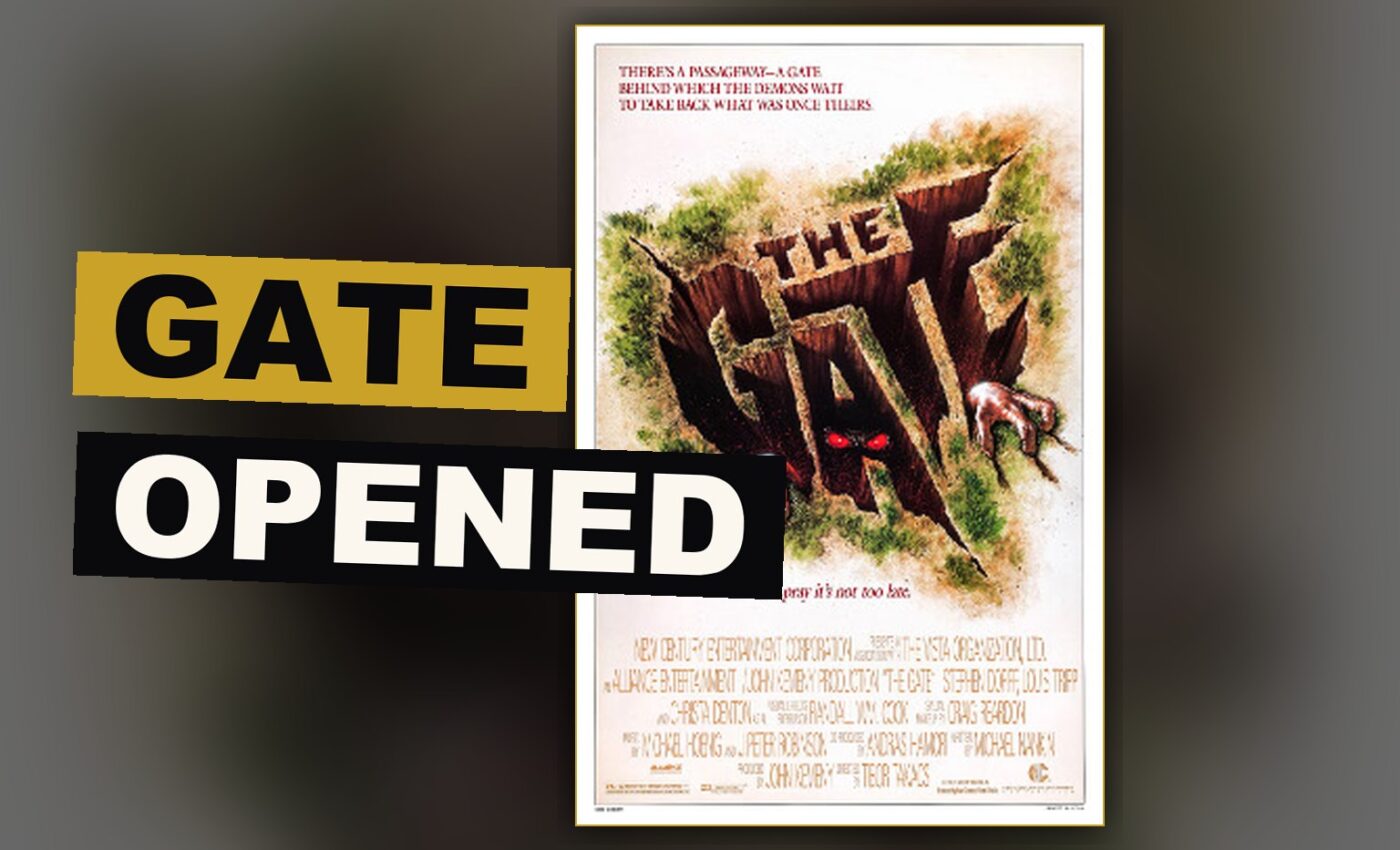
The Gate opens on a nightmare and never really leaves it. Tibor Takács’s 1987 film starts with Glen dreaming that his house stands empty, that he climbs into his tree-house, and that lightning splits the tree and drops it on him. He wakes to find the tree already gone — cut down by workmen in his own backyard. The dream was early. That is the whole engine of The Gate: something underneath the ordinary lawn has been waiting, and the people digging it up are the last to understand what they have done.
A Geode in the Backyard
The workmen unearth a large geode. Glen and his older friend Terry find it, and Glen catches a splinter, leaving a small amount of blood behind. That detail matters more than the film lets on at first.
Blood is the first thing the hole gets.
Glen’s parents leave town, putting his sister Alexandra, called Al, in charge. Al throws a party. While the party-goers play a levitation game downstairs, Terry and Glen break open the geode. They find strange writing left on a notepad, read the incantations aloud, and the night turns.
Everyone at the party is shocked when Glen levitates. Glen sees his bedroom wall stretching. Terry embraces an apparition of his dead mother, which turns out to be Glen’s dog Angus — and Angus dies as a result. By morning the film has taken three children, one suburban house, and a dead pet, and has not yet shown its monsters.
“Pray it’s not too late.”
The tagline is a promise the film keeps. Terry brings a heavy metal album to Glen’s house with lyrics based on “The Dark Book.” He believes the hole in the backyard is a gateway to a domain of evil gods, and speculates that their actions opened it. He concludes that the only missing element would be to deposit a sacrifice into the hole. Unknown to either boy, a friend of Al’s dumps Angus’s body in. The summoning completes itself.
The boys read a section from “The Dark Book” that was supposed to close the gateway. They find the hole closed and assume they have succeeded. Then a swarm of moths shatters Glen’s bedroom window, and Angus’s corpse is found in Terry’s bed. Demonic arms try pulling Al under her bed. Terry and Glen barely save her.
They try to leave the house and are greeted outside by Glen and Al’s parents, who are demons in disguise. The nightmarish hell is not in the yard anymore. It is wearing the family’s faces.
Pint-Sized Demons, Full-Size Dread
The demons are small. That is the film’s smartest decision and its strangest one. A horde of pint-sized things pouring out of a hole in a lawn should be funny, and The Gate knows it, and refuses to let the joke save you. The battle between good and evil here is fought by three kids against creatures that fit through a bedroom window.
Takács does not waste time. The film is a horror-fantasy by genre and a domestic siege by structure: parents gone, sister in charge, house under attack, no adult worth trusting once the parents come back wrong. Michael Nankin wrote it. A 3D remake directed by Alex Winter was in production, initially set for a release in 2011, but no release occurred at that time.
Stephen Dorff plays Glen in his film debut. Christa Denton plays Al. Louis Tripp plays Terry Chandler. Kelly Rowan and Jennifer Irwin play Lori Lee and Linda Lee. Deborah Grover and Scot Denton play the parents. Ingrid Veninger, Linda Goranson, Sean Fagan, Carl Kraines and Andrew Gunn round out the cast.
Why the Small Stuff Works
Watch what the film does with scale. Terry loses his mother twice — once to death, once to an apparition that turns out to be the dog, which then dies. Glen levitates in front of a room full of teenagers and nobody can explain it. Al is dragged under her own bed in a house she was left to run. The Gate keeps shrinking its threats until they are the size of a child’s room, and that is exactly why they land.
The film’s demons are nasty and small, and the movie never apologizes for either. It also never explains the rules past what Terry can guess from a book and an album. That refusal is a strength. A gateway that comes with a manual is a puzzle. A gateway that comes with a heavy metal record and a dead dog is a nightmare.
The Score, and Whose Score It Is
IMDb publishes a score for The Gate. This paper’s own score is a 9.0, arrived at separately. The point is not that the two agree — they do not. The point is that a film released in 1987, buried among the horror output of its year, still holds a 9.0 with this paper.
Pray it’s not too late.
The parts that matter most are the ones a lesser film would cut. The splinter and the blood. The notepad writing itself. The levitation game played by kids who have no idea they are mid-ritual. The parents who come back and are not the parents. The Gate builds its horror out of household objects and household people, and it does not need a bigger budget than it had.
The parts that matter least are the ones the film races past. The mythology of “The Dark Book” stays thin. The 3D remake that Alex Winter was set to direct never arrived.
What The Gate understands, and what most demon movies forget, is that the scariest thing in a child’s life is not the monster. It is the moment the adults leave, and the moment they come back changed. Glen and Al get both. Terry gets a mother who is not his mother, and then a dog who dies for the mistake of being loved.
That is the film. A hole in the yard, a book nobody should read, a record nobody should play, and three kids holding a house together because there is no one else. Takács made it in 1987 and it still holds.
Get the Notebook.
The day's best stories and every fresh verdict, in plain English, in your inbox by seven. One email a day, no more.