
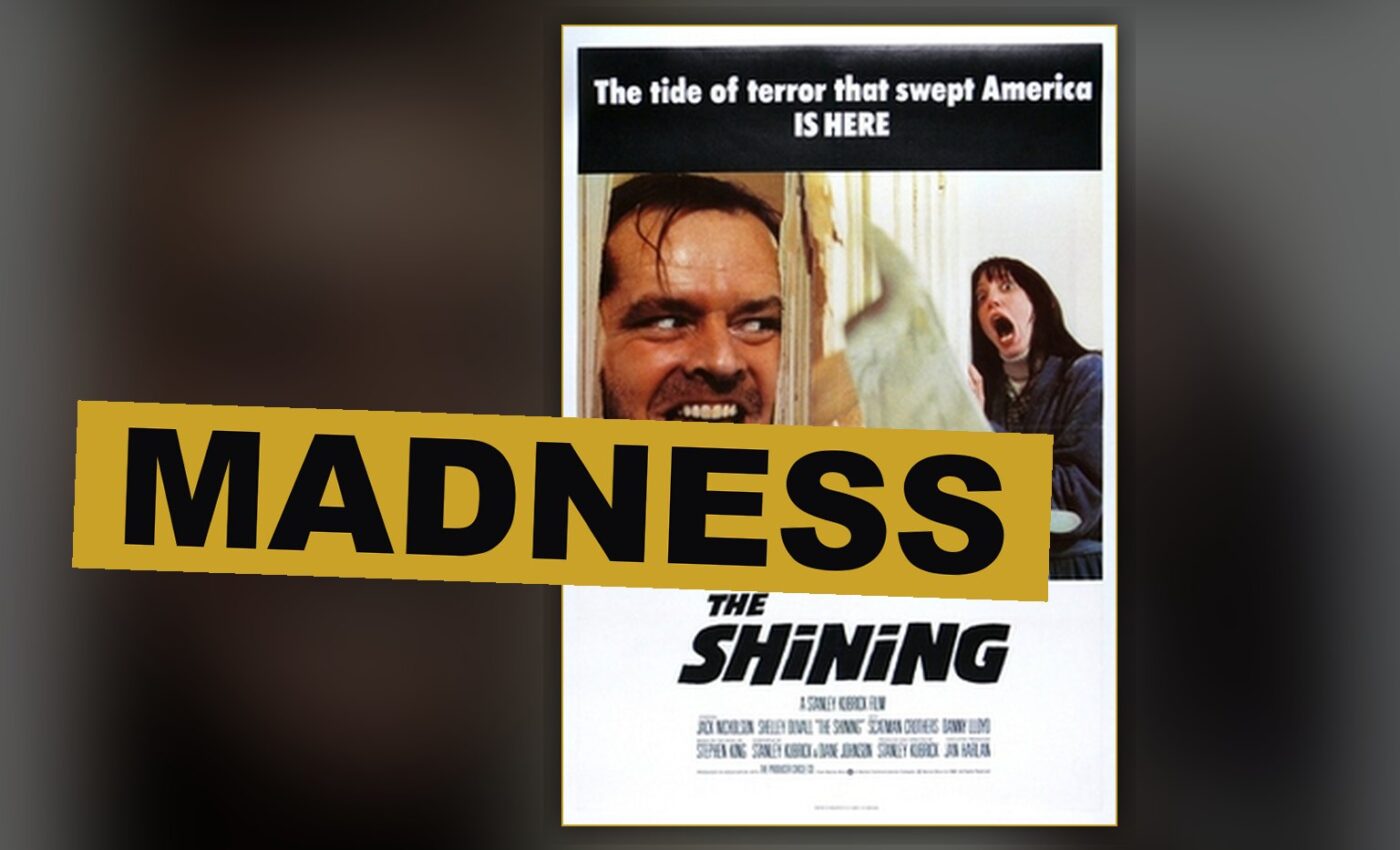
Stanley Kubrick’s The Shining opened in the United States on May 23, 1980, through Warner Bros., and it has not loosened its hold since. It is a horror film and a thriller at once, 144 minutes long, produced and directed by Kubrick and co-written with the novelist Diane Johnson from Stephen King’s 1977 novel. Jack Nicholson plays Jack Torrance, Shelley Duvall plays Wendy, Danny Lloyd plays Danny, and Scatman Crothers plays Dick Hallorann. Few horror pictures have kept their grip this long without a sequel or a remake to prop them up.
Jack Torrance Takes the Overlook Job
The setup is plain, and the plainness is the point. Jack Torrance takes a caretaker position looking after the remote Overlook Hotel in the Colorado Rocky Mountains while it is closed for the winter. He brings his wife and his son. They will be alone in the building until spring.
Hotel manager Stuart Ullman, played by Barry Nelson, tells Jack that a previous caretaker, Charles Grady, killed his wife, his two young daughters and himself in the hotel a decade before. Jack takes the job anyway. That is the whole engine of the film, and Kubrick never dresses it up.
Danny has a premonition and a seizure before the family leaves Boulder. A doctor, played by Anne Jackson, examines him. Wendy tells the doctor about a past incident when Jack accidentally dislocated Danny’s shoulder during a drunken rage. Jack has been sober ever since. The film does not ask you to forgive him. It asks you to watch him.
Dick Hallorann and the Word ‘Shining’
Before the seasonal break, the Overlook’s head chef, Dick Hallorann, tells Danny about a telepathic ability the two share. Hallorann’s grandmother called it “shining.” He says the hotel also shines, because of its residual and unpleasant history, and he warns Danny to avoid Room 237.
Scatman Crothers plays that scene with a warmth the rest of the film quietly withholds. It is the only stretch of The Shining where an adult treats the boy like a person rather than a problem. Crothers got the part after Slim Pickens was offered it and turned it down. Pickens had worked with Kubrick on Dr. Strangelove and said he would take the role only if his scenes were shot in fewer than 100 takes. Kubrick declined. The film is better for it.
A Month Passes, and Jack Comes Apart
A month passes. Danny starts having frightening visions, including those of the murdered Grady sisters. Jack’s mental health deteriorates. He suffers from writer’s block, is prone to violent outbursts, and has dreams of killing his family.
Danny gets lured to Room 237 by unseen forces. Wendy later finds him with signs of physical trauma and blames Jack. Jack sulks in the ballroom, where the ghostly bartender Lloyd, played by Joe Turkel, entices him back to drinking. Wendy tells him Danny was attacked by a “crazy woman” in Room 237. Jack investigates, encounters a hideous female ghost in the bathroom, and tells Wendy he saw nothing. He blames Danny for inflicting the bruises himself and reacts angrily when Wendy suggests leaving.
That sequence is the film’s spine. Jack does not descend into madness so much as choose it, one small lie at a time.
The Grady Sisters and the Arbus Question
The actresses who played the ghosts of the murdered Grady daughters, Lisa and Louise Burns, are identical twins. The characters in the book and the film script are sisters, but not twins. In the film’s dialogue, Ullman says he thinks they were “about eight and ten.” They are still called the Grady twins in most discussions of the film.
There is a resemblance between the staging of the Grady girls and Diane Arbus’ 1967 photograph Identical Twins, Roselle, New Jersey. Arbus’ biographer Patricia Bosworth noted it, as did Leon Vitali, the Kubrick assistant who cast and coached the girls, and numerous Kubrick critics. Kubrick met Arbus personally and studied photography under her during his time at Look magazine. Kubrick’s widow says he did not deliberately model the Grady girls on the photograph, despite the widespread attention to the resemblance. That denial is worth keeping in mind, and it does not make the resemblance go away.
Casting Choices That Still Rankle
Nicholson was Kubrick’s first choice for Jack Torrance. Robert De Niro, Robin Williams and Harrison Ford were all considered, and all met with King’s disapproval. Kris Kristofferson was Kubrick’s backup if Nicholson had declined. King disavowed Nicholson because of his part in One Flew Over the Cuckoo’s Nest; the novelist thought viewers would read him as unstable from the first frame. King preferred Jon Voight, Michael Moriarty or Martin Sheen. He was told the lead actor “was not negotiable.”
Nicholson initially suggested Jessica Lange for Wendy. Duvall knew early that she had the role. Her Wendy is less capable and more vulnerable than the novel’s. Kubrick pushed her throughout the shoot, she said, “to get the performance out of me that he wanted.” King called the casting of Duvall “an example of absolutely grotesque casting” in a 1978 interview. He was wrong about that.
The Release Schedule and the Cuts
| Version | Release | Notes |
|---|---|---|
| US theatrical | May 23, 1980 | Warner Bros. |
| UK theatrical | October 2, 1980 | Columbia-EMI-Warner Distributors |
| European cut | Theatrical | Jackson and Burton scenes removed, credits unchanged |
| Total cuts | Across releases | About 27 minutes cut in total |
Production took place almost exclusively in England at EMI Elstree Studios, with sets based on real locations. Kubrick often worked with a small crew, which let him do many takes, sometimes to the exhaustion of the actors and staff. The then-new Steadicam mount was used to shoot several scenes, giving the film its immersive look.
Each theatrical version was cut shorter than the one before it, about 27 minutes in total. In the European cut, all scenes involving Anne Jackson and Tony Burton were removed, but the credits stayed the same. Barry Dennen appears on screen in every version, though barely, and without dialogue in the European cut.
What the Awards Got Wrong
Reactions at release were mixed. King criticized the film for deviating from the novel, and in 1997 he produced a three-part miniseries adaptation he considered more faithful. The film received two controversial nominations at the 1st Golden Raspberry Awards in 1981 — Worst Director and Worst Actress. The Worst Actress nomination, for Duvall, was later rescinded in 2022.
That reversal is the most telling item in the film’s long record. Duvall’s performance was never the problem. The award was.
What Still Holds Up After 144 Minutes
The Shining earns an 8.4 out of 10. What holds it below a perfect mark is not the ambiguity, which is the film’s greatest asset, but the thinness of Wendy’s interior life on the page. She is written as a reactor, and Duvall spends the whole film making more of that than the script gives her.
Everything else lands. The Overlook is a character, the Steadicam work still feels like a new idea, and Nicholson’s Jack is a portrait of a man who was already gone before the snow arrived. The tagline called it “a masterpiece of modern horror,” and for once the marketing undersold it. The film’s real subject is not ghosts. It is a family trapped in a building with a man who has decided his own comfort matters more than their safety. That is why it still works.
Get the Notebook.
The day's best stories and every fresh verdict, in plain English, in your inbox by seven. One email a day, no more.


