
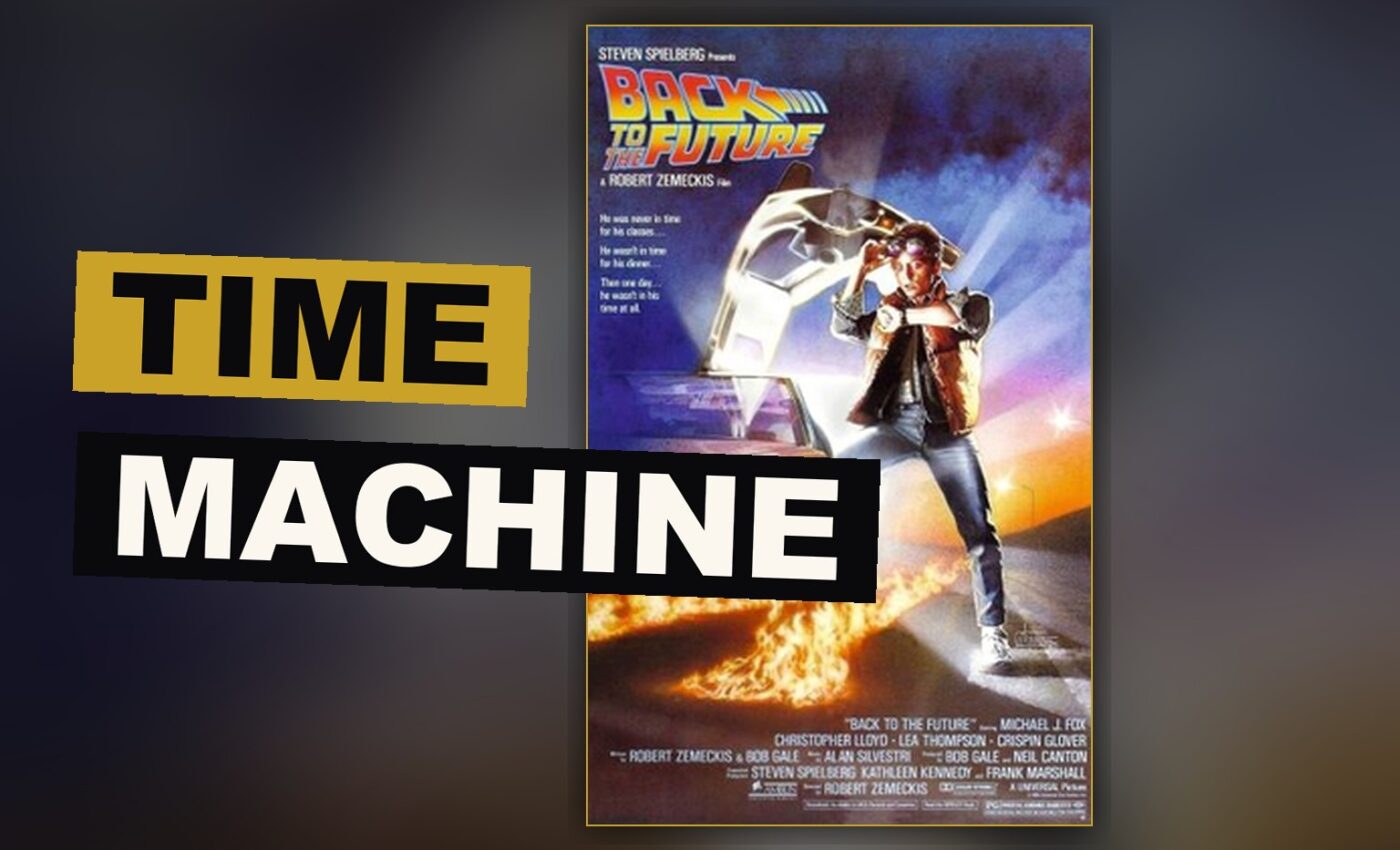
Robert Zemeckis’s Back to the Future opens in a Hill Valley garage full of clocks, and it never stops running. The film, released in 1985, sends teenager Marty McFly thirty years back in time in a DeLorean, strands him in 1955, and asks him to fix his own family before he stops existing. It is a comedy that keeps a stopwatch on the wall. It earns its 8.5 out of 10.
The DeLorean in the Twin Pines Lot
The machine is a modified DeLorean, and Doc Brown powers it with plutonium he swindled from Libyan terrorists. That detail matters. The film treats time travel as an engineering problem with a fuel bill, not a magic trick. Doc inputs a destination of November 5, 1955 — the day he first conceived the invention. Then the terrorists arrive and gun him down. Marty flees in the car.
He hits 88 miles per hour, 142 kilometers per hour, and the film’s whole engine turns over. Zemeckis and co-writer Bob Gale built a script where the rules are stated out loud and then obeyed. When Marty lands in 1955 with no plutonium, he cannot go home. The film does not cheat him out of that.
A Teenager Who Erases Himself
In 1985, Marty lives with a depressed, alcoholic mother, siblings who have failed professionally and socially, and a meek father, George, bullied by his supervisor, Biff Tannen. Marty’s band fails a music audition. He confides in his girlfriend, Jennifer Parker, that he fears becoming like his parents.
That fear is the film’s real subject, and the time travel is how it gets examined. In 1955, Marty saves George from an oncoming car and gets knocked unconscious doing it. Lorraine finds him, tends to him, and becomes infatuated with him. She is a 1955 teenager, and she is his mother. The film plays the joke straight and lets the discomfort sit.
Marty’s siblings start vanishing from a photograph he carries. The image is the cleanest piece of storytelling in the movie: a family portrait as a countdown clock.
Casting Fox Changed the Film
Michael J. Fox was the first choice for Marty. Gale and Zemeckis wanted him because of his timing on the NBC sitcom Family Ties, where he played the sophisticated Alex P. Keaton. They thought that timing could translate to Marty’s clumsiness. Fox was unavailable, so Eric Stoltz was cast instead.
Filming began in November 1984. Shortly after, Zemeckis decided Stoltz was wrong for the part. He made the concessions needed to hire Fox, including re-shooting scenes already filmed with Stoltz and adding $4 million to the budget. The film shot in and around California and on sets at Universal Studios, and wrapped the following April.
That is a costly correction, and it is the right one. Fox plays Marty as a kid who is quick and a little bit of a coward, which is exactly what the plot needs. Christopher Lloyd’s Doc Brown is the opposite: an eccentric scientist who treats the impossible as a scheduling problem.
A Hill Valley That Repeats Itself
The film’s best trick is the town. Hill Valley in 1955 is the same place as 1985, with recurring characters. Biff is a high school bully in 1955 and George’s boss in 1985. Principal Strickland, played by James Tolkan, runs the high school in both years. The film does not announce the symmetry. It just lets you notice.
Crispin Glover’s George is a nerd in 1955 who grows into a cowardly, submissive father. Lea Thompson plays Lorraine as a 1955 teenager and as Marty’s unhappy mother, and the two versions share a face and nothing else. Thomas F. Wilson’s Biff is the engine of the past: he is why George is afraid, and he is why Marty has something to fix.
The supporting cast fills the town out. Claudia Wells plays Jennifer. Marc McClure and Wendie Jo Sperber play Dave and Linda McFly. George DiCenzo and Frances Lee McCain play Lorraine’s parents, Sam and Stella Baines. Jeffrey Jay Cohen plays Skinhead, Casey Siemaszko plays 3-D, and Billy Zane plays Match in Biff’s gang. Huey Lewis cameos as a judge at the Battle of the Bands.
The Lightning Bolt and the Flyer
Doc explains that the only power source in 1955 capable of generating the 1.21 gigawatts needed for time travel is a lightning bolt. Marty has a flyer from the future documenting an upcoming strike at the town courthouse. The film’s climax is a race against a documented weather event.
This is where the script’s discipline pays off. The deadline is not invented at the last minute. It was planted, dated, and then waited for. The running order of the final act is a schedule, and the film keeps it.
The Schedule the Film Keeps
| Beat | Time or date | What happens |
|---|---|---|
| Destination input | November 5, 1955 | Doc sets the DeLorean’s target date |
| Time jump | 88 mph (142 km/h) | Marty activates travel and lands in 1955 |
| Discovery | 1955 | Marty learns he has no plutonium |
| Power problem | 1955 | Doc identifies lightning as the only source |
| Deadline | Documented strike | A flyer from the future dates the courthouse bolt |
Every entry on that table is a promise the film made and then kept. That is rarer than it sounds.
What the Film Is Actually About
Back to the Future is a comedy about a kid who improves his family by accident. Marty does not set out to make George confident. He sets out to exist. The rekindled romance between George and Lorraine is a side effect of survival, and the film is honest about that.
The 1985 bookends are the part that has aged into the film’s real argument. Marty returns to a home where George is no longer meek and Biff is no longer in charge. The film frames that as a happy ending. It is also a fantasy about fixing your parents, which is a stranger and sadder idea than the DeLorean.
Zemeckis and Gale conceived the idea in 1980. They were desperate for a hit after a run of collaborative failures, and the project was rejected more than forty times by studios that did not consider it raunchy enough to compete with the era’s successful comedies. A development deal landed at Universal Pictures after Zemeckis directed Romancing the Stone in 1984.
That history is visible in the finished film. Back to the Future is not raunchy. It is tightly wound, family-friendly, and built around a mechanical deadline. The studios were wrong about what audiences wanted, and the film’s 116 minutes are the proof.
The Part Worth Watching
The photograph is the best thing in the movie. It is a small prop doing the work of a countdown, and it makes the stakes visible without a line of explanation. The lightning bolt is the second best, because it turns a weather report into a plot device.
The weakest stretch is the middle, where Marty’s attempts to pair up his parents repeat a joke about Lorraine’s interest in him. The film knows the joke is uncomfortable and leans on it a beat too long. It recovers, but the pace sags there.
What holds up is the construction. Back to the Future sets rules, states them, and then lives inside them. The DeLorean needs plutonium, then lightning. Marty needs his parents to fall in love. Doc needs a deadline. Every problem has a stated solution and a stated cost.
The film is also funnier than its reputation as a franchise starter suggests. Fox plays Marty as a kid who talks his way out of rooms. Lloyd plays Doc as a man who has already solved the problem in his head and is waiting for everyone else. Their scenes together are the film’s engine.
Eight and a half out of ten. Back to the Future is a machine that runs clean, and the parts that show their age are the parts where the machine is most visible. It is still the standard for a time-travel comedy that respects its own rules.
Get the Notebook.
The day's best stories and every fresh verdict, in plain English, in your inbox by seven. One email a day, no more.


