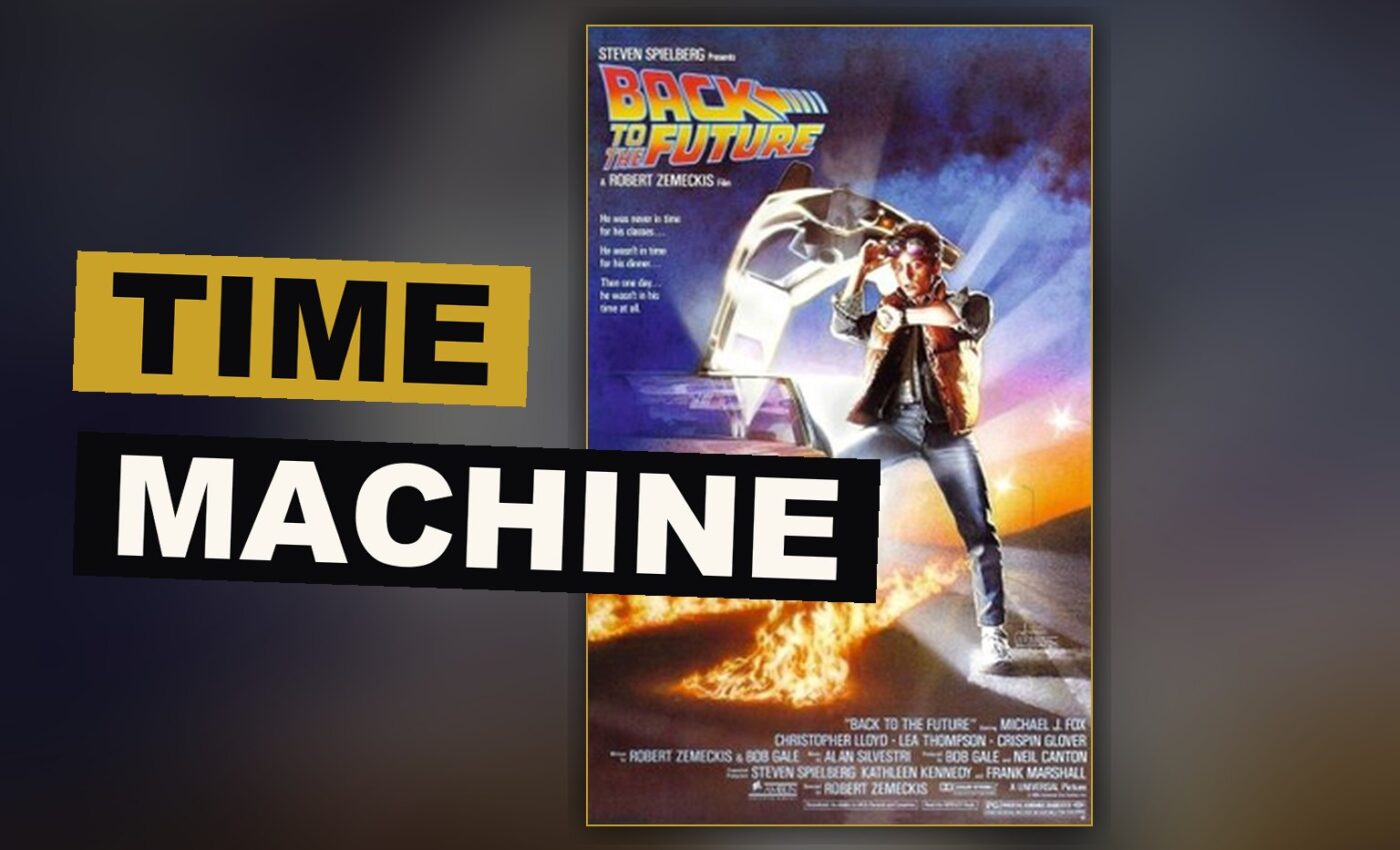
A teenager is thrown thirty years into the past by a car built for one purpose, and somehow the whole thing works. Back to the Future, directed by Robert Zemeckis, turns a strange premise into one of the most confident, tightly made comedies of its time.
A Boy and a Car Built for One Purpose
The film’s young lead carries the story’s center. He plays fear and comic timing together, and he makes the danger of losing his own existence feel real instead of a mere device of the story. The older man who built the car is the story’s other support, a character whose energy never grows dim in a single scene. His talk moves fast, his manner is odd, and yet he makes long explanations of time travel sound urgent rather than dull.
The two performers build a pair the story depends on. Without the bond between them, the film’s central joke, a boy who must make his own parents fall in love, would not hold together. Here is what the film gets right, in order:
- A script that sets up every payoff early, so nothing in the last act feels cheap.
- A lead performance that holds fear, humor, and heart together at once.
- A supporting turn as the maker of the car that could have been foolish but instead feels true.
- A steady pace that rarely lags, even in scenes built mostly on talk.
- Music that places the story firmly in its two periods without pressing the point too hard.
Two Versions of the Same Small Town
Zemeckis and his team build the town twice, once for the present day and once for the past, and the film uses the distance between them well. Small details carry weight: a diner, a clock on the square, a familiar street. The film does not stop to explain what has changed. It shows the difference and lets the audience do the work.
The father figure the boy meets as a young man could have been played only for laughs, and instead the part turns into something more awkward and human. The mother figure gives the story its strangest and most amusing turn, moving from teenager to parent in front of the audience. The film never loses sight of the fact that the boy is trying to fix his parents’ future without revealing who he really is, and that setup pays off again and again.
The comedy holds up because it rests on character, not on cheap jokes alone. The boy’s anger at being caught in the past, his fear of being found out, his confusion at meeting his own parents as teenagers, all of it lands because the actors give it full effort. Nothing here feels like a nod to the audience over the heads of the characters.
The film is not without weak spots. Some side characters get thin treatment, and a few rules around the workings of time travel ask the viewer to accept them without much question. The middle portion of the story, while still funny, moves at a slightly gentler pace than the opening and closing parts. None of this seriously harms the experience, but it keeps the film just short of perfect.
The pace picks back up hard through the final portion of the story.
Back to the Future works because its parts fit together. The script, the acting, the design of its two time periods, and the pacing all move in the same direction, toward a settled and satisfying end. Zemeckis does not reach past what the story needs. He builds a machine, in both the literal and story sense, and lets it run exactly as planned.
Back to the Future earns its standing as one of the finest studio comedies of its time. It balances humor, danger, and an odd kind of feeling, and it does so without ever feeling drawn out. The two leads remain the reason it still works decades later, but everything built around them holds up just as well.