
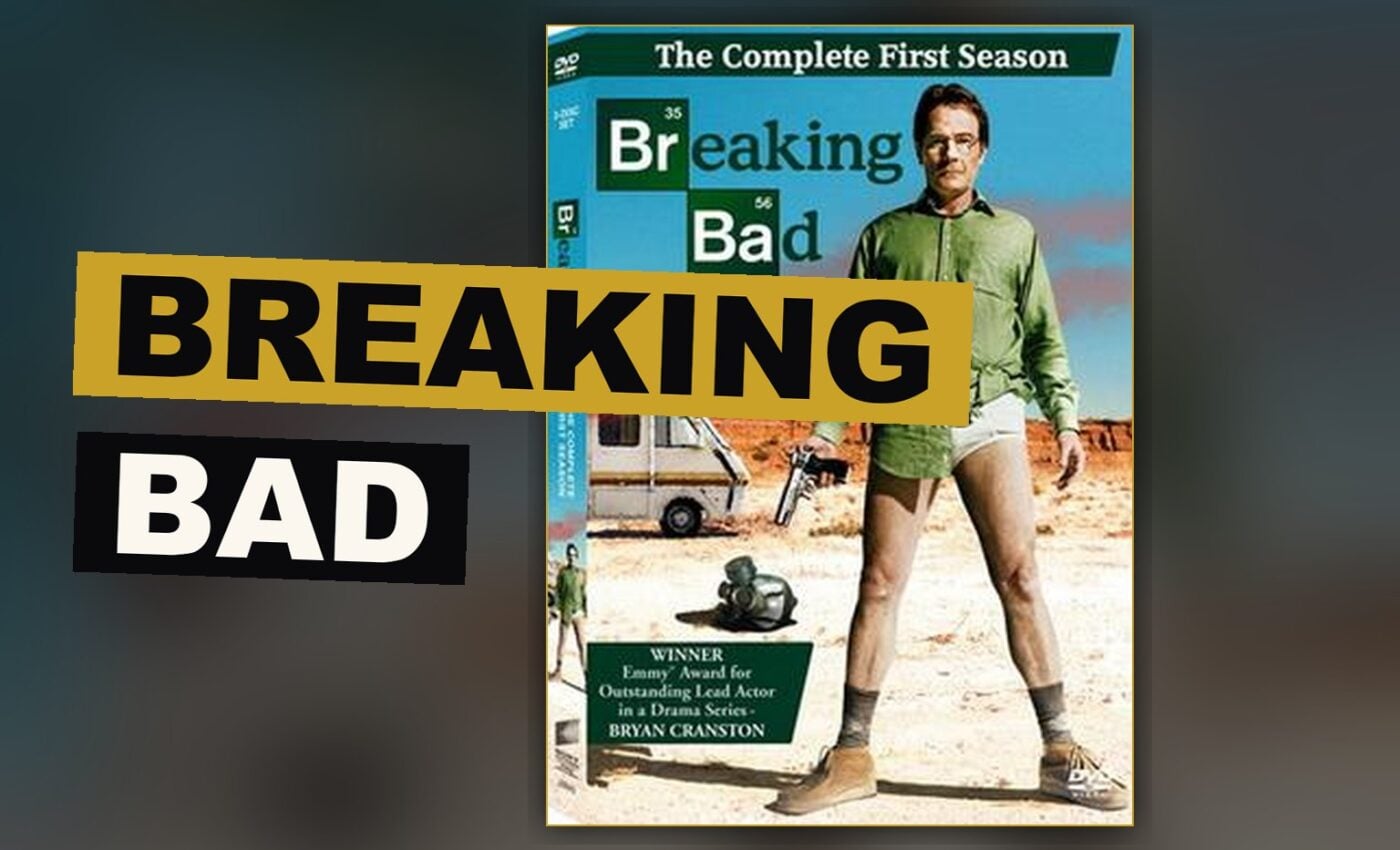
Vince Gilligan’s Breaking Bad opens with a chemistry teacher in his underwear, a gun, and a desert. It ends five seasons later as one of the most acclaimed dramas ever made for American television. The show ran on AMC from January 20, 2008, to September 29, 2013 — five seasons, 62 episodes — and it earned its reputation the hard way, one bad decision at a time.
Walter White’s Stage III Diagnosis
The premise is simple and terrible. Walter White, played by Bryan Cranston, is a high school chemistry teacher in Albuquerque, New Mexico. He works part-time at a car wash. He is diagnosed with stage-three lung cancer and given a prognosis of two years. He decides to cook methamphetamine to secure his family’s financial future, and he brings in a former student, Jesse Pinkman, played by Aaron Paul.
What follows is a slow study in how a man talks himself into each next thing. Walter produces a blue methamphetamine of unusual purity. He takes the alias Heisenberg. His brother-in-law, Hank Schrader, played by Dean Norris, works for the Drug Enforcement Administration. The series sets its events between 2008 and 2010.
“He becomes filled with a sense of fearlessness and an unrelenting desire to secure his family’s financial future at any cost.”
Bryan Cranston Was Not AMC’s First Choice
The casting story is worth knowing because it explains the performance. Gilligan cast Cranston after working with him on the X-Files episode “Drive,” where Cranston played an anti-Semite with a terminal illness who took Fox Mulder hostage. Gilligan wanted Walter to stay both loathsome and sympathetic, and he believed Cranston could hold that line.
AMC executives were reluctant. They knew Cranston only as Hal on Malcolm in the Middle. The network approached John Cusack and Matthew Broderick about the role. Both declined. Executives were persuaded after watching the X-Files episode.
Cranston then built the character from the outside in. He gained 10 pounds to reflect Walter’s decline. He dyed the natural red highlights of his hair brown. He worked with costume designer Kathleen Detoro on a wardrobe of mostly neutral greens and browns, and with makeup artist Frieda Valenzuela on a mustache he called “impotent” and like a “dead caterpillar.” When Gilligan left Walter’s past unexplained, Cranston wrote his own backstory.
The Fifth Season and the Netflix Effect
The show’s ratings did not arrive all at once. The first three seasons drew modest viewership. Then Breaking Bad became available on Netflix before the fourth season, and the audience grew. Viewership rose again during the second half of the final season in 2013. The series finale became one of the most watched cable episodes of its era.
The first season drew generally positive reviews. Later seasons, especially the fifth, drew widespread acclaim for the performances, writing, direction, cinematography, and character development. The supporting cast — Anna Gunn as Skyler White, Betsy Brandt as Marie Schrader, RJ Mitte as Walter White Jr., Bob Odenkirk as Saul Goodman, Jonathan Banks as Mike Ehrmantraut, Giancarlo Esposito — carries weight the show rarely wastes.
What Breaking Bad Gets Right
The arc is the argument. Walter does not break bad in a single hour; he breaks in installments, and each one is small enough to forgive. The show’s real subject is not drugs but the story a man tells himself about why he needs them. Cranston’s Walter is loathsome and sympathetic at once, exactly as Gilligan intended, and that balance is the whole engine.
The later seasons earn their acclaim. The writing, direction, and cinematography tighten as the operation expands — against local gangs, regional distributors, Mexican cartels, and the DEA through Hank. The show places Walter’s family at risk and does not blink. The final season is the strongest, and the finale lands.
The critical consensus since 2013 is that Breaking Bad is one of the greatest television series of all time. That verdict holds up. It collected 16 Primetime Emmy Awards, 2 Golden Globe Awards, 2 Peabody Awards, and a British Academy award. The numbers are impressive. The craft is the reason to watch.
The Numbers Behind Breaking Bad
- Score: 9.5/10
- Network: AMC
- Run: January 20, 2008 – September 29, 2013
- Seasons: 5
- Episodes: 62
- Genres: Drama, Crime
- Emmy Awards: 16
- Golden Globe Awards: 2
- Peabody Awards: 2
The show’s first seasons are slower than its reputation suggests, and a viewer arriving now on the strength of the finale may find the early episodes patient to a fault. That patience is the point. Walter’s transformation only works because the show refuses to rush it. The modest early viewership and the Netflix-driven surge tell the same story: this is a series that rewards staying.
9.5 of 10.
Get the Notebook.
The day's best stories and every fresh verdict, in plain English, in your inbox by seven. One email a day, no more.