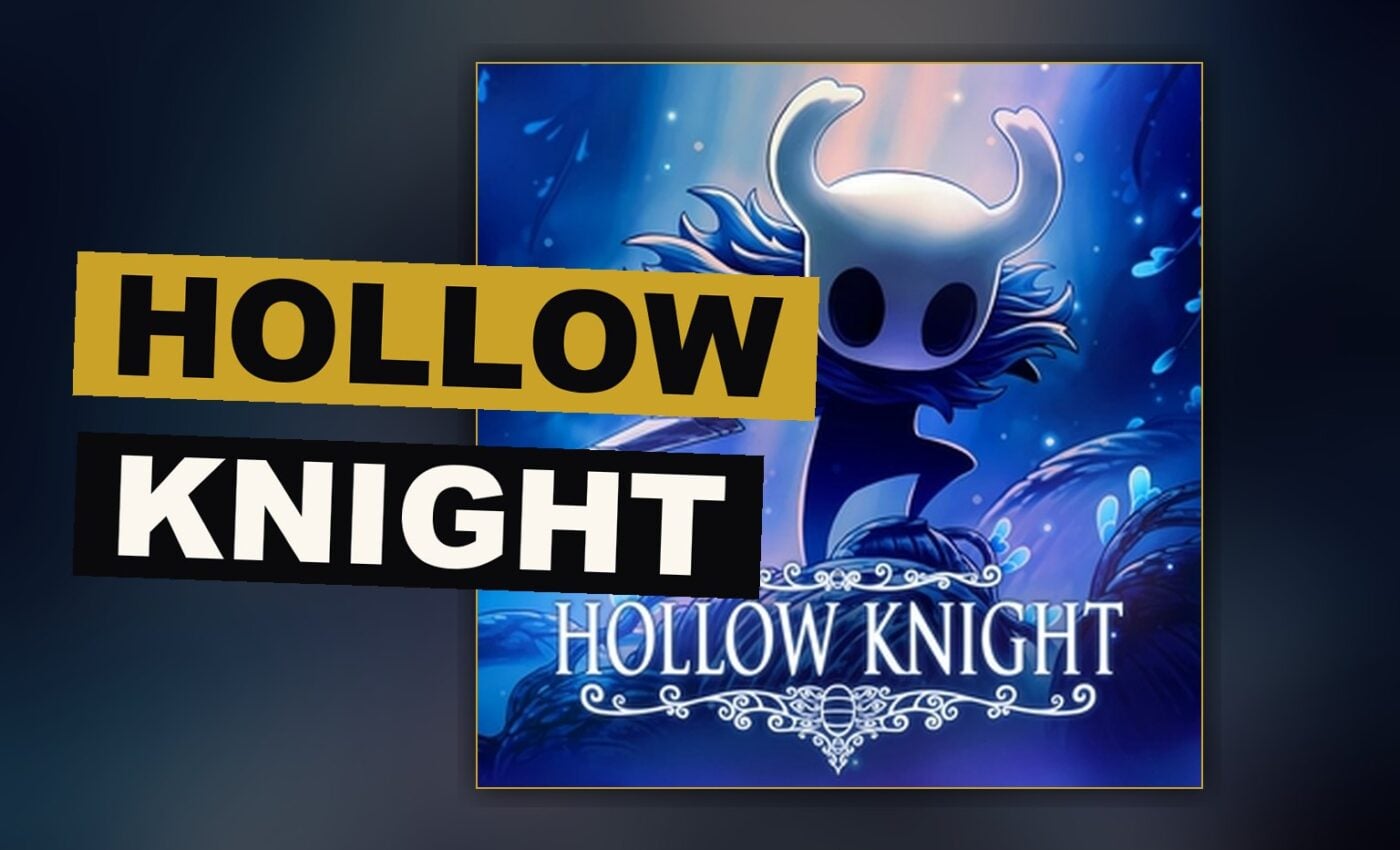
Hollow Knight arrived in 2017 from a small studio in Adelaide with no publisher behind it and no marketing muscle. Team Cherry, founded by artist Ari Gibson and web designer William Pellen, built a 2D Metroidvania about a silent insectoid warrior descending into a ruined kingdom. Nearly a decade later it stands as one of the most complete works the genre has produced.
A Town Above the Ruins
The player controls a nameless insectoid warrior, commonly known as The Knight, who arrives in King’s Pass and soon reaches Dirtmouth, a quiet town sitting just above the remains of Hallownest. The kingdom was once a flourishing civilization of insects. It fell after being overrun by “The Infection,” a supernatural disease that enters a bug’s dreams, controls its mind, and drives it to madness and undeath.
Hallownest’s ruler, The Pale King, tried to lock the Infection inside the Temple of the Black Egg. Magical seals held it for a time. The disease escaped anyway, and the kingdom collapsed into ruin.
The Knight’s mission is to find and kill three bugs called the Dreamers, who serve as the living seals on the temple door. Remove the seals, and the source of the Infection — the Radiance — can be confronted.
Masks, Soul, and the Shade
Combat is close and deliberate. The Knight strikes with a sword-like Nail and can learn spells for long-range attacks. Hit points are represented by masks. Striking enemies yields Soul, stored in a Soul Vessel. Soul initially only powers Focus, which regenerates masks, but offensive spells consume it as the game goes on.
Death has weight. Lose every mask and the Knight dies, leaving a Shade at roughly the spot where the player fell. All Geo, the game’s main currency, is gone, and Soul capacity is cut until the Shade is defeated. Die again before that happens and a new Shade appears, erasing the old one and the Geo it held.
Movement abilities arrive through exploration: a mid-air jump, the ability to adhere to and jump off walls, a dash. Charms, found or bought from NPCs, customize the Knight further. Some extend the Nail’s range. Others make Soul easier to collect. Equipping one takes up a notch.
The Moths and the Pale King
The story is told through dialogue with bug-themed NPCs, environmental imagery, and writings scattered across Hallownest. In ancient times, a tribe of moths worshipped the Radiance, a primordial being who could control the minds of other bugs. When the Pale King arrived from afar, he used his powers to grant sapience and knowledge to the realm’s creatures. The moths turned to worshipping him. The Radiance fell into obscurity — but worship of her continued beneath the king’s notice, keeping her alive inside the Dream Realm.
The Knight repeatedly encounters Hornet, daughter of the Pale King and one of the Dreamers. She tests the protagonist’s combat prowess in two battles.
Born at Ludum Dare
The concept behind Hollow Knight was conceived in 2013 at the Ludum Dare game jam. Gibson and Pellen wanted to make a game inspired by older platformers that replicated the explorational aspects of its influences. They cite Faxanadu, Metroid, Zelda II: The Adventure of Link, and Mega Man X.
A crowdfunding campaign raised over A$57,000 by the end of 2014. Hollow Knight released for Linux, macOS, and Windows in early 2017, then for Nintendo Switch, PlayStation 4, and Xbox One in 2018. Versions for Nintendo Switch 2, PlayStation 5, and Xbox Series X/S followed in 2026. Four free downloadable expansions landed between 2017 and 2018.
What the Difficulty Is For
Hollow Knight was well-received, with praise aimed at its music, art style, worldbuilding, atmosphere, combat, and level of difficulty. That last item is the one worth arguing about. Difficulty here is not a filter or a boast. It is the mechanism that makes Hallownest feel like a place rather than a backdrop.
Losing Geo to a Shade forces a decision every time: go back for it, or cut the loss and push forward. The map stays dark until it is earned. Bosses demand that the player actually learn the movement arsenal instead of skating past it. The game never explains itself, and that refusal is the point — the lore sits in writings and in the mouths of NPCs, and the player assembles it or does not.
The Parts That Hold Up
The art style and music carry the tone without leaning on cutscenes. Hallownest’s districts differ enough that exploration keeps rewarding the player, and the bug-themed cast gives the ruin a population rather than a body count.
The structure has a cost. A player who misses a movement ability can stall against a wall for a long stretch, and the game offers little direction about where to go next. That opacity is deliberate, but it is not free.
The Numbers
- Release: early 2017 (Linux, macOS, Windows); 2018 (Nintendo Switch, PlayStation 4, Xbox One); 2026 (Nintendo Switch 2, PlayStation 5, Xbox Series X/S)
- Developer and publisher: Team Cherry
- Genre: Metroidvania, 2D side-scrolling, single player
- Crowdfunding: over A$57,000 raised by the end of 2014
- Expansions: four free downloadable expansions, 2017–2018
- Metacritic user score: 9.0/10
What the Game Gets Right
Hollow Knight earns its reputation. Team Cherry took a game jam idea and built a kingdom with rules, history, and consequences, then trusted players to work it out. The combat is tight, the world is dense, and the difficulty serves the fiction instead of decorating it.
The 2026 ports put the game in front of another audience, but nothing about the original design needed fixing. What matters is that a two-person studio with a crowdfunded budget produced something this complete. The opacity will lose some players, and the Shade mechanic will frustrate others. Both are choices, and both are defensible.
Get the Notebook.
The day's best stories and every fresh verdict, in plain English, in your inbox by seven. One email a day, no more.