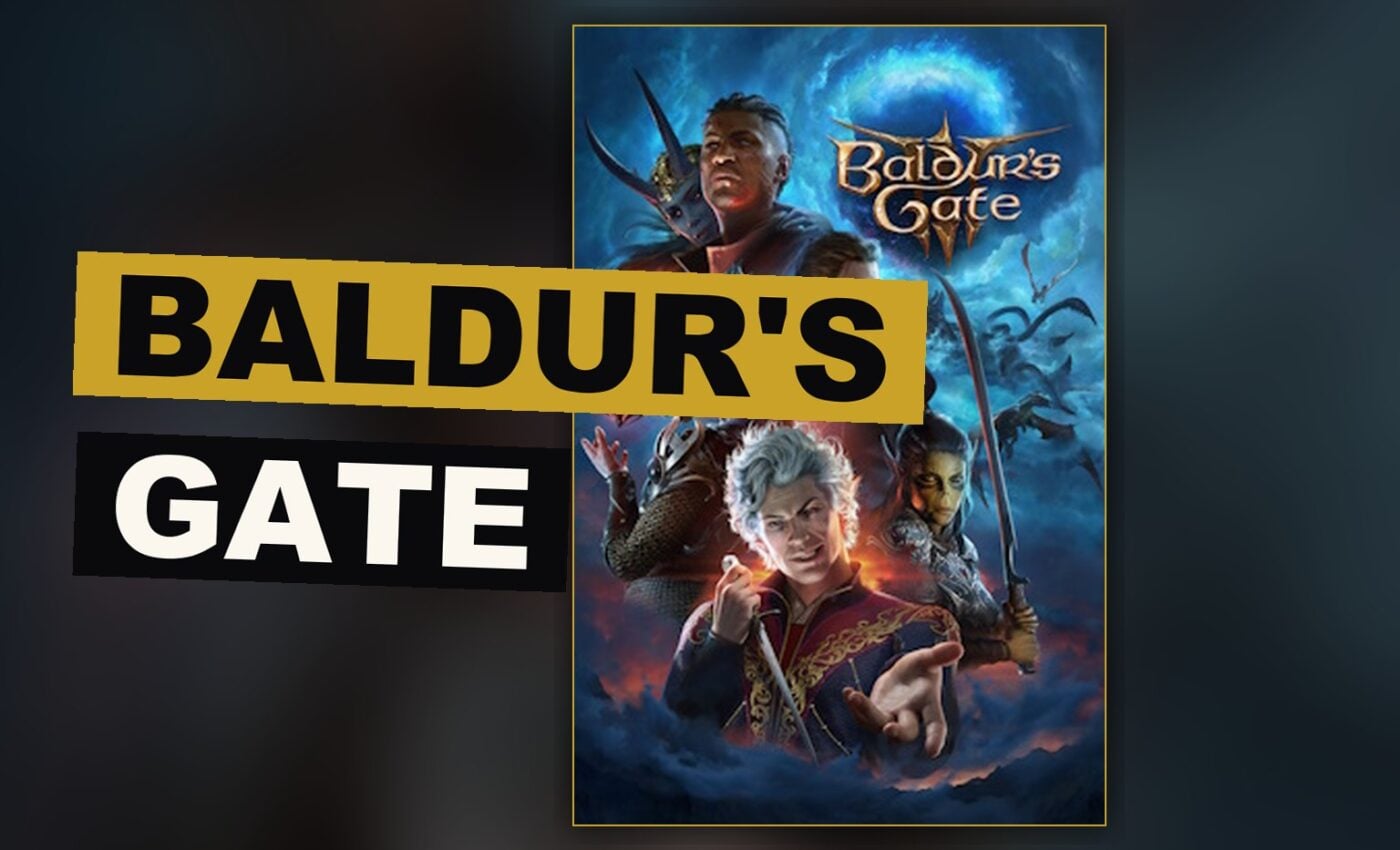
Larian Studios spent years building Baldur’s Gate 3, and it shows in every corner of the game. The role-playing game launched in full on Windows on August 3, 2023, with PlayStation 5, macOS, and Xbox Series X/S versions following later the same year. It is the third entry in the Baldur’s Gate series. Larian took the fifth edition Dungeons & Dragons rules and the Forgotten Realms setting and built something that plays like a tabletop campaign run by a dungeon master with unlimited patience.
A Nautiloid, a Parasite, and the Sword Coast
The story opens with abduction. A nautiloid ship appears out of nowhere, its tentacles snatch the player from the ground, and mind flayers implant a parasite in the player’s brain. The infection will turn the player into one of them. The ship crashes in the Sword Coast outlands, and the player survives by fate or fortune.
From there the party sets out for a cure, only to land in a conspiracy that runs as deep as the Nine Hells. The land of Faerûn is in turmoil. Refugees flee the helltorn stronghold of Elturel, and a cult marches across the Sword Coast under a cryptic god called the Absolute. The road leads to Baldur’s Gate.
Rolling a Twenty-Sided Die for Everything
Baldur’s Gate 3 adapts the fifth edition rules of Dungeons & Dragons, and several mechanics are identical between the two. Outcomes are decided by rolling a twenty-sided die. Some rolls come with advantage or disadvantage, meaning two dice are rolled and the player takes the best or worst result.
Combat is turn-based, while exploration of large areas happens in real time. The camera floats free, adjustable from top-down isometric to third person. Characters level up by collecting experience points through exploration, combat, and solving puzzles. The maximum player level is 12, against a limit of 20 in the tabletop game.
Ten Companions, One Narrator
The game’s narrator is Amelia Tyler, who recounts the world along with the player’s thoughts and observations, acting as the dungeon master. Larian originally planned for her to deliver lines contemptuously, but was impressed by her deadpan delivery instead.
Of the ten companions, six can be chosen as the player character in the character creator. These origin characters have a pre-set class, race, and appearance. Their classes can be changed, but personalities and backstories are sometimes tied to them. Astarion is a hedonistic high elf vampire spawn rogue, voiced by Neil Newbon and written by Stephen Rooney. Gale is a human wizard from Waterdeep, voiced by Tim Downie, and the most popular origin character choice. Eight of the ten companions are introduced in act one, with six recruitable near the start.
An ancient evil has returned to Baldur’s Gate, intent on devouring it from the inside out.
Three Acts, Three Very Different Games
Act one is set primarily around the wreckage of the mind flayer ship. It has no designated tutorial, but certain resources and encounters are built to guide the player anyway. Locations include a druids’ grove, a goblin camp, and a monastery set against a mountain pass. Writer Ali Jones called it a “fairytale backdrop,” and IGN’s Leana Hafer described it as “mostly idyllic wilderness.”
The Underdark is a large subterranean area reachable through multiple entrances, each leading to unique environments. Act one ends when players cross the mountain pass or the Underdark into act two, which runs through the Shadow Cursed lands toward Moonrise Towers. Only one companion joins in act two. The Last Light Inn and the Gauntlet of Shar sit along the way.
Act three moves into the dense city of Baldur’s Gate itself, with some areas outside it, including a visiting circus and the shoreline.
A Cancelled Third Game and a Century of Story Time
Baldur’s Gate (1998) and Baldur’s Gate II: Shadows of Amn (2000) were developed by BioWare. A third game, subtitled The Black Hound and developed by Black Isle Studios, was cancelled in 2003 after a licensing dispute.
Wizards of the Coast, which owns Dungeons & Dragons, declined Larian’s first pitch following the release of Divinity: Original Sin in 2014. Impressed by prerelease material for Divinity: Original Sin II in 2017, Wizards welcomed a new pitch. Baldur’s Gate 3 occurs over 100 years after the events of Shadows of Amn in story terms, and shortly after the D&D tie-in adventure Baldur’s Gate: Descent into Avernus (2019).
Mods, Multiplayer, and Split Screen
Baldur’s Gate 3 supports single-player and multiplayer, including co-operative play and split screen. It also includes support for modding, though using mods disables achievements. In character creation, the player picks a class, species, and backstory, plus starting spells if the class uses magic.
Levelling up opens new class features. Feats arrive at certain level intervals and let players diversify or specialise a style of play, either choosing a new ability or increasing stats, which the game calls abilities. After levelling, players can also drop a level into a different class, known as multiclassing.
What Larian Got Right
The twenty-sided die is the whole design in miniature. Every conversation, every lock, every climb over a wall comes down to a roll the player can see, and that visibility is what makes the choices feel like they carry weight. The game does not hide the math. It shows the number, shows the modifier, shows the advantage or disadvantage, and then lets the result land.
The companion work is the other pillar. Six origin characters available as player characters, each with a pre-set class and race but a changeable build, is a strange middle ground between a blank slate and a fixed protagonist. It works because the personalities and backstories stay tied to the characters even when the mechanics do not. Astarion, the high elf vampire spawn rogue, is the clearest example: Newbon’s performance and Rooney’s writing hold the character together regardless of what class the player assigns.
Amelia Tyler’s narrator is the quietest success. A dungeon master who describes the world and the player’s own thoughts could easily become an intrusion. Larian’s decision to keep her deadpan, after initially planning contempt, keeps her out of the way of the scene while still doing the work a table needs.
Where the Cracks Show
Act structure is where the game is least even. Act one gets the druids’ grove, the goblin camp, the monastery, the Underdark, and six recruitable companions. Act two gets one companion, Moonrise Towers, the Last Light Inn, and the Gauntlet of Shar. Act three gets the city, a circus, and the shoreline.
That imbalance is not a flaw in any single act. It is a flaw in how they sit together. The middle act is the one that carries the least new company, and for a game built on party relationships, that is the stretch where the design thins out. The level 12 cap against the tabletop’s 20 is the same kind of compromise: a real limit, honestly set, that still leaves the endgame feeling shorter than the journey that got you there.
The modding rule, where using mods disables achievements, is a small thing that will annoy a specific kind of player. It is also defensible. Achievement tracking is the one part of the game Larian cannot verify once the files change.
The Dice and the Companions
Baldur’s Gate 3 earns its reputation on the strength of two decisions. The first is trusting the die. The second is trusting the companions. The combat, the exploration, the camera, and the multiclassing all serve those two things rather than competing with them. A game adapted from a tabletop rulebook could have drowned in its own systems. This one does not.
The act imbalance is real and worth naming, but it is the kind of problem that comes from a studio putting its best material first rather than spreading it thin. The cancelled Black Hound and the long stretch of story time between Shadows of Amn and this game produced something the series had never had before: a Baldur’s Gate that plays like the table it came from. That is the part worth keeping.
Get the Notebook.
The day's best stories and every fresh verdict, in plain English, in your inbox by seven. One email a day, no more.