
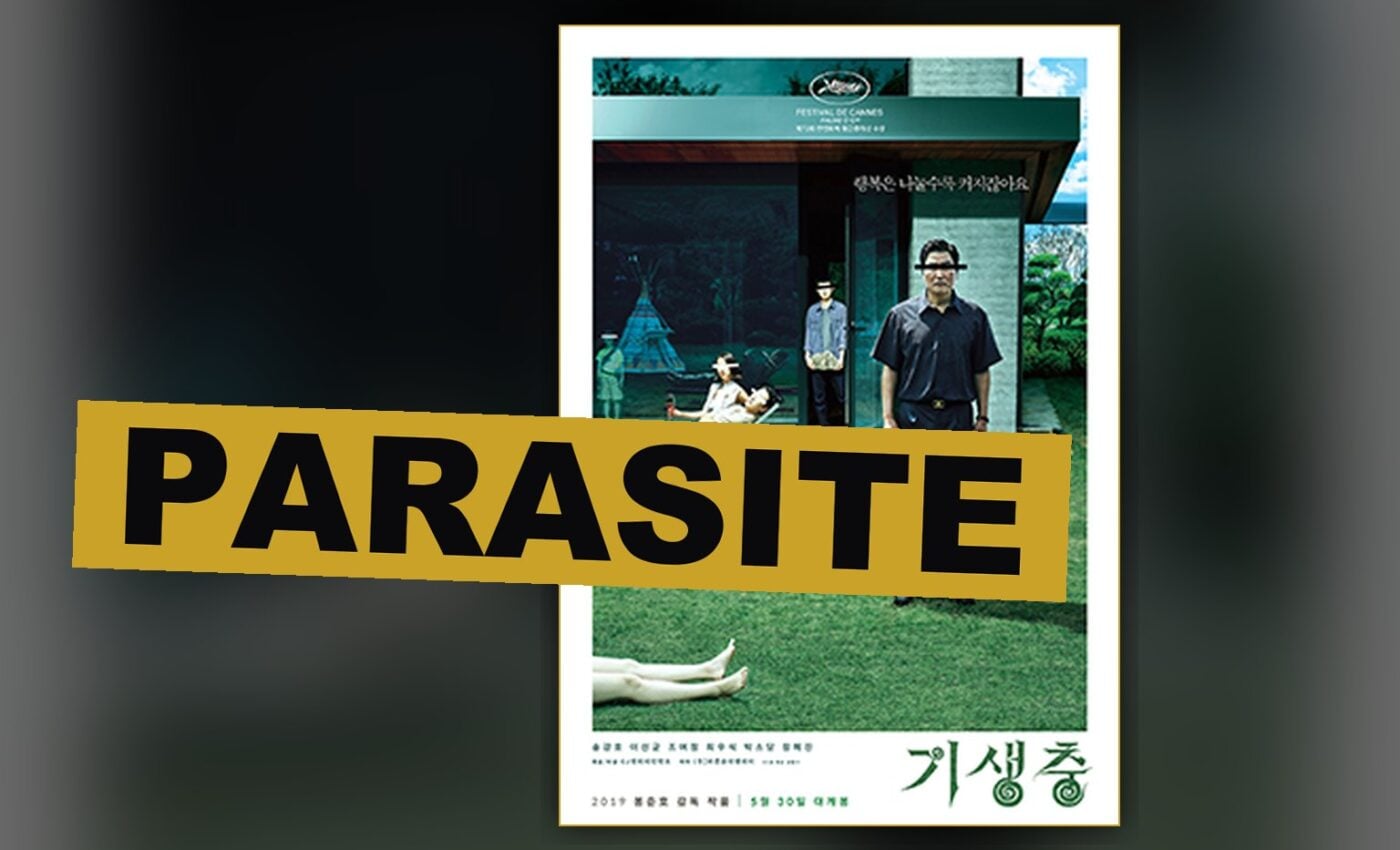
Bong Joon Ho’s Parasite premiered at the Cannes Film Festival on 21 May 2019 and became the first Korean film to win the Palme d’Or. By the following February it had won Best Picture at the 92nd Academy Awards, the first non-English-language film to do so. The budget was $11.4 million. It grossed $258 million worldwide.
A Semi-Basement in Seoul
Kim Ki-taek and Chung-sook live in a semi-basement flat with their daughter Ki-jung and son Ki-woo. Money is short and the work is low-paid. Family friend Min-hyuk hands them a scholar’s rock he says promises wealth, then leaves to study abroad. He suggests Ki-woo lie about his qualifications and take over his job tutoring Da-hye, the daughter of the wealthy Parks.
Ki-jung forges a certificate. Ki-woo, posing as a Yonsei University student named “Kevin”, is hired by Mrs Park by the end of his first lesson.
- Kim family: Song Kang-ho plays Ki-taek; Jang Hye-jin plays Chung-sook; Choi Woo-shik plays Ki-woo; Park So-dam plays Ki-jung
- Park family: Lee Sun-kyun plays Dong-ik; Cho Yeo-jeong plays Yeon-kyo; Jung Ji-so plays Da-hye; Jung Hyeon-jun plays Da-song
- Household staff: Lee Jung-eun plays Moon-gwang; Park Myung-hoon plays Geun-se; Park Keun-rok plays Driver Yoon
- Crew: Bong Joon Ho (director, co-writer); Han Jin-won (co-writer); Hong Kyung-pyo (cinematographer); Yang Jin-mo (editor); Jung Jae-il (composer)
Four Jobs, One Family
The scheme is to place every Kim inside the Park household without the Parks learning they are related. Ki-woo recommends “Jessica” — Ki-jung — as an art therapist for Da-song, the Parks’ young son, who has been traumatised since a seizure after seeing a “ghost” in the kitchen. Ki-jung then frames Yoon, the chauffeur, by making it appear he had a sexual encounter in the car. Ki-taek takes his place.
The Kims exploit housekeeper Moon-gwang’s peach allergy to convince Mrs Park she has tuberculosis. Chung-sook replaces her. Meanwhile Ki-woo begins a secret relationship with Da-hye.
That is the comedy, and it is genuinely funny. Bong builds the first act on competence: the Kims are good at this, and the film lets you enjoy how good they are. The tagline — “Act like you own the place” — is the joke and the thesis at once.
Moon-gwang Comes Back
The Parks leave on a camping trip. The Kims revel in the house. Then Moon-gwang appears at the door, saying she forgot something in the basement. She goes through a hidden entrance to an underground bunker built by the house’s architect and previous owner.
What she has been hiding down there changes the film. The source does not spell out the full detail of the bunker’s history, and I will not either — it is the hinge the movie turns on, and it lands harder if you meet it cold.
What matters is the shift. The con comedy stops. Bong spends an hour making you complicit in a scheme, then makes you watch what that complicity costs. The Parks are not villains. Mrs Park is introduced as a sweet but naïve stay-at-home wife. That is the point. Nobody here has to be cruel for the damage to happen.
What Bong Built Before This
The script comes from a play Bong wrote in 2013. He adapted it into a 15-page film draft, which Han Jin-won split into three different drafts. Bong has said he was inspired by the Korean film The Housemaid (1960) and the 1930s Christine and Léa Papin incident.
You can feel the stage bones in the geography. Almost everything happens in one house, and the house is the argument: the semi-basement below, the bright rooms above, the bunker under both. Hong Kyung-pyo shoots the vertical distance like it is a character. Yang Jin-mo’s editing keeps the moves between floors sharp enough that the class gap reads as a physical fact rather than a speech.
The performances hold the tonal turn. Song Kang-ho plays Ki-taek as a man who is tired rather than defeated, which makes his later choices legible instead of sudden. Park So-dam’s Ki-jung is the most adaptable of the family, and the film knows it. Choi Woo-shik has said his character is “intelligent but does not have the vigor needed to succeed in examinations” — a line that describes the whole family’s problem in one sentence.
The Numbers
- Runtime: 133 minutes
- Genres: Comedy, Thriller, Drama
- Premiere: 21 May 2019, Cannes Film Festival
- South Korean release: 30 May 2019, CJ Entertainment
- Budget: $11.4 million
- Worldwide gross: $258 million
- Score: 8.5/10
Why the Oscars Mattered
Parasite won Best Picture at the 92nd Academy Awards, plus Best Director, Best Original Screenplay, and Best International Feature Film. It is the first South Korean film to receive any Academy Award recognition, and one of only four films overall to win both the Palme d’Or and Best Picture.
The box office figure is the one that should embarrass the industry. $258 million on an $11.4 million budget, from a subtitled Korean-language film, in a year when the conventional wisdom still held that subtitles cap a movie’s ceiling. That ceiling was never real. It was a distribution habit dressed up as a market fact.
Where the Last Act Slips
Parasite is not a puzzle box and it is not a parable with a moral pinned to the end. It is a heist that turns into something else, and it earns the turn because Bong makes the first half pleasurable. You root for the Kims. Then you have to sit with what rooting for them means.
The weakness is the last act’s appetite. Once the bunker opens, the film piles incident on incident, and the precision that made the con so satisfying gets a little ragged. Bong is reaching for a bigger statement than the house can hold, and a couple of beats land as design rather than consequence.
That is a small complaint against a film this controlled. The screenplay, the editing, and the production design are all operating at a level most thrillers never touch, and the ending refuses the easy exit. Parasite is the rare awards juggernaut that deserved the noise.
Get the Notebook.
The day's best stories and every fresh verdict, in plain English, in your inbox by seven. One email a day, no more.