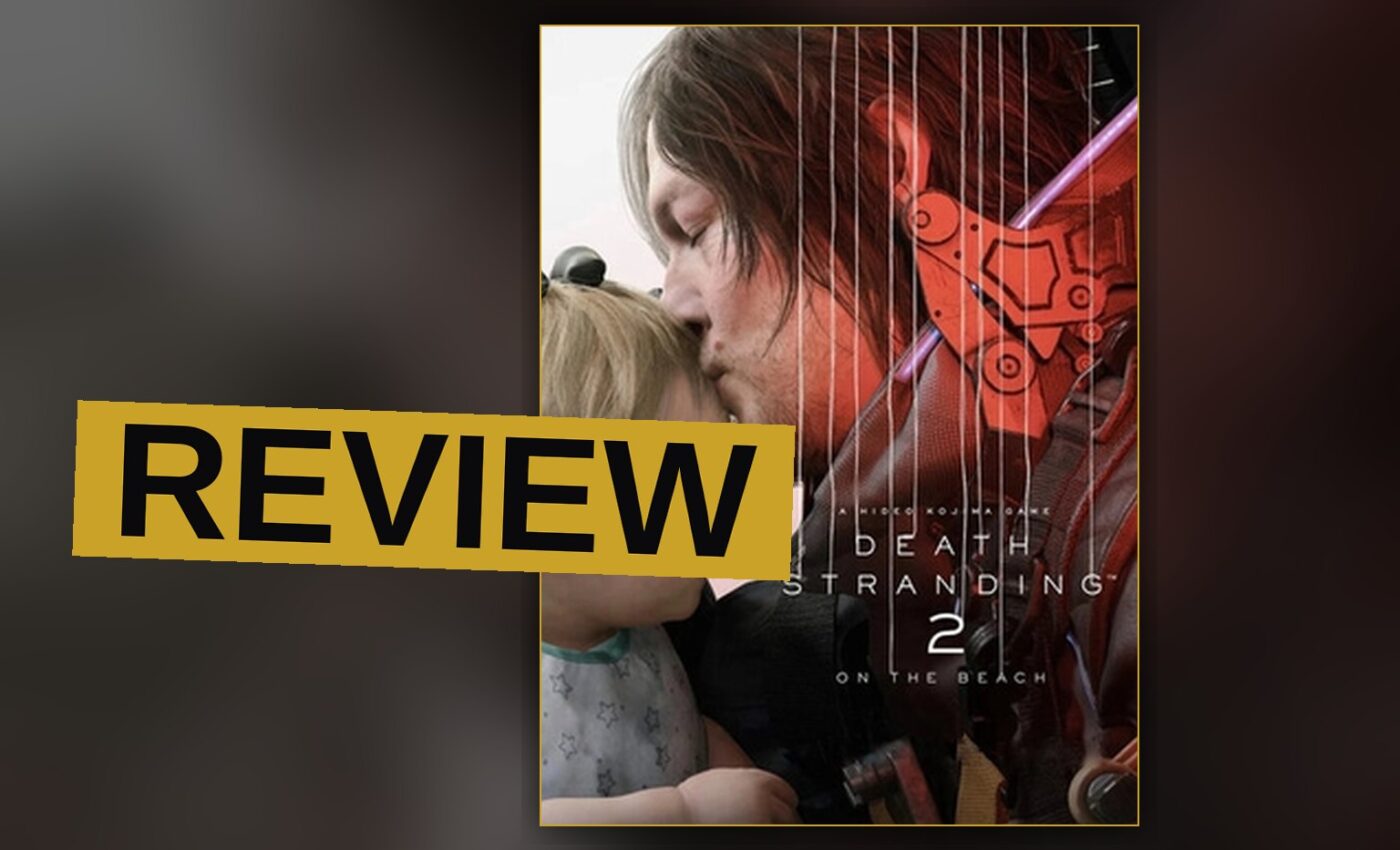
When Hideo Kojima ended Death Stranding in 2019, he left Sam Porter Bridges on a beach, staring at an impossible future. Six years later, Death Stranding 2: On the Beach picks up that thread and pulls it across an ocean of regret, duty, and the stubborn human habit of carrying on. The sequel does not reset the board. It plays the same hand, but it plays it with more nerve, more humor, and more weight than anyone had a right to expect.
Death Stranding 2: On the Beach is available now for PC and PS5. It is a direct continuation of the first game’s story, and it assumes you have played it. If you have not, stop reading and go back. This review will not hold your hand through the lore.
Trailer, via PlayStation.
Sam, Fragile, and the New Crew
The game opens with Sam Porter Bridges, played again by Norman Reedus, living a quiet life in a small settlement. He has a daughter, Lou, and a dog. He has retired from the delivery business. The world, fragile as it is, has found a kind of peace.
That peace does not last. A new threat emerges from the beaches, and Sam is pulled back into the fray. He is joined by Fragile, played by Léa Seydoux, who has become a hardened leader in the years since the first game. The cast also expands with new faces: a mysterious woman named Tomorrow, a soldier named Neil, and a robot companion named Dollman who is, frankly, the best thing in the game.
The performances are strong across the board. Reedus carries the weariness of a man who has saved the world once and does not want to do it again. Seydoux brings a sharp edge to Fragile that was missing before. But the real standout is the writing, which manages to be both deeply earnest and genuinely funny. There is a scene early on involving a delivery of pizza that had me laughing out loud, and a later scene involving a baby that had me in tears.
Beaches Return, But Different
The central mechanic of the first game was the chiral network, a system that let players deliver cargo across a fractured America. Death Stranding 2: On the Beach keeps that core loop, but it expands it in meaningful ways. The map is larger, with more verticality and more environmental hazards. The terrain is more varied, from snow-capped mountains to sun-baked deserts to flooded ruins.
The new traversal tools are the highlight. Sam can now use a grappling hook to scale cliffs, a hoverboard to glide across flat ground, and a cargo catapult to launch packages across chasms. These tools are not just gimmicks. They change how you approach every route, and they make the act of moving from point A to point B feel like a puzzle in itself.
The beaches themselves, the otherworldly spaces where the dead linger, are also more fleshed out. They are no longer just linear corridors. They are open, dreamlike spaces with their own rules and their own dangers. Exploring them feels genuinely unsettling, in the best way.
Combat That Finally Works
The first game’s combat was often criticized as clunky and unsatisfying. Death Stranding 2: On the Beach fixes that problem. The shooting mechanics have been tightened, the cover system is more responsive, and the enemy AI is smarter. You can now switch between weapons on the fly, and the game encourages you to use stealth as much as brute force.
The new “strand” mechanic, which lets Sam use a rope-like weapon to bind enemies, is a clever addition. It allows for non-lethal takedowns that feel satisfying and strategic. The boss fights, which were a weak point in the original, are now set pieces that rival anything in Metal Gear Solid V. One fight against a giant whale-like creature is a standout, and it uses the game’s music to devastating effect.
That said, the combat is still not the main draw. The game is at its best when you are alone on a mountain path, balancing a stack of cargo, checking your stamina, and planning your next step. The combat is a spice, not the main course.
Story of Connection
The plot of Death Stranding 2: On the Beach is dense, and it will not be to everyone’s taste. Kojima does not do subtle. The game is full of speeches about the nature of connection, the danger of isolation, and the importance of carrying on even when the future looks bleak. Some of it lands. Some of it does not.
What works best is the relationship between Sam and Lou. The father-daughter dynamic is the emotional core of the game, and it is handled with surprising tenderness. There is a scene near the end of the first act that recontextualizes the entire first game, and it is the kind of moment that makes you want to replay everything just to see it with new eyes.
The game also introduces a political thread, with a faction called the “Hollows” who oppose the chiral network and want to sever humanity’s connection to the beaches. It is not a subtle allegory, but it gives the story a sense of stakes that the first game sometimes lacked.
Music and the Sound
The soundtrack, composed by Ludvig Forssell, is a major step up from the first game. The ambient tracks are more textured, and the action cues are more urgent. But the real treat is the licensed music. Low Roar, the Icelandic band that became synonymous with the first game, returns with several tracks, and they are used perfectly. There is a moment in the second act where a Low Roar song kicks in as you crest a hill, and it is the kind of moment that makes the whole journey worth it.
The sound design is also excellent. The crunch of boots on snow, the hum of the chiral network, the distant cry of a BT — all of it is mixed with care. Playing with headphones is strongly recommended.
Performance and Technical Issues
On PS5, Death Stranding 2: On the Beach runs at a smooth 60 frames per second in performance mode, and at 30 in quality mode. The quality mode is stunning, with ray-traced reflections and enhanced draw distances. The PC version, which I also tested, offers even more options, including ultrawide support and uncapped frame rates.
I encountered a few minor bugs during my playthrough. One side mission failed to trigger a cutscene, and I had to reload a save. A piece of cargo fell through the world and was unrecoverable. These are small issues, and they did not ruin the experience, but they are worth noting.
The game is long. My playthrough took about 60 hours, and I did not complete every side mission. If you want to see everything, you are looking at 80 hours or more. That is a commitment, and it is not for everyone. But for those who love the world Kojima has built, it is time well spent.
Verdict on the Beach
Death Stranding 2: On the Beach is not a game for everyone. It is slow, strange, and unapologetically weird. It asks you to invest hours in walking, climbing, and balancing cargo. It asks you to sit through long cutscenes and listen to speeches about the nature of humanity. It asks a lot.
But it rewards that investment. The game is a meditation on connection, on the weight we carry, and on the people we carry them for. It is a game about the act of delivering, and it makes that act feel heroic in a way that few games have managed.
The improvements over the first game are substantial:
- The combat is better.
- The traversal is better.
- The story is more focused.
- The music is better.
It is a sequel that honors its predecessor while pushing the formula forward.
It is also a game that knows exactly what it is. It is not trying to be a mainstream blockbuster. It is trying to be a Kojima game, and it succeeds.
The delivery is complete.
Get the Notebook.
The day's best stories and every fresh verdict, in plain English, in your inbox by seven. One email a day, no more.