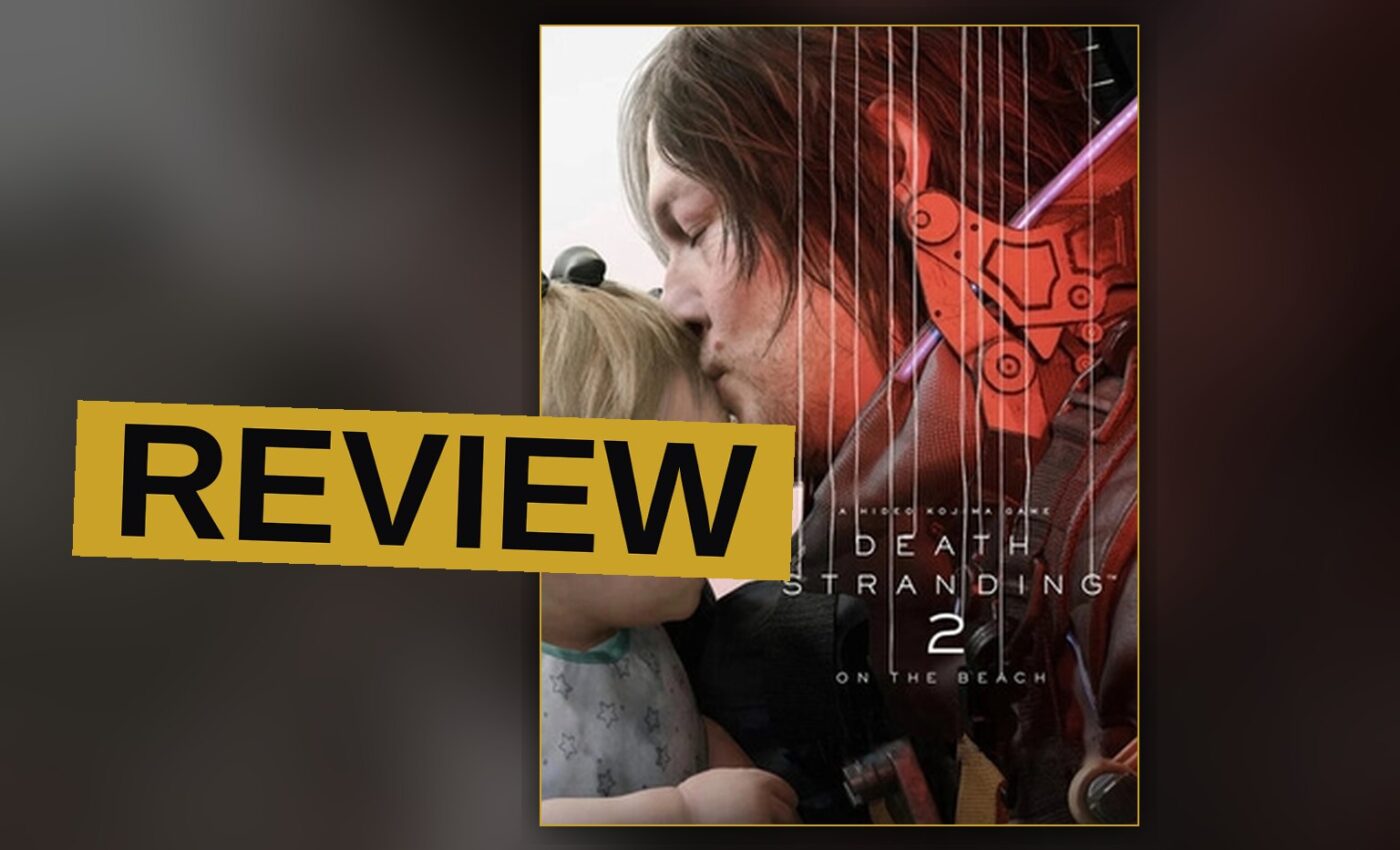
Death Stranding 2: On the Beach is a game about walking, and about the fact that walking is never just walking. Hideo Kojima wrote, produced, designed and directed it. Kojima Productions developed it. Sony Interactive Entertainment published it. It is out now on PlayStation 5 and PC, and it is the studio’s second game as an independent entity and its second collaboration with Sony.
Trailer, via PlayStation.
Sam Porter Bridges Is Retired, and Then He Isn’t
The game picks up eleven months after the first Death Stranding. Sam, again played by Norman Reedus, lives in quiet isolation near the former US-Mexico border with his adopted daughter Lou. The United Cities of America is fully connected through the Chiral Network. Bridges, the logistics company, is defunct. Deliveries run on the Automated Porter Assistant System, unmanned robots that put human porters out of work.
Then the plate gates open. These transcontinental portals appear in areas of high chiral density, and one links Mexico to Australia. Fragile, played by Léa Seydoux, founder of the private company Drawbridge, recruits Sam to go through. Australia is cut off, overrun by bandits and hostile robots called ghost mechs, and the Beached Things are evolving. Sam’s hub is the tar-traversing ship DHV Magellan, where he rests, talks to companions, and runs VR training.
The Running Order
| Phase | Setting | Objective |
|---|---|---|
| Start | Mexico | Deliver to preppers, connect the Chiral Network |
| Early | Mexico and Australia | Unlock and customize vehicles |
| Mid | Australia | Rebuild roads and bridges after disasters |
| Late | Australia | Build the monorail from mines to cities |
| Throughout | DHV Magellan | Rest, talk to companions, run VR training |
A Backpack That Fights Back
The core loop is unchanged in shape and sharper in feel. You carry packages to scattered preppers and survivors and connect them to the Chiral Network. You balance cargo weight on Sam’s backpack. You cross terrain that does not want you.
Vehicles arrive early this time, and they can be customized heavily. Additional batteries extend their range. Gun turrets can be bolted on for defense. Earthquakes and sandstorms reshape the landscape and force new routes. Players rebuild roads and bridges, and eventually a monorail system that moves large quantities of goods from mines to cities.
Combat Steps Forward, Stealth Still Works
On the Beach leans harder on combat than its predecessor. Players can fight directly, use stealth, or avoid the encounter entirely. Lethal and non-lethal options sit side by side. The asynchronous online layer returns: structures and signs you build can appear in other players’ worlds, and you can “like” theirs to show gratitude.
Elle Fanning, George Miller, and the Rest of the Drawbridge Crew
The cast is the deepest Kojima has assembled. Elle Fanning plays Tomorrow, an amnesiac young woman with powers tied to the tar. Shioli Kutsuna is Rainy, Luca Marinelli is the spectral soldier Neil Vana, and Alissa Jung is Lucy, Sam’s late wife. Troy Baker returns as Higgs. Tommie Earl Jenkins plays Charlie, Drawbridge’s mysterious benefactor, and Alastair Duncan is the President, who leads the Automated Public Assistance Company behind APAS.
The likenesses are their own draw. George Miller appears as Tarman, Fatih Akin as Dollman, and Guillermo del Toro and Nicolas Winding Refn return from the first game as Deadman and Heartman. Debra Wilson and Lindsay Wagner round out the roster.
What Kojima Kept From the Pandemic
Kojima began writing On the Beach before 2020 and reworked the narrative from scratch to reflect the effect of COVID-19 on the worldwide population. That rework is legible in the finished game.
The extinction event has intensified: the ghostlike creatures called Beached Things (BTs) are evolving, natural disasters are frequent, and the Australian continent is overrun by bandits and hostile robots called “ghost mechs”.
Automation replaced the porters. A plague pushed the world indoors and apart. The plate gates are not a metaphor anyone has to dig for.
What Holds Up
Death Stranding 2: On the Beach is the rare sequel that fixes the friction without sanding off the identity. The first game’s defenders spent years arguing that the delivery grind was the argument. This one makes the same argument with better tools, and loses almost nothing in the trade.
The Australia setting does real work. Mexico and Australia are both large open worlds, freely explorable, and the disaster systems give them a rhythm the first map never quite had. When a sandstorm wipes a route you spent an hour clearing, the game is not punishing you. It is restating its thesis.
What matters most is the cast. Fanning’s Tomorrow gives the expedition an emotional center the first game’s ensemble never located, and the returning trio of Reedus, Seydoux and Baker carry the continuity without leaning on it. The likeness casting of Miller, Akin, del Toro and Refn could have been a stunt. It reads instead as a director putting his friends in the room where the story happens.
The noise is the combat expansion. More guns is not automatically more game, and the stealth-versus-lethal spread is the least interesting new system here. It works. It is not why anyone will still be talking about this in five years.
What will last is the asynchronous layer, the same quiet experiment the first game ran, now running on a bigger and lonelier map. Strangers leave you a bridge. You leave them a sign. Nobody speaks. That is the whole idea, and On the Beach finally has the machinery to make it land.
Get the Notebook.
The day's best stories and every fresh verdict, in plain English, in your inbox by seven. One email a day, no more.