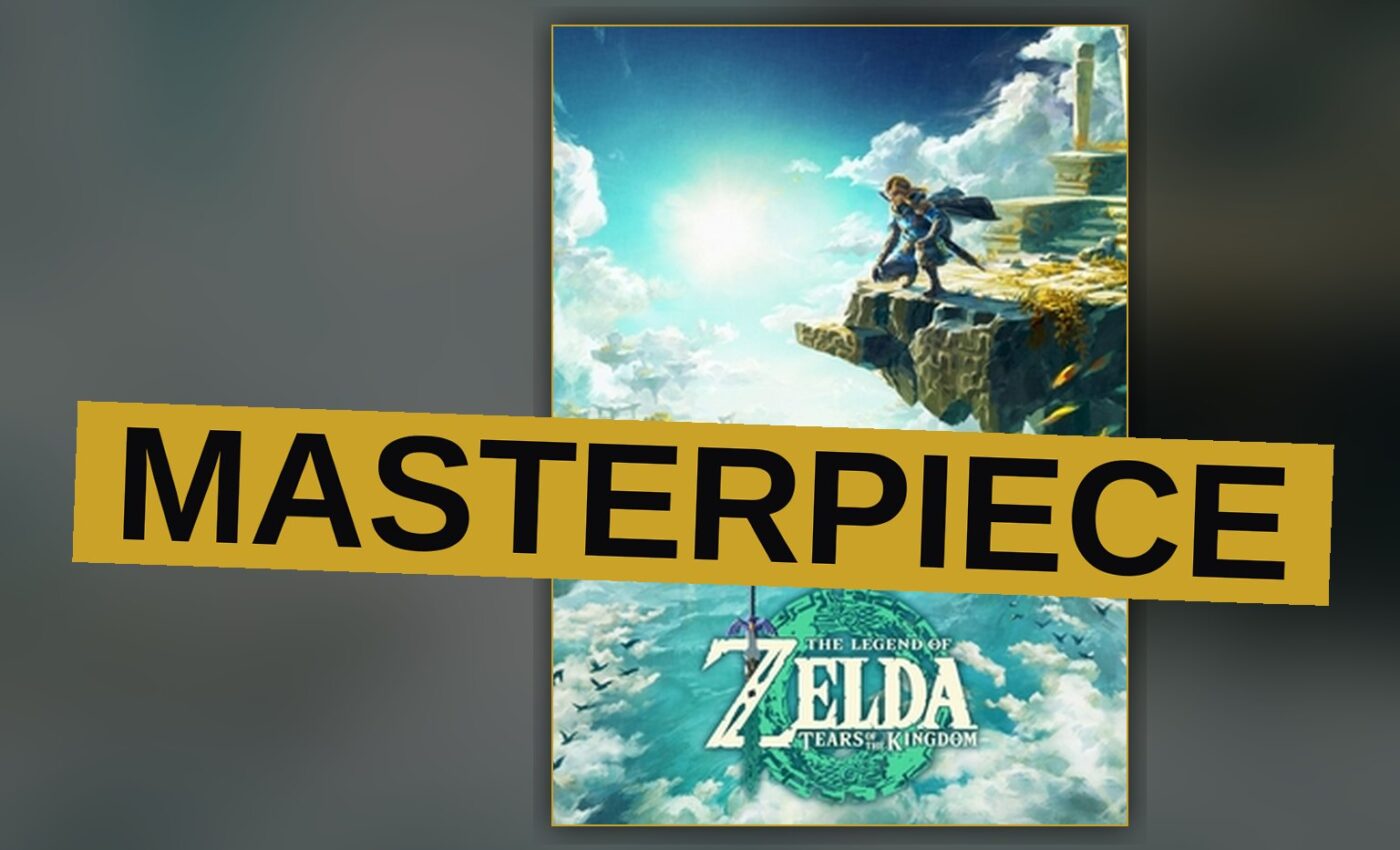
Nintendo did not need to reinvent Hyrule. It needed to prove the place was still worth crossing. The Legend of Zelda: Tears of the Kingdom, released three years ago, on May 12, 2023, answers that by stacking a second Hyrule above the first and a third one underneath it, then handing Link a set of tools that turn the whole map into a workbench. The result is the rare sequel that justifies its own length.
Trailer, via Nintendo of America.
A mummy under Hyrule Castle
The story starts underground. Link and Zelda descend beneath Hyrule Castle to trace the gloom, a poisonous substance seeping out and making people ill. They find murals of the founding of Hyrule and the Imprisoning War, an ancient battle against a being called the Demon King, which Zelda ties to the mysterious Zonai race.
Deeper in, they find a mummy held by a disembodied arm. It wakes, attacks them, wounds Link’s right arm and shatters the Master Sword. Hyrule Castle rises into the sky. Zelda falls and vanishes with a strange artifact. Link wakes on the Great Sky Island, where the spirit Rauru, a Zonai, transplants his own arm onto Link because Link’s right arm is beyond saving.
The sky islands and the Depths
Tears of the Kingdom keeps the open-world structure of Breath of the Wild (2017) and adds two regions. The sky holds floating islands with puzzles, treasure, enemies and bosses. Below, the Depths is a dark underground area that needs light items to cross and hides treasure alongside lava and gloom, which temporarily cuts Link’s maximum hearts until he returns to the surface.
Four main dungeons — the Water Temple, Wind Temple, Fire Temple and Lightning Temple — must be cleared to advance. Link reunites with Sidon of the Zora, Tulin the Rito archer, Yunobo the Goron mining president and Riju of the Gerudo, and each temple pairs with one of them.
Ultrahand is the whole game
The Sheikah Slate powers are gone, replaced by five. Ultrahand picks up and attaches objects, and with Zonai devices it builds vehicles: rockets, sleds, fans. Fuse joins materials and equipment to a weapon or shield — a rocket on a shield sends Link into the air. Ascend, Recall and Autobuild round out the set.
This is where Tears of the Kingdom separates itself from its predecessor. Breath of the Wild asked players to read a landscape. This one asks them to argue with it. A cliff is no longer a wall to climb; it is a problem to solve with whatever is lying nearby.
Built from cut Breath of the Wild ideas
Nintendo EPD began work after Breath of the Wild wrapped, with director Hidemaro Fujibayashi and producer Eiji Aonuma returning. The concepts began as downloadable content ideas that grew past their scope. The team watched social media posts and built mechanics to encourage experimentation, drawing on Wii Sports Resort (2009), The Elder Scrolls V: Skyrim (2011) and Red Dead Redemption 2 (2018) while trying to stay distinct from its own predecessor.
The game was teased at E3 2019 and fully revealed at E3 2021. It arrived to acclaim, praised for its expanded world, new mechanics, scale and story. The frame rate drew criticism.
The adventure is yours to create in a world fueled by your imagination.
The numbers behind the launch
| Date | Milestone |
|---|---|
| E3 2019 | Teaser announcement |
| E3 2021 | Full reveal |
| May 12, 2023 | Release on Nintendo Switch |
| First three days | Over 10 million copies sold |
| June 2026 | 22.71 million copies sold |
Those figures are the argument for the sequel’s scale, but they are not the argument for its quality. Ten million copies in three days says the audience was waiting. It does not say the wait was earned. The Depths and the sky islands do.
Where it grinds
The frame rate is the real cost. A game that asks players to build machines and drop them into a physics sandbox cannot afford to stutter, and it does. The criticism is fair and it is not minor.
The dungeon structure is also the safest thing here. Four temples tied to four allies is a familiar shape, and the game rarely surprises inside them the way it surprises on the surface. The puzzles are sound. They are also the part of Tears of the Kingdom that feels most like the series looking backward while everything around it looks forward.
Why it earns a 9.5
What holds up is the construction. Ultrahand, Fuse and the Zonai devices turn Hyrule into a place where the player’s own ideas are the content, and the sky and the Depths give that freedom somewhere new to spend itself. The story, built on Rauru, the Zonai and the Imprisoning War, gives the wandering a destination.
The frame rate keeps this from being flawless, and the temples keep it from being a clean break from the past. Neither is enough to sink it. Tears of the Kingdom is the rare sequel that makes its predecessor feel like a first draft — bigger, stranger and more willing to hand the player the tools and step back.
Get the Notebook.
The day's best stories and every fresh verdict, in plain English, in your inbox by seven. One email a day, no more.