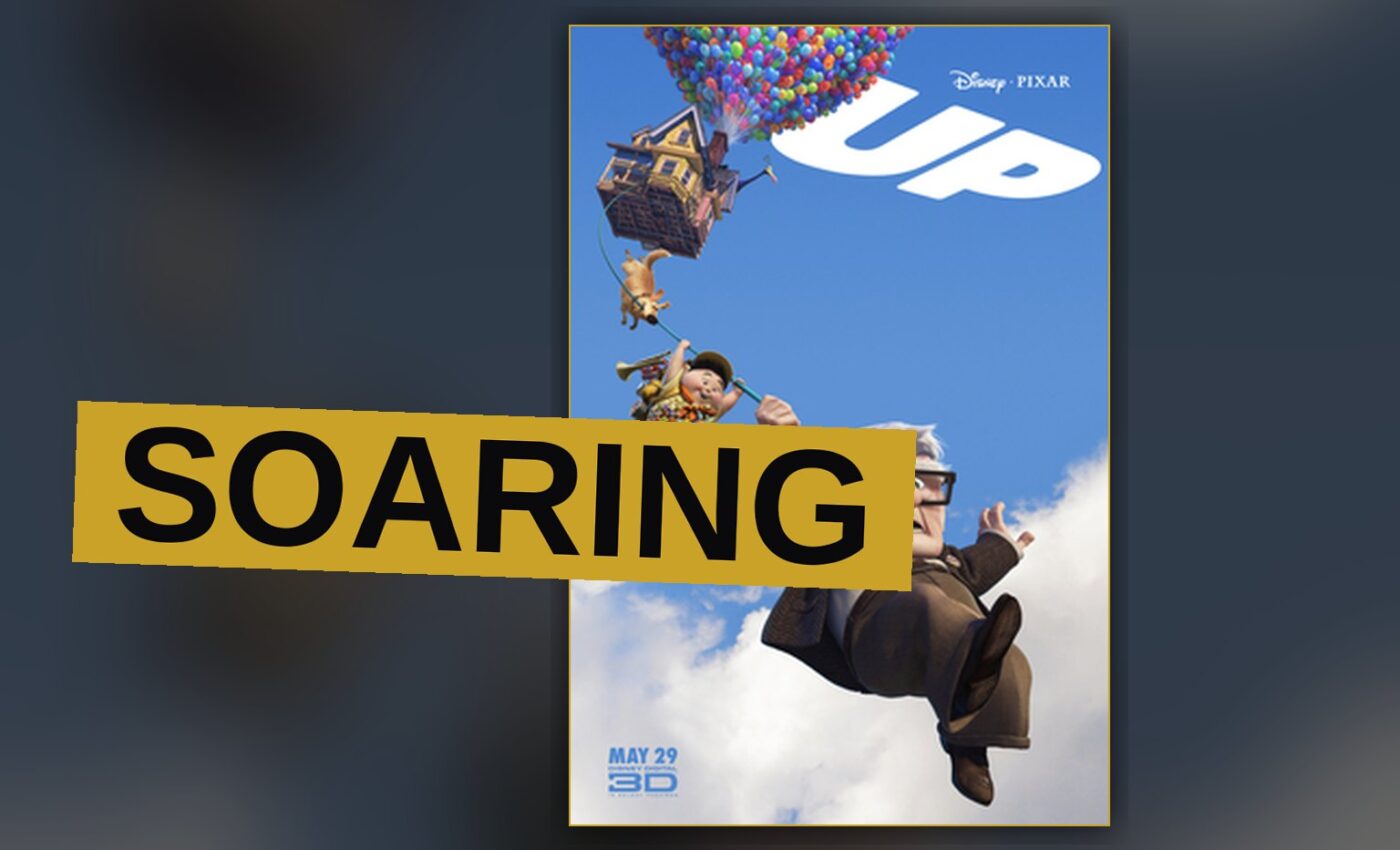
Up opens with a montage that lasts about ten minutes and contains no dialogue. It is the story of Carl and Ellie, a married couple who spend a lifetime saving for adventure and never quite get it. By the end of that montage, Ellie is gone, and Carl is alone in the house they built together. It is one of the most devastating sequences Pixar has ever made, and it earns every tear.
The film then becomes something else. Carl, facing eviction and a forced move to a retirement home, ties thousands of balloons to his house and sails it to South America. He wants to keep a promise. He does not expect a stowaway, a boy scout named Russell, or a giant flightless bird, or a talking dog. But he gets all of them.
Trailer, via Disney UK.
Carl’s House and the Weight of the Past
The house is the film’s real engine. Carl’s attachment to it is not sentimentality. It is grief made physical. Every object inside it is a memory of Ellie, and the house itself is the last place where she was real. When he lifts it off the ground, he is not escaping. He is carrying her with him.
Russell, the boy who accidentally joins the trip, is the counterweight. He is eager, clumsy, and desperate for approval. His own father is absent, and his scout sash is full of badges he earned alone. Carl sees him as a nuisance. The film slowly shows that Russell is what Carl used to be: full of hope and hungry for a father figure.
The trip to Paradise Falls is not quick. The house floats over clouds, past storms, and into a lost world. The animation is bright and precise. The colors pop. The physics of a balloon-lifted house are nonsense, but the film commits to the idea so completely that it stops mattering.
Meeting Charles Muntz
Charles Muntz is the antagonist, and he is a sharp one. He is a famous explorer from Carl’s childhood, a hero who was disgraced when he could not prove he found a giant bird skeleton. He spent decades hunting the bird, and he has gone mad with the need to clear his name.
Carl meets Muntz and briefly believes he has found a kindred spirit. Both men are old. Both are driven by a promise to a lost partner. But Muntz has let his obsession curdle into cruelty. He will kill the bird, and anyone who protects it, to get what he wants. Carl has to choose between his hero and his conscience.
The choice is not hard, but it is painful. Carl has to let go of the idea that the past can be restored. Muntz is what Carl could have become. The film makes that explicit in a scene where Muntz and Carl face each other across a canyon, and you can see the same stubbornness in both of them.
Dug, Kevin, and the Talking Dogs
The talking dogs are a comic relief, but they are also a clever piece of world-building. Dug, the dog who befriends the group, wears a collar that translates his thoughts into speech. He is loyal, simple, and endlessly enthusiastic. His famous line — “Squirrel!” — is a joke about his own nature, and it lands every time.
The other dogs are less friendly. They are armed with weapons and follow Muntz’s orders. They speak in clipped, military tones. The film uses them for chase sequences and slapstick, but it never forgets that they are tools of a tyrant.
The bird, Kevin, is a giant creature with bright plumage and a clumsy gait. She is not a pet. She is a mother, and her chicks are waiting for her. Russell adopts her immediately, and Carl grudgingly accepts her. The film treats her as a character, not a plot device. Her panic when separated from her babies is real, and her reunion with them is one of the film’s warmest moments.
Action at the Falls
The middle of the film is a series of set pieces. A storm throws the house into danger. A pack of dogs chases the group through a canyon. The house is dragged, dropped, and nearly lost. The action is inventive and fast, but it never overwhelms the emotional core.
The best sequence is the final confrontation. Muntz and Carl fight aboard the airship, with the house tethered below. Carl uses his age and his wits, not his strength. He outsmarts Muntz, and Muntz falls to his death. It is a quick, clean end for a man who spent his life chasing a lie.
Then comes the moment the film has been building toward. Carl’s house is damaged beyond repair. The balloons are gone. He cannot land at Paradise Falls the way he planned. He has to choose: keep the house, or save his friends. He throws out the furniture, the chairs, the mementos. The house floats away, light and empty. Carl watches it go. He does not cry. He just lets it go.
The Promise Kept
The film does not end at Paradise Falls. Carl lands the house, and he and Russell walk home. They sit on a curb and eat ice cream. Carl gives Russell the “Ellie badge,” a scrap of the adventure book, and tells him he is a senior scout now. Russell’s father is still absent, but Carl is there. It is not the adventure Carl planned. It is better.
The final image is the house, settled on the cliff at Paradise Falls, next to the waterfall. It is a monument, not a home. Carl does not need it anymore. He has a new purpose.
Scoring Up
Up is a film that understands loss better than most dramas, and it wraps that understanding in a colorful, funny, exciting adventure. It is not perfect. The villain is thin, and the middle sags slightly under the weight of its own chase scenes. But the opening montage alone is worth the price of admission, and the film never loses sight of its central idea: that love is not about holding on. It is about knowing when to let go.
The voice cast is strong. Ed Asner gives Carl a gruff, wounded dignity. Jordan Nagai makes Russell sweet without being saccharine. Christopher Plummer brings a cold, regal menace to Muntz. Bob Peterson voices Dug with a perfect, guileless charm. The score, by Michael Giacchino, is soaring and tender, and it carries the emotional beats with grace.
The film was a commercial and critical success when it opened in 2009. It was the first Pixar film to open the Cannes Film Festival, and it won the Academy Award for Best Animated Feature. It was nominated for Best Picture, a rare honor for an animated film. It remains one of the studio’s most beloved works.
Up is a film about aging, grief, and the quiet heroism of ordinary people. It is also a film about a boy and an old man and a dog and a bird, and it is funny and warm and sad and hopeful. It does not talk down to children, and it does not condescend to adults. It trusts its audience to feel what it feels.
The film’s greatest achievement is that it makes you care about a house. By the end, you understand why Carl could not leave it, and you understand why he finally could. That is not a small thing. That is the whole point.
Up earns its reputation. It is a classic, and it will last. It is not the best Pixar film ever made — that honor belongs to a few others — but it is among the most emotionally honest. It is a film about moving on, and it does not flinch from the cost of moving on.
- The opening montage is the best sequence in the film.
- The villain, Charles Muntz, is compelling but underdeveloped.
- The talking dogs are a comic highlight.
- The action sequences are inventive but occasionally repetitive.
- The ending is earned and emotionally satisfying.
Up is a great film with a few small flaws. It is a film that will make you cry in the first ten minutes and then make you laugh for the next ninety. It is a film about loss that is not bleak, and a film about adventure that is not shallow. It is a film about a man who learns that the life he planned is not the life he needed.