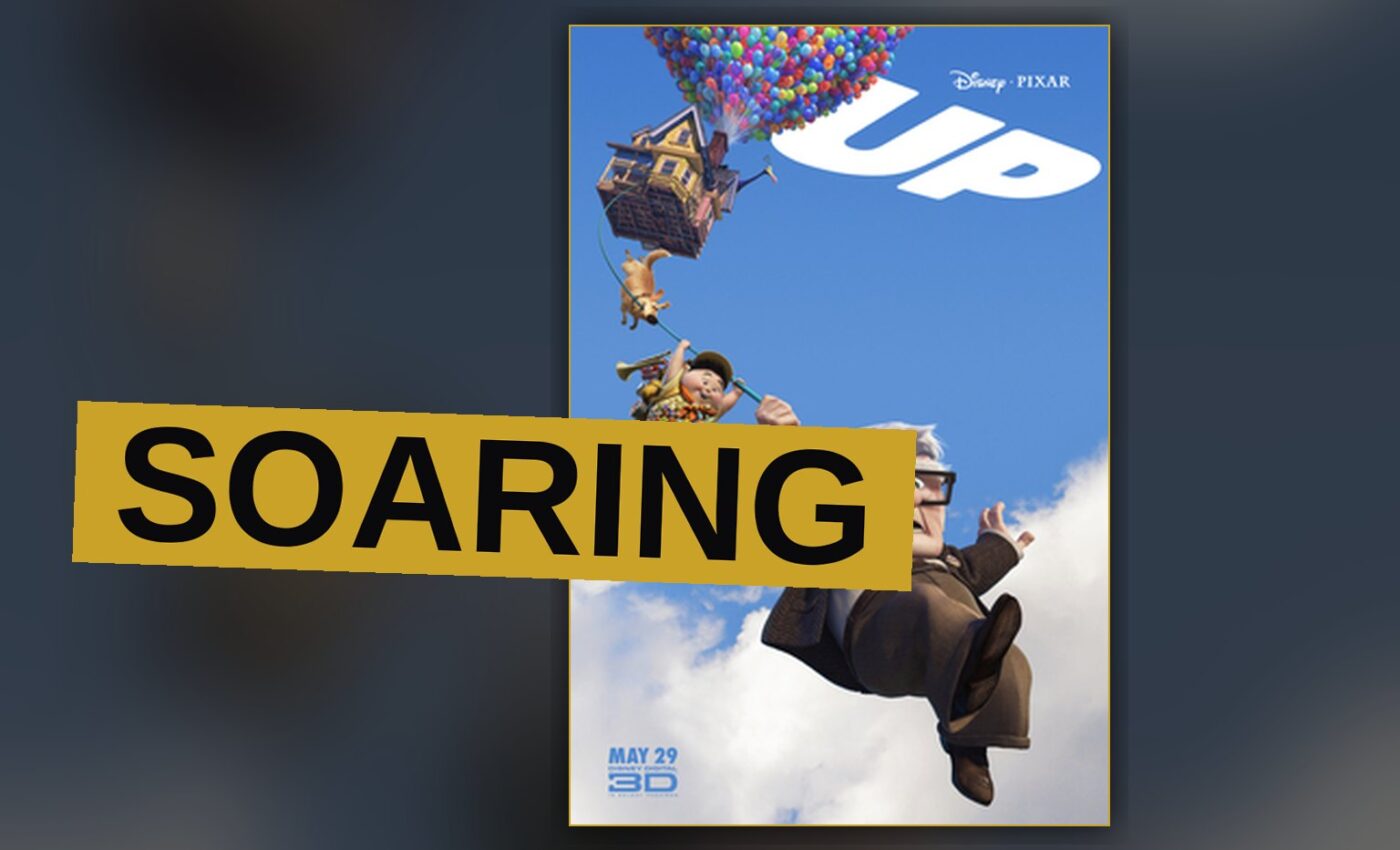
The house floats on helium, and so does the movie. Pete Docter’s Up, released by Pixar in 2009, opens with a widower who ties thousands of balloons to his home and sails for South America, and it never once apologizes for the absurdity. That is the trick. The film earns its strangeness by grounding every wild turn in a small, plain grief.
Trailer, via Disney UK.
Carl Fredricksen and the Promise to Ellie
Carl Fredricksen is 78 when the story catches up with him. He spent his life planning a trip to Paradise Falls in Venezuela with his wife, Ellie, and spent it instead on broken cars and hospital bills. The film shows this in a wordless montage: the couple saves money, the money goes to more pressing needs, and the years pass without the trip.
Ellie falls ill before they can go. She gives Carl her scrapbook, the record of the adventures she dreamed of, and then she dies.
What follows is the engine of the whole picture. A court orders Carl into an assisted living facility after he injures a construction worker who damaged his mailbox. Rather than go, Carl resolves to keep his promise. He attaches balloons to the house and flies it to Paradise Falls.
That is not a whimsical premise. It is a man refusing to lose the last thing he and his wife shared.
Russell, the Stowaway Scout
Russell is eight years old and a Wilderness Explorer. He needs one final merit badge, for assisting the elderly, and he knocks on Carl’s door to earn it. When the house lifts off, Russell is on the porch. He becomes an accidental passenger.
The pairing works because neither one is sentimental about the other. Carl wants the boy gone. Russell wants the badge. The film lets them be irritated with each other for a long stretch before it lets them be anything else.
Jordan Nagai voices Russell. Ed Asner voices Carl, and the performance is the spine of the film. Asner plays the old man as gruff, tired and not especially kind, which makes the moments when he softens land harder than if he had played warm from the start.
Dug, Kevin and the Dogs of Paradise Falls
A storm pushes the house all the way to a tepui in Venezuela. Carl and Russell harness themselves to the still-buoyant house and tow it across the mesa. Along the way they meet a giant flightless bird that Russell names Kevin, and a talking dog named Dug.
Dug is voiced by Bob Peterson, who also wrote the film with Docter. Peterson plays Dug as eager and simple, a dog whose only ambition is to be liked. The other dogs are organized under a pack leader, Alpha, also voiced by Peterson, with Beta voiced by Delroy Lindo and Gamma by Jerome Ranft.
The dogs can talk because of collars their master invented. That is the film’s one piece of pure invention, and it is played for comedy rather than explained at length. It works.
Charles Muntz and the Bird He Cannot Prove
Christopher Plummer voices Charles Muntz, the explorer Carl idolized as a boy. Muntz was discredited when a giant bird skeleton he brought back from Paradise Falls was deemed fake. He went back to the falls and vowed not to return until he brought a live specimen.
Muntz is the film’s villain, and he is a specific kind of one: a man whose reputation was taken from him and who will do anything to get it back. He has sinister plans to capture Kevin. He has been at this for decades.
Plummer plays him with charm first and menace underneath, which is the right order. Muntz is not a monster when he arrives. He is a hero who has been alone too long.
The Cast Behind the Balloons
The voice cast is small and mostly unsentimental. Asner, Plummer, Nagai and Peterson carry the film. Around them are smaller turns: John Ratzenberger as Construction Foreman Tom, David Kaye as a newsreel announcer, and Mickie McGowan and Danny Mann as a police officer and a construction worker.
Elie Docter voices young Ellie, and Jeremy Leary voices young Carl. Those two scenes, at the top of the film, do more work than most full features.
The film runs 96 minutes. It is Pixar’s first feature presented in 3D. Michael Giacchino composed the score.
What the Opening Montage Does
The first ten minutes of Up are the most discussed stretch of the film, and the reputation is deserved. The montage covers a marriage, a miscarriage, the couple’s inability to have children, and Ellie’s death, with almost no dialogue.
That sequence is why the rest of the film can be as silly as it is. The balloons, the talking dogs, the bird named Kevin — none of it would hold without the weight the opening puts underneath it. The film front-loads its grief so the adventure can be light.
Docter conceived the outline in 2004, based on fantasies of escaping from life when it became too irritating. He and eleven other Pixar artists spent three days in Venezuela for research. The film was originally titled Heliums.
| Element | Detail |
|---|---|
| Director | Pete Docter |
| Writers | Bob Peterson, Pete Docter, Tom McCarthy |
| Runtime | 96 minutes |
| Carl Fredricksen | Ed Asner |
| Charles Muntz | Christopher Plummer |
| Russell | Jordan Nagai |
| Dug / Alpha | Bob Peterson |
| Composer | Michael Giacchino |
| Debut | 62nd Cannes Film Festival, May 13, 2009 |
| US release | May 29, 2009 |
What Holds and What Slips
The film’s weakest stretch is the middle, when Carl and Russell are towing the house across the mesa. The pacing sags there. The dogs are funny, but the pack is a lot of machinery for a story that is really about two people and a house.
The stronger argument is that the film never loses track of what it is about. Carl is not trying to have an adventure. He is trying to keep a promise, and the adventure keeps getting in the way. Every set piece is an obstacle between him and the falls.
The ending resolves this the right way. Carl has to choose between the house and the people in front of him, and the film knows which one matters. It does not cheat the choice.
Up was named by the National Board of Review and the American Film Institute among the year’s best films. It drew acclaim for its screenplay, animation, characters, themes, narrative, emotional depth, humor, Asner’s performance, Giacchino’s score and that opening montage. All of that is earned, though the acclaim for the montage is the part that has aged best.
The Verdict on Up
Up is a film that trusts its audience to sit with a long, quiet sadness before it hands them a talking dog. That is a strange bet for a family picture, and it pays off because the sadness is specific. Carl is not sad in general. He is sad about a trip he never took and a woman he did not get enough time with.
The film’s comedy is broad and its villain is thin, and neither of those things sinks it. Muntz exists to give Carl something to push against, and Plummer gives him enough dignity that the push has weight.
What makes Up last is the same thing that makes the opening montage famous: it treats an ordinary life as worth the trouble of an extraordinary journey. The balloons are a delivery system for a promise. The house is not a vehicle. It is a marriage.
The film is not Pixar’s most inventive hour, and its middle act wanders more than it should. But the first ten minutes and the last ten minutes are close to perfect, and the 96 minutes between them are better than most animation released since.
8 of 10.
Get the Notebook.
The day's best stories and every fresh verdict, in plain English, in your inbox by seven. One email a day, no more.